Artwork
The Mussel Eaters
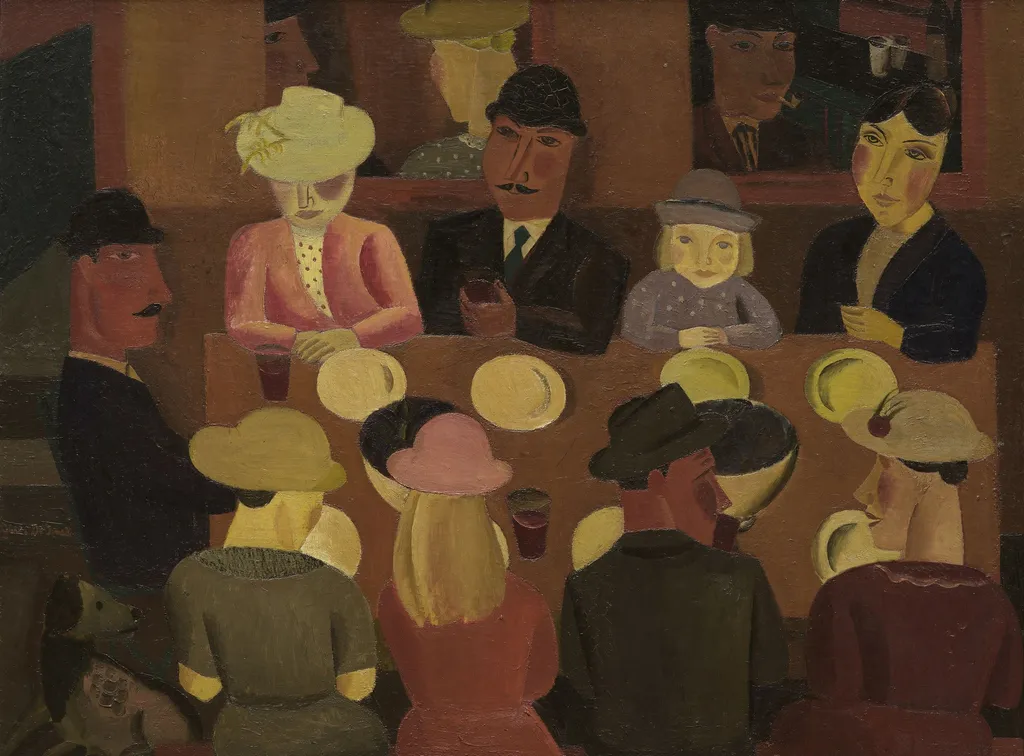
The Mussel Eaters is an oil painting by the Luminist artist Gustave De Smet. It dates from 1923 and is held in the collection of the Royal Museum of Fine Arts Antwerp.
About this work
Subject & Meaning
The composition includes a dog and focuses on the act of consuming mussels, specifically the species Mytilus edulis, which are presented on a plate.
The painting depicts a domestic interior scene centered on a family meal, featuring a man, a woman, and a child gathered around a table. The composition includes a dog and focuses on the act of consuming mussels, specifically the species Mytilus edulis, which are presented on a plate. Created in 1923, the work captures a humble, everyday moment of sustenance, grounding its subject matter in the realistic portrayal of a common Belgian dining practice.
The inclusion of the dog and the specific arrangement of the figures and food items emphasizes the intimacy and simplicity of the household setting.
Technique & Style
The Mussel Eaters is an oil on canvas painting created in 1923 by Gustave De Smet. Executed in the realist tradition, it depicts a domestic scene featuring a man, woman, child, dog, plate, and mussels (Mytilus edulis) rendered with textured brushwork and muted tonal modeling. The work measures 93 cm in height by 123 cm in width and is housed in the Royal Museum of Fine Arts Antwerp, where it remains part of the Flemish Community's collection.
The surface handling reflects careful preservation, with the oil paint layer applied to a primed canvas support that has retained its structural integrity despite minor craquelure in the background areas. Formal composition emphasizes balanced grouping of figures around a central table, while stylistic elements include naturalistic detail and subdued coloration characteristic of early 20th-century Belgian genre painting.
History & Provenance
Gustave De Smet created the oil painting The Mussel Eaters in 1923. The work depicts a domestic scene featuring a man, woman, child, and dog gathered around a table with plates of mussels. It is executed in oil paint on canvas, measuring 93 cm in height and 123 cm in width.
The painting is currently held in the collection of the Royal Museum of Fine Arts Antwerp, where it forms part of the Flemish Community collection.
The Mussel Eaters (1923) is held by the Royal Museum of Fine Arts Antwerp, where it is catalogued with accession dimensions of 93 cm × 123 cm. The work has been part of the museum’s holdings within the Flemish Community collection since at least the date of its creation.
Legacy
The Mussel Eaters has been recognized as a representative example of early 20th-century Flemish genre painting, reflecting De Smet’s focus on rural life and modest domestic scenes. Its depiction of a working-class family sharing a simple meal contributed to discussions about social realism in Belgian art during the interwar period. The work remains part of the collection at the Royal Museum of Fine Arts Antwerp, where it is displayed as a key piece illustrating the artistic traditions of the Flemish community. Scholars cite its compositional balance and textural detail as influential within regional modernist movements.
Overview
Created in 1923, The Mussel Eaters is an oil painting by Belgian artist Gustave De Smet. Executed during the early phase of his career, the work belongs to the later period of the Latem School and now resides in the collection of the Royal Museum of Fine Arts in Antwerp.
Context
The painting emerges from a period when Belgian artists were exploring expressive color, simplified forms, and emotional intensity, aligning with broader European movements such as German Expressionism. De Smet’s focus on ordinary subjects, family, food, domestic animals, places the work within a social realist current that sought to elevate everyday life through heightened visual language.
Own this work as a print
Artist & collection

Artist
Gustave Franciscus De Smet, also known as Gustaaf De Smet and Gust De Smet (21 January 1877 – 8 October 1943) was a Belgian painter and printmaker.