Artwork
Harvest Moon
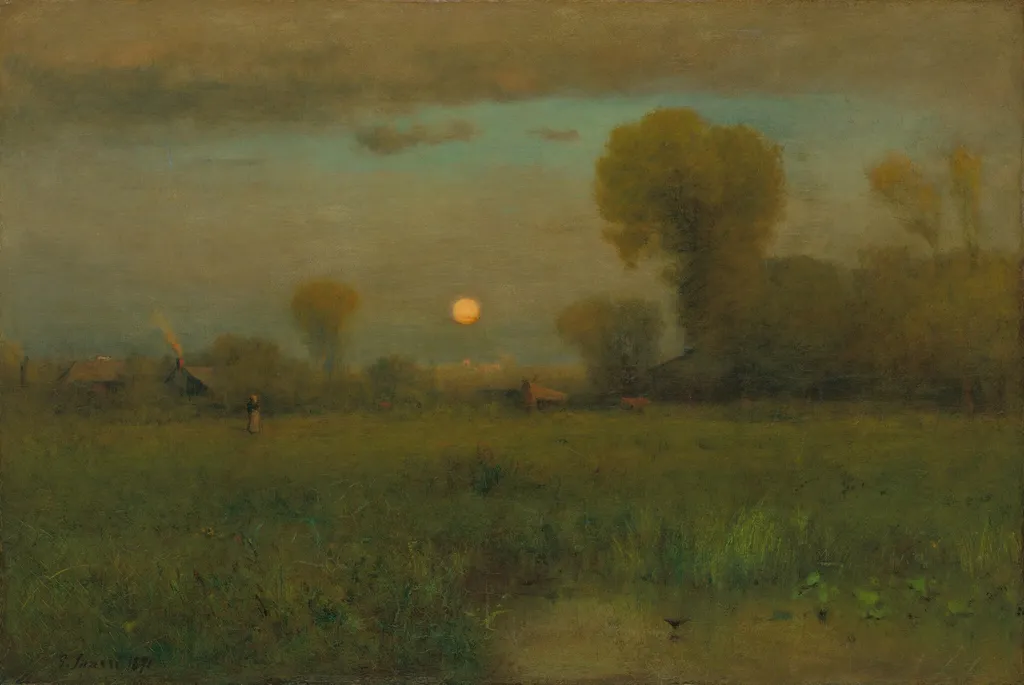
Harvest Moon is an oil painting by the Hudson River School artist George Inness. It dates from 1891 and is held in the collection of the National Gallery of Art.
About this work
Technique & Style
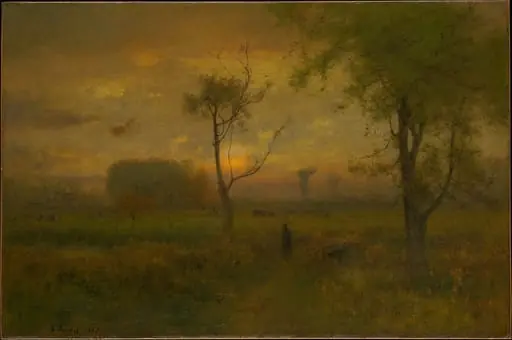
Subtle glazing overlays passages of luminous sky and shadowed field, creating a hushed, twilight effect in which the moon’s glow suffuses the entire scene.
Painted in 1891, _Harvest Moon_ is executed in oil on a linen canvas measuring 76.2 × 113.03 cm. The handling is characterized by broad, softly modulated brushwork that dissolves distinct forms into atmospheric unity, aligning with Inness’s late Tonalist manner. Subtle glazing overlays passages of luminous sky and shadowed field, creating a hushed, twilight effect in which the moon’s glow suffuses the entire scene. The composition privileges horizontal recession and a low horizon line, anchoring the viewer in a quiet, expansive landscape where color and light merge into a singular, meditative mood.
History & Provenance
George Inness completed the oil painting Harvest Moon in 1891. The work was initially associated with Thomas Benedict Clarke, who established the Art House gallery in New York to promote Inness's art and exhibited the painting there by September 1891. William H. Fuller acquired the piece by 1892, lending it to the Union League Club in January of that year, but returned it to Clarke in December 1893, citing that it did not align with his collection.
Clarke subsequently lent it to the Pennsylvania Academy of Fine Arts for their 1893–1894 annual exhibition. The painting was later sold at the American Art Association in February 1899 to Francis Sydney Smithers. Upon Smithers's death, it passed to his wife, Mabel Stevens Smithers, who bequeathed it to the Corcoran Gallery of Art on April 18, 1952. The National Gallery of Art acquired the work in 2014.
Harvest Moon is held by the National Gallery of Art in Washington, D.C., where it entered the collection through a 1952 bequest from Francis Sydney Smithers and his wife Mabel Stevens Smithers to the Corcoran Gallery of Art, which later transferred the work to the National Gallery of Art in 2014.
The painting’s accession history includes ownership by Thomas Benedict Clarke, who acquired it by 1892 and exhibited it at the Art House in New York in 1891, and its subsequent donation to the Corcoran Gallery of Art in 1952.
Exhibition history features displays at the Union League Club in New York in January 1892 and at the Pennsylvania Academy of Fine Arts in Philadelphia during the 1893–1894 season.
The work measures 76.2 cm in height and 113.03 cm in width, reflecting its original dimensions as recorded in the National Gallery of Art’s collection data.
Context
George Inness's Harvest Moon (1891) was first publicly recognized in a September 1891 review by the New-York Daily Tribune, which covered an exhibition at the Art House in New York. This venue was established specifically by Thomas Benedict Clarke to promote Inness's work, situating the painting within a targeted promotional context shortly after its completion. The work's historical trajectory includes a brief period with collector William H. Fuller, who returned it in late 1893 for being inconsistent with his other holdings before it was exhibited at the Pennsylvania Academy of Fine Arts.
Eventually acquired by the Corcoran Gallery of Art through the bequest of Mabel Stevens Smithers in 1952, the painting entered the collection of the National Gallery of Art in 2014, marking its long-term institutional preservation.
Legacy
Harvest Moon helped shape Inness’s late atmospheric approach, where tonal harmony and spiritual light became hallmarks of his mature style. Critics in the early 1890s noted its poetic treatment of nature, a quality that influenced subsequent American tonalists seeking emotional resonance through landscape. The painting’s visibility in major venues such as the Pennsylvania Academy of Fine Arts and its inclusion in the 1908 _Masters in Art_ feature kept his vision in public view, reinforcing his reputation as a precursor to modernist abstraction.
After passing through several prominent collections, it entered the National Gallery of Art in 2014, ensuring continued scholarly attention to its compositional innovations.
The work’s provenance through Thomas Benedict Clarke and later the Corcoran Gallery highlighted its significance within American art circles, while its frequent exhibitions cemented its role as a reference point for later artists exploring luminous space.
Overview
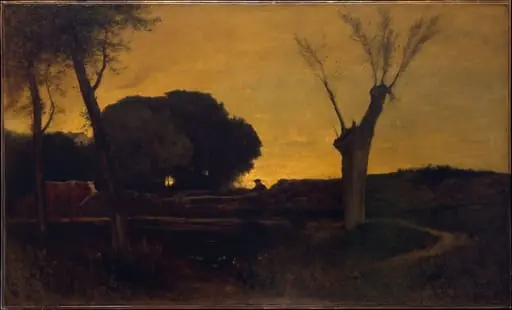
George Inness’s 1891 oil on canvas titled Harvest Moon depicts a tranquil evening scene. A luminous orange moon ascends behind a cluster of trees and distant structures, casting a gentle glow over a grassy field where a solitary figure and a dog stand. The composition balances natural elements with a hint of human presence, inviting quiet contemplation of the landscape.
Subject & Meaning
The work centers on a simple, everyday moment: a person and a dog in an open field under the soft illumination of a rising moon. The juxtaposition of the celestial body with the modest human activity underscores a harmonious relationship between humanity and the natural world, suggesting a serene, reflective mood.
Own this work as a print
Artist & collection

Artist
George Inness (May 1, 1825 – August 3, 1894) was an American landscape painter. Now recognized as one of the most influential American artists of the nineteenth century, Inness was influenced by the Hudson River School…