Artwork
Luigi Palma di Cesnola
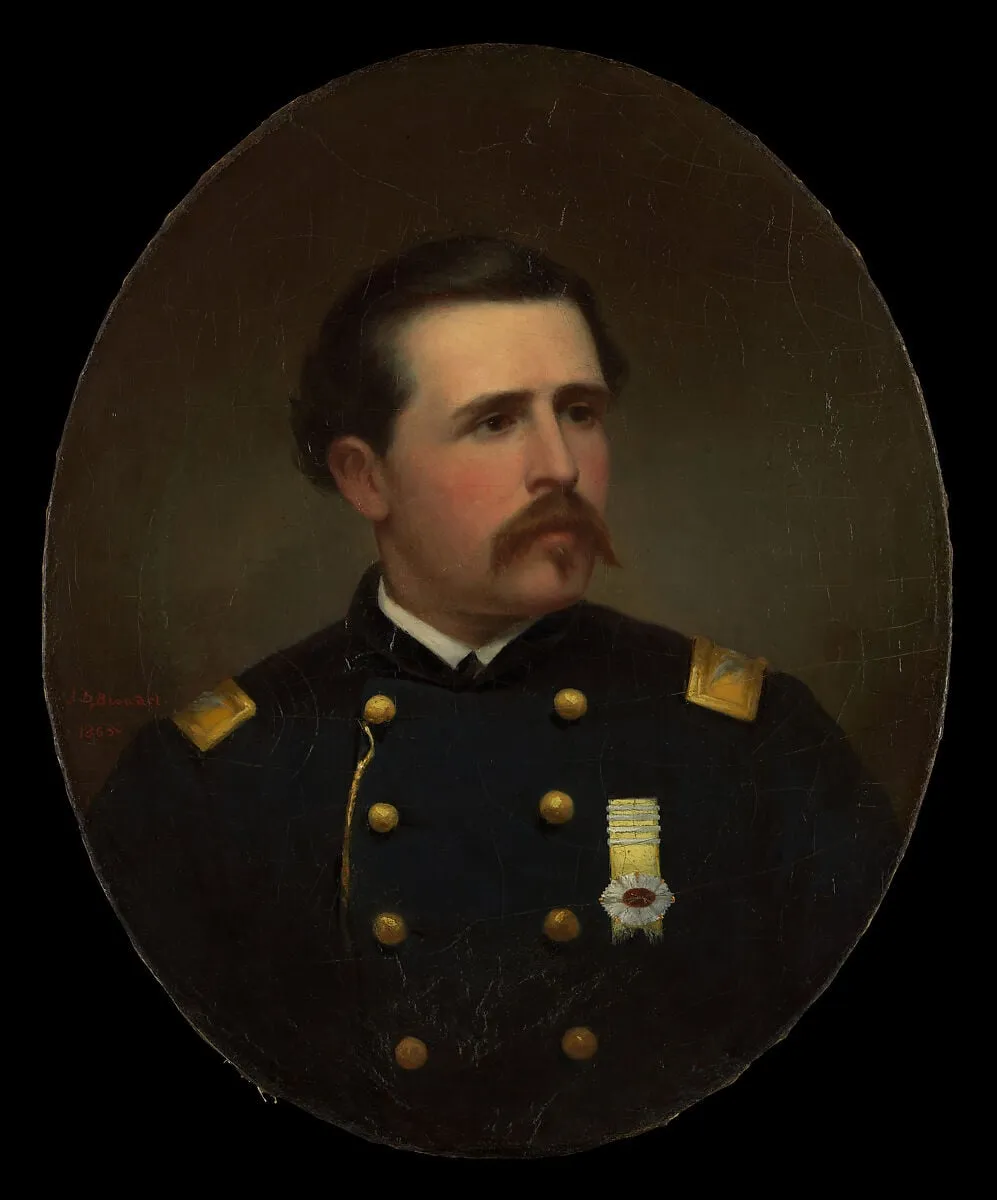
Luigi Palma di Cesnola is an oil painting by the American Folk Art artist Jacob D. Blondel. It dates from 1865 and is held in the collection of the Metropolitan Museum of Art. Jacob D.
About this work
A man in a dark military uniform stands stiffly against a plain background, his face serious, gold braid glinting on his shoulders. The sitter is Luigi Palma di Cesnola, a soldier who became the first director of The Met. Jacob D. Blondel painted it in 1865, just after the Civil War, when such portraits honored service. Few of Blondel's paintings survive.
Subject & Meaning
Blondel, the painting utilizes the oil-on-canvas medium to capture the sitter's likeness within the genre of portraiture.
The work functions strictly as a formal portrait, depicting Luigi Palma di Cesnola as a man and a soldier. Created in 1865 by Jacob D. Blondel, the painting utilizes the oil-on-canvas medium to capture the sitter's likeness within the genre of portraiture. The iconography is defined by the explicit representation of Cesnola in his capacity as a soldier, emphasizing his military identity alongside his status as a man.
The visual composition focuses entirely on the individual figure, offering no additional narrative scenes, allegorical figures, or complex symbolic objects beyond the inherent meaning of the military vocation. Consequently, the work represents the subject's personal and professional stature during the mid-19th century, serving as a direct visual record of the individual rather than an abstract or mythological narrative.
Technique & Style
The work is executed in oil on canvas, a standard support for portraiture in the mid‑19th century. Its dimensions measure 69.2 × 56.2 cm, as recorded in the Metropolitan Museum of Art catalogue. The painting portrays a soldier in uniform, rendered with the naturalistic detail typical of academic portraiture of the period.
The use of oil paint allows for layered modeling and subtle chiaroscuro, contributing to a lifelike rendering of the sitter’s features. The composition is straightforward, emphasizing the subject’s rank and presence. No specific conservation or handling records are cited in the available documentation.
History & Provenance
The portrait of Luigi Palma di Cesnola was produced by Jacob D. Blondel in 1865, executed in oil on canvas. The painting entered the collection of the Metropolitan Museum of Art, where it is classified within The American Wing. The sources document the work's creation date, medium, and current institutional home, but provide no further information regarding a commissioning party, prior owners, intermediate custody, or acquisition circumstances leading to its presence at the Met.
The portrait of Luigi Palma di Cesnola by Jacob D. Blondel, completed in 1865, is held in the collection of the Metropolitan Museum of Art. Classified within The American Wing, the oil-on-canvas work measures 69.2 cm in height and 56.2 cm in width. While the sources confirm the painting's current location and physical dimensions, they do not provide a specific accession or inventory number for the piece.
Furthermore, the available documentation does not record any exhibition history for this portrait, noting only its creation date and its status as a depiction of a soldier and man.
Legacy
The painting by Jacob D. Blondel, portraying Luigi Palma di Cesnola, entered the Metropolitan Museum of Art's collection and was placed within The American Wing, signaling its acceptance as an important example of 19th‑century American portraiture. Its display alongside other canonical works has contributed to scholarly discussions of Civil War‑era military portraiture and has reinforced Cesnola’s status as a notable figure in American art history. The work’s continued exhibition and study underscore its lasting reputation as a representative piece of the period.
Overview
Jacob D. Blondel's 1865 oil on canvas depicts Luigi Palma di Cesnola, a figure significant for his military service and later contributions to The Metropolitan Museum of Art. The portrait captures him in a dark military uniform, standing formally with a serious expression. Created shortly after the American Civil War, the work reflects a common practice of honoring veterans through painted likenesses. It is also one of the few known surviving works by Blondel.
Context
Created in 1865, immediately following the conclusion of the American Civil War, this portrait of Luigi Palma di Cesnola served a prevalent cultural function: to acknowledge and celebrate military service. Such depictions were a customary means of honoring individuals who had contributed to the national conflict. The artist, Jacob D. Blondel, was primarily active in New York, and this particular oil on canvas stands among the limited number of his works that have endured to the present day.
Artist & collection

- The Colonel
 Portrait of Brigadier General Joseph Lewis Hogg
 Retrato de Don Alejandro Díaz
 Johan Fredrik Holmberg (k. 1900)
 Gen. U.S. Grant
 Deák Ferenc
 Portrait of John D. Rockefeller
 General Andrew Jackson
 Untitled (Portrait of a Man)
 Lt. Huntington Frothingham Wolcott
 Karl Emanuel Janssonin muotokuva
 El pintor Francisco Sainz