Artwork
The Crucifixion
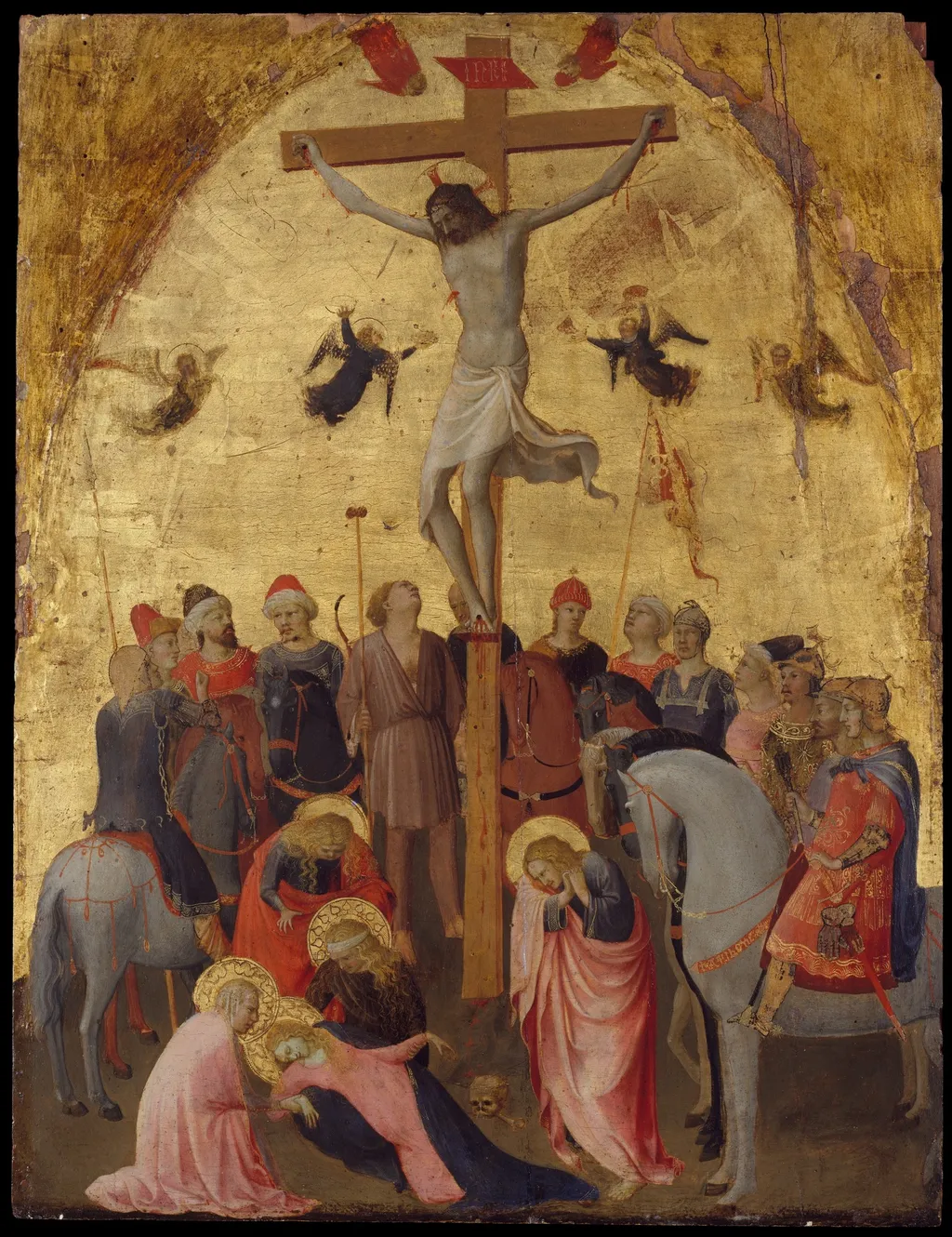
The Crucifixion is a tempera painting by the Early Renaissance artist Fra Angelico. It dates from 1420 and is held in the collection of the Metropolitan Museum of Art.
About this work
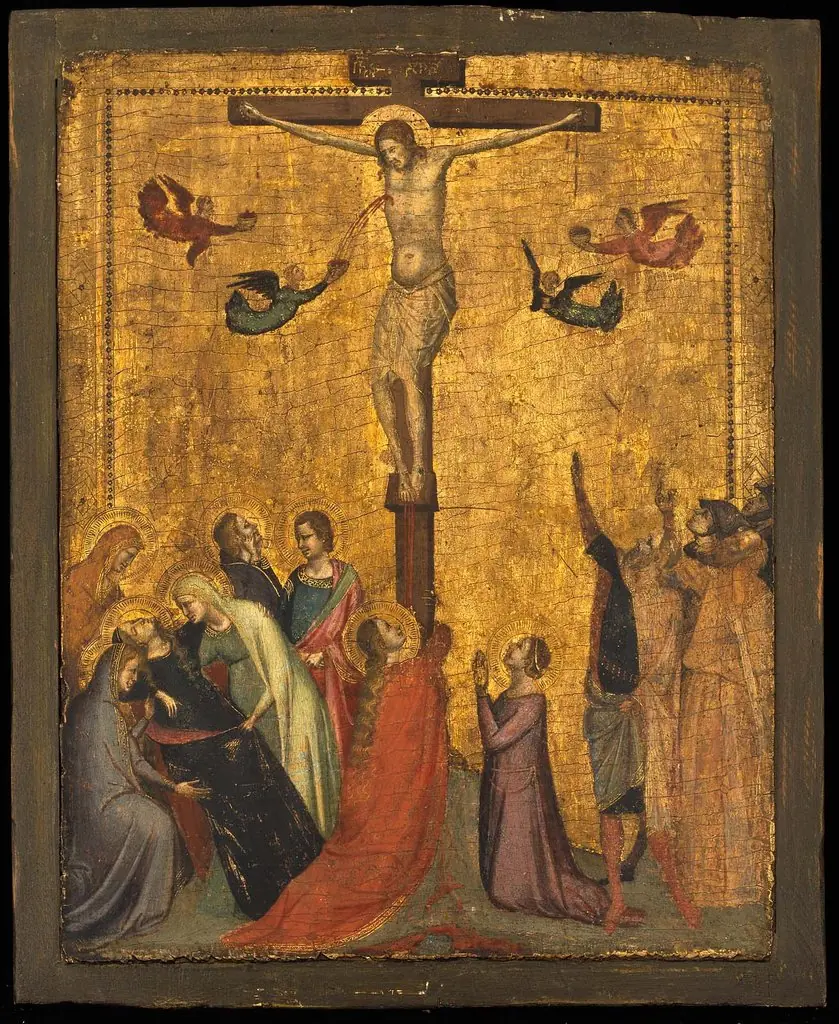
In the foreground, the Virgin Mary collapses in grief at the foot of the cross, between Mary Magdalene and Mary of Cleophas, while Roman soldiers and their horses keep watch behind. Fra Angelico painted the small tempera panel around 1420-23, likely for private devotion, arranging the figures in a semicircle drawn from Lorenzo Ghiberti's bronze doors for the Florence Baptistry.
Subject & Meaning
Iconographic elements include Christ on the cross, the Virgin Mary, Mary Magdalene, soldiers (among them an equestrian figure), and angels.
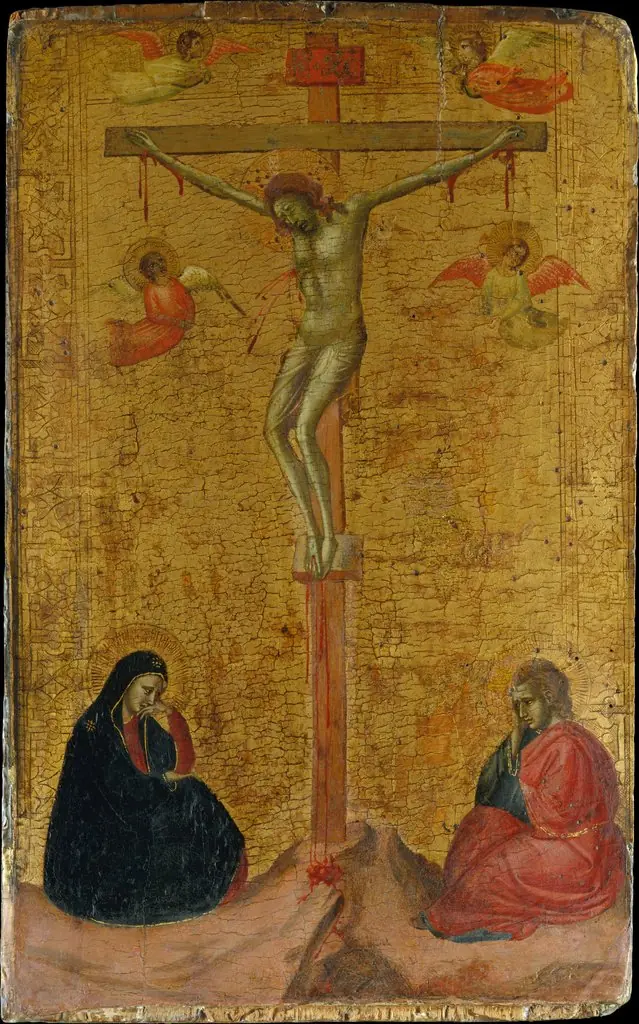
The painting's main subject is the Crucifixion of Jesus, central to Christian salvation. Iconographic elements include Christ on the cross, the Virgin Mary, Mary Magdalene, soldiers (among them an equestrian figure), and angels. A skull at the base references Golgotha, symbolizing mortality and Christ's victory over death.
The work's meaning lies in the atonement and sacrifice for humanity's sins, consistent with its genre of religious art.
Technique & Style
Fra Angelico executed The Crucifixion in tempera on a wood panel, the standard support for Italian panel painting of the early 15th century (1420). The painting measures 64 by 49 cm. Its composition includes Christ on the cross, the Virgin Mary, Mary Magdalene, angels, soldiers on horseback, and a skull at the base, referencing Golgotha. The crowded scene and attention to sacred iconography reflect the religious genre and the artist's characteristic devotional clarity. No condition information is available from the provided sources.
Overview
This early tempera painting by Fra Angelico, created around 1420 23, depicts the Crucifixion on a small wooden panel with a gold ground. Measuring 63.8 by 48.3 cm, it is held in The Metropolitan Museum of Art. The work is notable as Fra Angelico's apparent only signed piece and likely served as the pinnacle of an altarpiece.
It showcases the artist's developing skill in rendering human emotion within a structured three-dimensional space, a hallmark of his subsequent career.
History & Provenance
Created early in Fra Angelico's career, around 1420 23, this panel is unique as it appears to be the artist's only signed work. Its specific shape and the implied low viewing angle suggest it originally functioned as the pinnacle, or uppermost section, of a larger altarpiece. The painting entered the collection of The Metropolitan Museum of Art in 1943, arriving as part of the bequest from Maitland F. Griggs, where it is cataloged under object number 43.98.5.
Own this work as a print
Artist & collection

Artist
Fra Giovanni da Fiesole (born Guido di Pietro; c. 1395 – 18 February 1455), known posthumously as Fra Angelico ( FRAH an-JEL-ik-oh, Italian: ), was an Italian Dominican friar and painter active during the early…

- The Crucifixion
 The Crucifixion
 The Crucifixion
 The Crucifixion
 Calvary
 The Crucifixion of Christ
 The Crucifixion
 Crucifixion
![Scenes from the Passion of Christ: The Agony in the Garden, the Crucifixion, and the Descent into Limbo [entire triptych], by Andrea Vanni](https://artifactworldgallery.com/img/andrea-vanni--scenes-from-the-passion-of-christ-the-agony-in-the-garden-th--1ebebae2d86a2ec2-w320.webp) Scenes from the Passion of Christ: The Agony in the Garden, the Crucifixion, and the Descent into Limbo [entire triptych]
Scenes from the Passion of Christ: The Agony in the Garden, the Crucifixion, and the Descent into Limbo [entire triptych]![Scenes from the Passion of Christ: The Crucifixion [middle panel], by Andrea Vanni](https://artifactworldgallery.com/img/andrea-vanni--scenes-from-the-passion-of-christ-the-crucifixion-middle-pan--abe5469a28e77ac7-w320.webp) Scenes from the Passion of Christ: The Crucifixion [middle panel]
Scenes from the Passion of Christ: The Crucifixion [middle panel]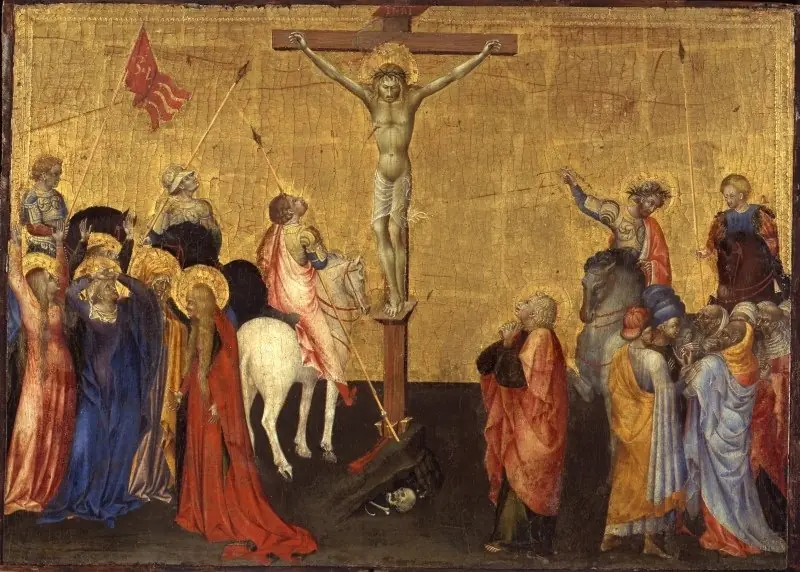 Crucifixion
 The Crucifixion