Artwork
Christ Washing the Disciples' Feet
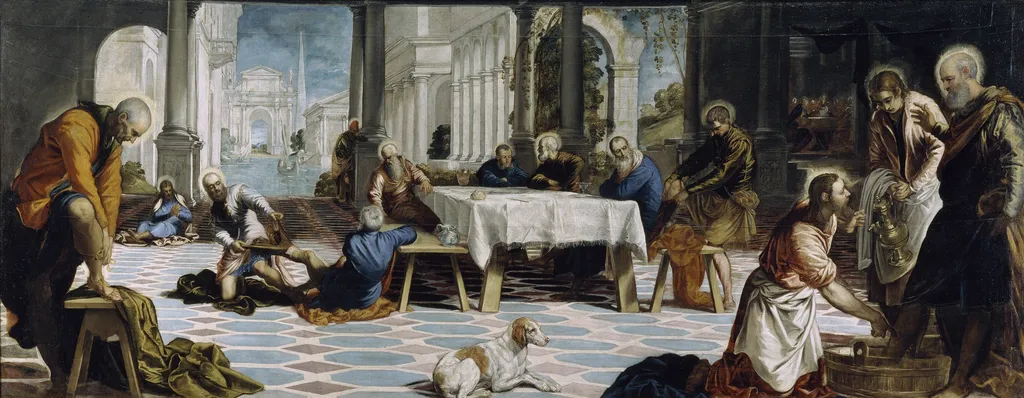
Christ Washing the Disciples' Feet is an oil painting by the Mannerist artist Jacopo Tintoretto. It dates from 1548 and is held in the collection of the Museo del Prado. Tintoretto’s oil painting titled Christ Washing the Disciples’ Feet was executed between 1548 and 1549.
About this work
Subject & Meaning
The iconography emphasizes Christ's humility and the inversion of worldly hierarchy, as the master performs the task of a servant.
The painting illustrates the episode from the Gospel of John (13:1–15) in which Jesus rises from the table during the Last Supper, removes his cloak, ties a towel around his waist, and begins to wash his disciples' feet. Tintoretto captures the precise moment when Simon Peter initially refuses the act, but, persuaded by Christ, consents to having not only his feet but also his head and hands washed. The iconography emphasizes Christ's humility and the inversion of worldly hierarchy, as the master performs the task of a servant.
The composition is dominated by the Last Supper setting, with the table and the disciples occupying most of the canvas. A dog lies at the center, included either to fill an otherwise empty space or to symbolize the faithfulness of the disciples. In one corner, a secondary scene depicts a miracle of Saint Mark drawn from Jacobus de Varazzi's Golden Legend.
The background features classical architecture reminiscent of Venice, with a small boat among canals rendered in cool blues and whites, lending an almost unreal atmosphere.
Technique & Style
Executed between 1548 and 1549, this work is an oil painting on canvas measuring 210 cm in height and 533 cm in width. The composition is notably decentered, with the primary narrative of Christ washing Saint Peter's feet relegated to the right side, while a large table and a dog occupy the central space. This arrangement was specifically designed for its original location on the right wall of a long room in the church of San Marcuola; when viewed from the right, the foreshortening of the table and the geometric floor tiles create a harmonious perspective that disappears when seen frontally.
Stylistically, the painting features powerful anatomies reminiscent of Michelangelo, particularly in the figure of an apostle untying his footwear. The background displays classical architecture inspired by Sebastiano Serlio's illustrations, depicting a Venetian-like cityscape with canals rendered in cold blues and whites to evoke an unreal atmosphere.
History & Provenance
Commissioned in 1547 for the Scuola del Santísimo Sacramento in the church of San Marcuola, Venice, Jacopo Tintoretto created this work between 1548 and 1549 alongside a separate Last Supper for the same location. After approximately seventy years in the church, the painting was acquired by Ferdinando Gonzaga, VI Duke of Mantua, around the turn of the 17th century, where it hung in the Ducal Palace. In 1627, King Charles I of England purchased the piece, but following the monarch's execution, it was sold to settle debts.
The Spanish ambassador Alonso de Cardenas secured the work and gifted it to Prime Minister Luis Méndez de Haro, who presented it to Philip IV of Spain. The painting remained in the sacristy of the Royal Monastery of El Escorial until its transfer to the Museo del Prado in 1939.
The painting Christ Washing the Disciples' Feet by Jacopo Tintoretto is held in the Museo del Prado. It bears the inventory number P00965. Its provenance includes a commission in 1547 by the Scuola del Santissimo Sacramento in Venice, acquisition by Ferdinando Gonzaga, Duke of Mantua, in the early 17th century, purchase by Charles I of England in 1627, and subsequent sale after the English Revolution.
The work remained in the sacristy of the Royal Monastery of El Escorial until its transfer to the Museo del Prado in 1939.
Context
The work Christ Washing the Disciples' Feet by Jacopo Tintoretto was created in 1548 as an oil painting on canvas and belongs to the religious genre within the Mannerist and Venetian school traditions. It was commissioned in 1547 by the Scuola del Santissimo Sacramento for the church of San Marcuola in Venice, alongside a Last Supper that remains in situ, and was executed between 1548 and 1549. After more than seven decades in Venice, the painting entered the collection of Ferdinando Gonzaga, Duke of Mantua, in the early 17th century, later passing to Charles I of England in 1627.
Following the English Civil War, it was sold through the intermediary of the Spanish ambassador and minister Don Luis Méndez de Haro to Philip IV of Spain. The work remained in the sacristy of the Monastery of San Lorenzo de El Escorial until its transfer to the Museo del Prado in 1939. Scholars note its sophisticated spatial composition, particularly the dynamic shift in visual balance when viewed from the right, where perspective and architectural elements, including a central dog symbolizing fidelity and a distant Venetian-inspired cityscape, enhance the narrative focus on Christ’s act of humility.
The depiction draws from John 13 in the Gospel and includes a miracle of Saint Mark recounted in the Golden Legend, reflecting both Venetian devotional practices and Renaissance artistic innovation.
Legacy
Tintoretto's Christ Washing the Disciples' Feet is regarded as one of his finest and most celebrated works, a status that has shaped its enduring reputation. The subject was significant enough in his output that the artist reproduced it in several versions. The painting's trajectory through the collections of Charles I of England and Philip IV of Spain, and its eventual installation at the Museo del Prado in 1939, cemented its place within the canon of Venetian Renaissance painting.
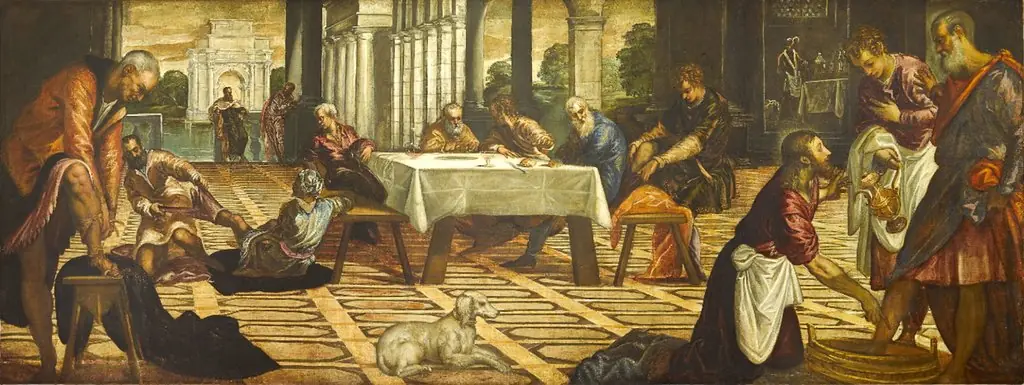
For some time the Prado canvas was mistakenly considered a workshop repetition, with scholars instead identifying a version in the cathedral of Saint Nicholas in Newcastle upon Tyne as the original. Expert opinion has since reversed that attribution, recognizing the Prado painting as the autograph work, a reassessment that has reinforced its standing as a masterpiece of Mannerism.
Overview
Tintoretto’s oil painting titled Christ Washing the Disciples’ Feet was executed between 1548 and 1549. The work belongs to the Venetian school of the mid‑sixteenth century and is presently exhibited in Madrid’s Museo del Prado. It portrays the biblical episode of Jesus humbly cleansing the feet of his followers, rendered with the artist’s characteristic dynamism and spatial complexity.
Artist & collection
Artist
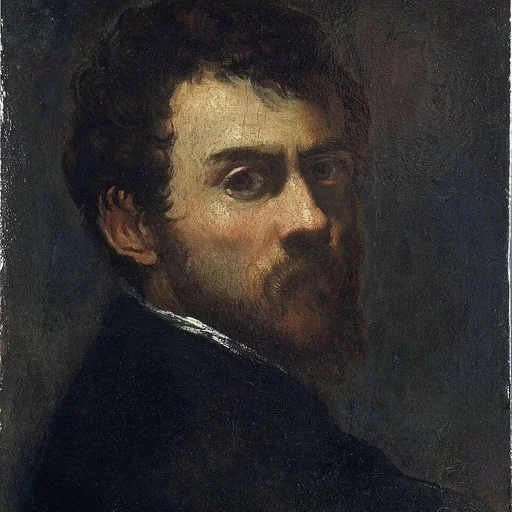
Jacopo Robusti (late September or early October 1518 – 31 May 1594), best known as Tintoretto ( TIN-tə-RET-oh; Italian:; Venetian: ), was an Italian Renaissance painter of the Venetian school.