Artwork
Crucifixion and Last Judgement diptych
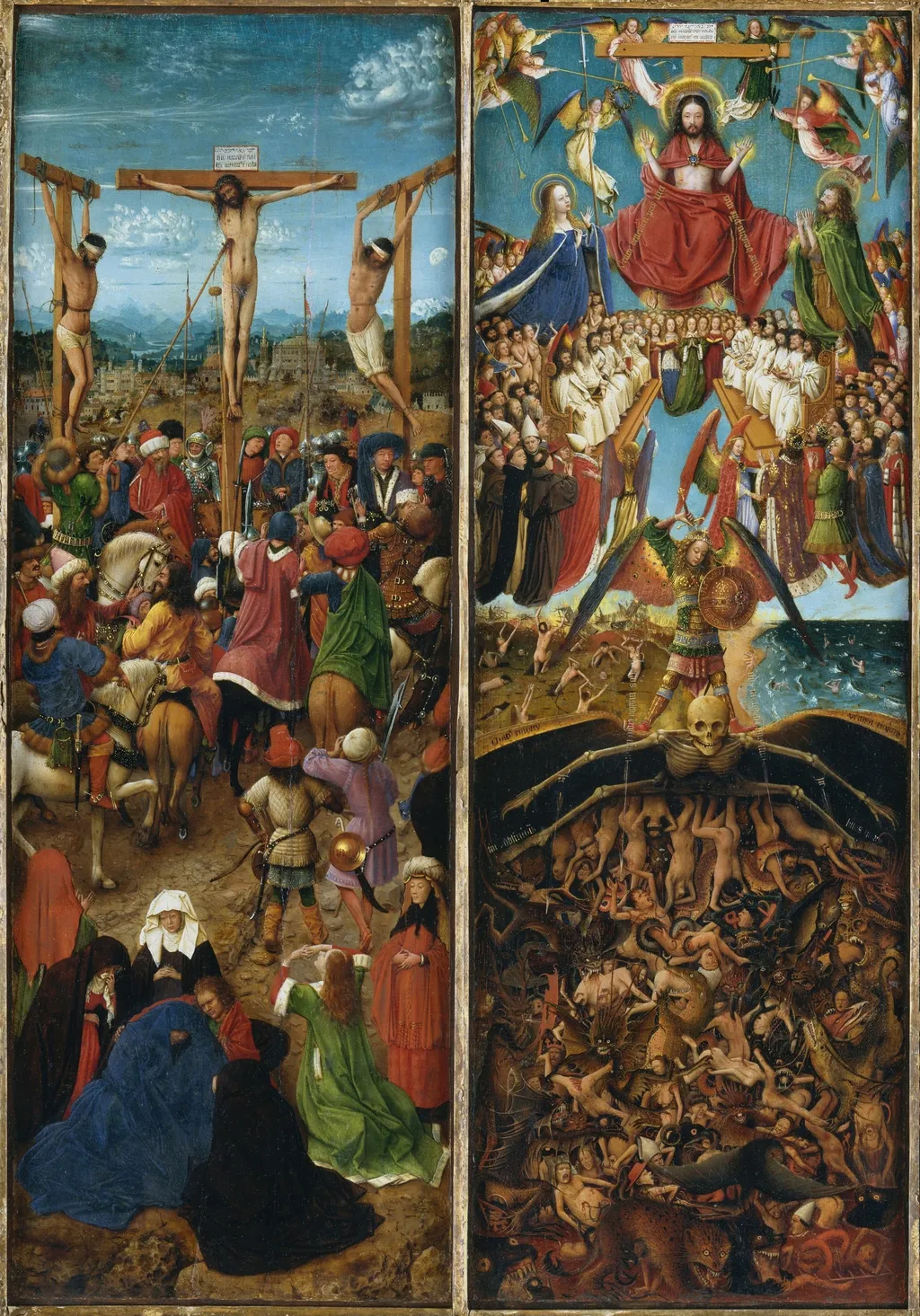
Crucifixion and Last Judgement diptych is an oil painting by the Northern Renaissance artist Jan van Eyck. It dates from 1440 and is held in the collection of the Metropolitan Museum of Art.
About this work
A diptych painted by Jan van Eyck around 1440, oil on two small panels each about 56.5 by 19.7 cm. It was likely commissioned for private devotion, meant to be seen up close. The dense, detailed imagery joins the Crucifixion with a Last Judgement. Van Eyck began the work, but parts were finished by followers or members of his workshop.
Subject & Meaning
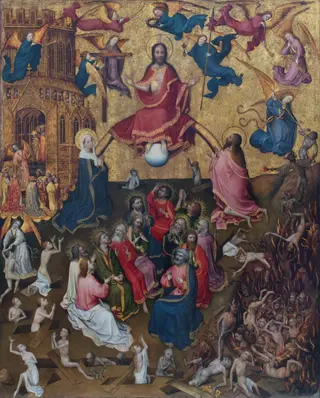
The diptych shows the Crucifixion on the left panel and the Last Judgment on the right, presenting Christ’s crucifixion alongside the final judgement of souls.
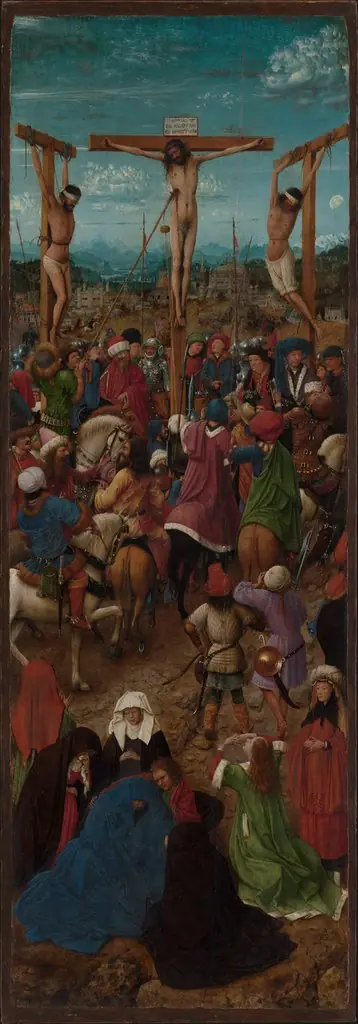
The diptych shows the Crucifixion on the left panel and the Last Judgment on the right, presenting Christ’s crucifixion alongside the final judgement of souls. The left wing includes the cross, the two thieves, the mourning Virgin Mary, Mary Magdalene and a crowd of soldiers and spectators, while the right wing depicts Christ in Majesty surrounded by saints, angels and the archangel Michael separating heaven from hell, with damned figures in a fiery pit. Van Eyck’s iconography adds Greek, Latin and Hebrew inscriptions, gilt frame passages, and a detailed landscape of Jerusalem that frames the scene.
The composition links personal penitence with eschatological warning, embodying Early Netherlandish theological themes and demonstrating the artist’s innovative oil technique to pack complex narrative into a small vertical format.
Technique & Style
Attributed to Jan van Eyck and executed circa the 1430s or 1440, this diptych comprises two small vertical panels originally painted in oil on oak. In 1867, the works were transferred from their original wood supports to canvas, a procedure that likely resulted in the loss of grisaille paintings on the reverses. Measuring approximately 56.5 by 19.7 cm, the miniature format suggests a function for private devotion.
Van Eyck utilized advanced oil techniques, manipulating glazes to achieve luminous surfaces and deep perspective, particularly in the sky of the Crucifixion panel. The composition displays a high horizon line and a dense aggregation of figures rendered with minute detail. Unusually, the artist adapted the traditionally horizontal Crucifixion narrative to a narrow vertical format, arranging scenes in a continuous upward slope reminiscent of medieval tapestries.
The work features complex spatial arrangements where figure size indicates proximity rather than strict perspective, alongside trilingual inscriptions in Hebrew, Greek, and Latin.
History & Provenance
The diptych was likely commissioned for private devotion, given its miniature format. The earliest surviving mention appears in 1841, when Johann David Passavant reported that the panels had been purchased in a Spanish monastery between Madrid and Burgos by the Russian diplomat Dmitry Tatishchev, then ambassador in Spain, between 1814 and 1821. Passavant initially believed the panels were wings of a lost triptych.
In 1845, Tatishchev donated the work to Tsar Nicholas I of Russia, who placed it in the Hermitage Museum in Saint Petersburg. The panels were transferred from their original oak supports to canvas in 1867, according to a Russian inscription on their reverse. In 1931, the Soviet government secretly sold the diptych through the M. Knoedler & Company gallery to Charles Henschel, who in turn sold it in November 1933 to the Metropolitan Museum of Art in New York for $185,000.
Dating remains debated: the Metropolitan's catalogue places the work around 1440–1441, while many scholars, citing technique and costume, argue for execution in the early 1430s, finished after van Eyck's death.
Context
Recognized as a masterpiece of the Northern Renaissance, this diptych is celebrated for its complex iconography and technical innovation within Early Netherlandish painting. Jan van Eyck, alongside contemporaries like Robert Campin and Rogier van der Weyden, revolutionized naturalism by manipulating oil glazes to achieve luminous surfaces and emotional depth. Art historian Otto Pächt described the work as an "Orbis Pictus," noting how van Eyck condensed expansive narratives into a vertical miniature format, a departure from traditional horizontal Crucifixion compositions.
While early scholarship in 1841 speculated the panels were wings of a lost triptych, Erwin Panofsky argued they were intended as a standalone diptych, citing their sumptuous execution as inconsistent with outer wings. Attribution debates have shifted over time; initially linked to Hubert van Eyck or Petrus Christus due to stylistic similarities with other works, current consensus dates the piece to the early 1430s or circa 1440, viewing it as a late work by Jan, potentially finished by workshop assistants.
Legacy
The diptych shaped later Northern Renaissance art through its pioneering oil technique and complex iconography, establishing a model for devotional panels that combine Crucifixion and Last Judgment in a single composition. Its acquisition by the Metropolitan Museum and earlier ownership by Russian patrons highlighted its prestige and helped cement Jan van Eyck’s reputation as a master of naturalism. Scholars continue to debate its attribution and dating, reflecting its central role in studies of Early Netherlandish painting and influencing subsequent attributions of similar works.
The work’s innovative vertical format and use of glazes informed later artists’ approaches to spatial depth and narrative simultaneity. Its legacy persists in modern scholarship and exhibitions, underscoring its enduring impact on the understanding of religious art.
Overview
The "Crucifixion and Last Judgement" is a small oil-on-panel diptych created around 1440, primarily by Jan van Eyck, though his workshop contributed to its completion. Measuring just 56.5 by 19.7 cm per panel, it was likely intended for personal contemplation. This early Northern Renaissance work is notable for its intricate details and the sophisticated blend of two major theological narratives.
Own this work as a print
Artist & collection

Artist
Jan van Eyck ( van EYEK; Dutch: ; c. before 1390 – 9 July 1441) was an early Netherlandish painter active in Bruges who was one of the early innovators of what became known as Early Netherlandish painting, and one of…

![The Raising of the Cross [center, left, and right panels], by Master of the Starck Triptych](https://artifactworldgallery.com/img/master-of-the-starck-triptych--the-raising-of-the-cross-center-left-and-right-panels--5f0053e23b45aff7-w320.webp)