Artwork
The Annunciation
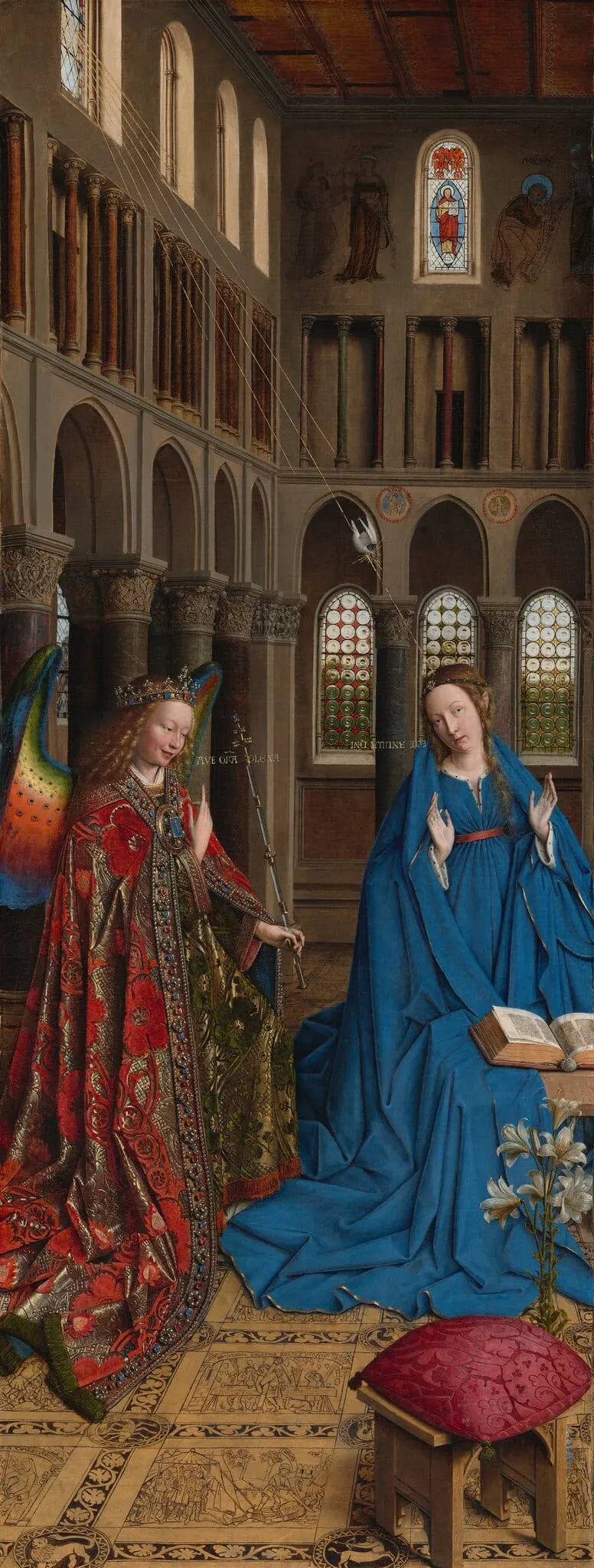
The Annunciation is an oil painting by the Northern Renaissance artist Jan van Eyck. It dates from 1435 and is held in the collection of the Andrew W. Mellon collection.
- Inscription
- Inscribed:top of back wall to the right of furthest left figure: MOYSES F[I]SCELLA; above second figure from left: FI...PHARAONIS; on banderole: O IN VS HEBREORVM HIC EST; on globe in window: ASIA; above third figure from left: Moyses; on banderole: NO ASSVMES NOM DI TVI I VAN[VM]; above fourth figure from left: DNS; middle of back wall on left roundel: ISAAC; on right roundel: JACOB; to the right of Gabriel: AVE GRA PLENA; to the left of Mary, upside down and backwards: ECCE ANCILLA DNI; lower left on floor: A DALIDA VXORE S; lower center: SAVL REX; DAVID; GOLIAS; second row center: SAMSSON MVLTAS GENTES INTERFECIT T 9VIVIO
About this work
Subject & Meaning
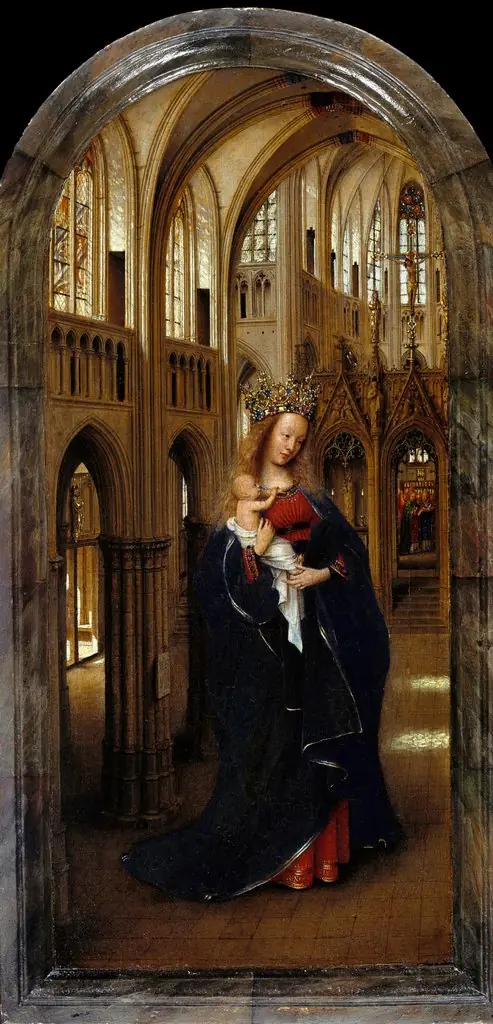
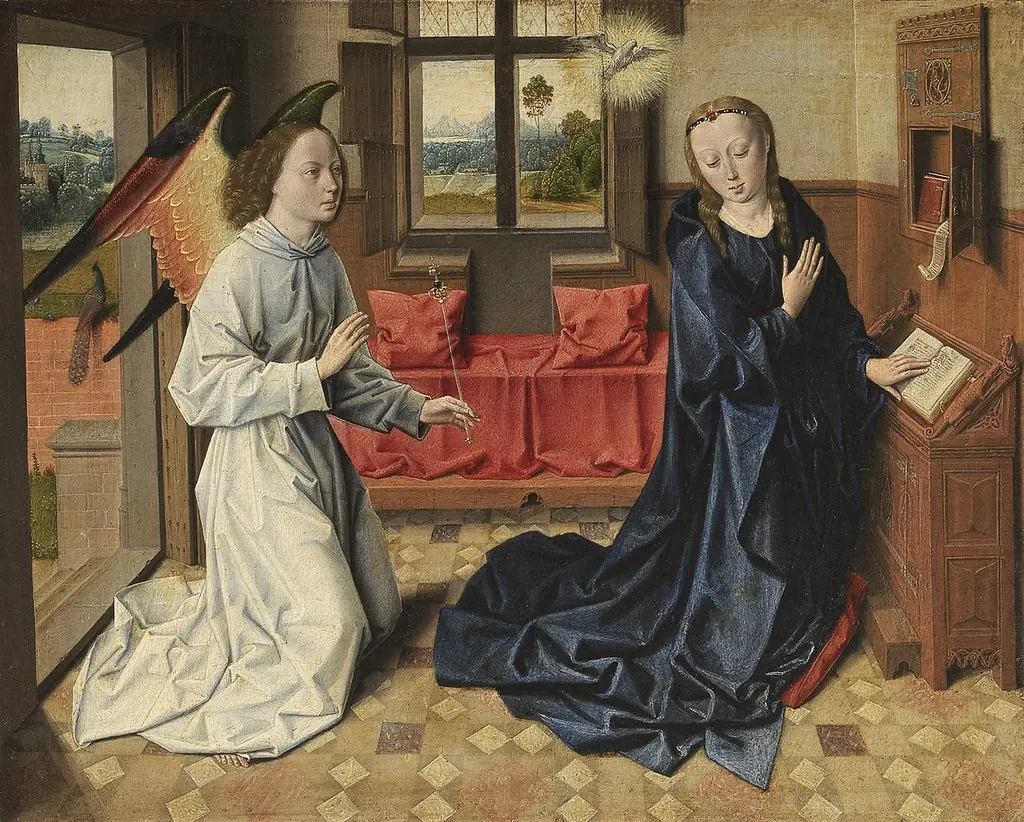
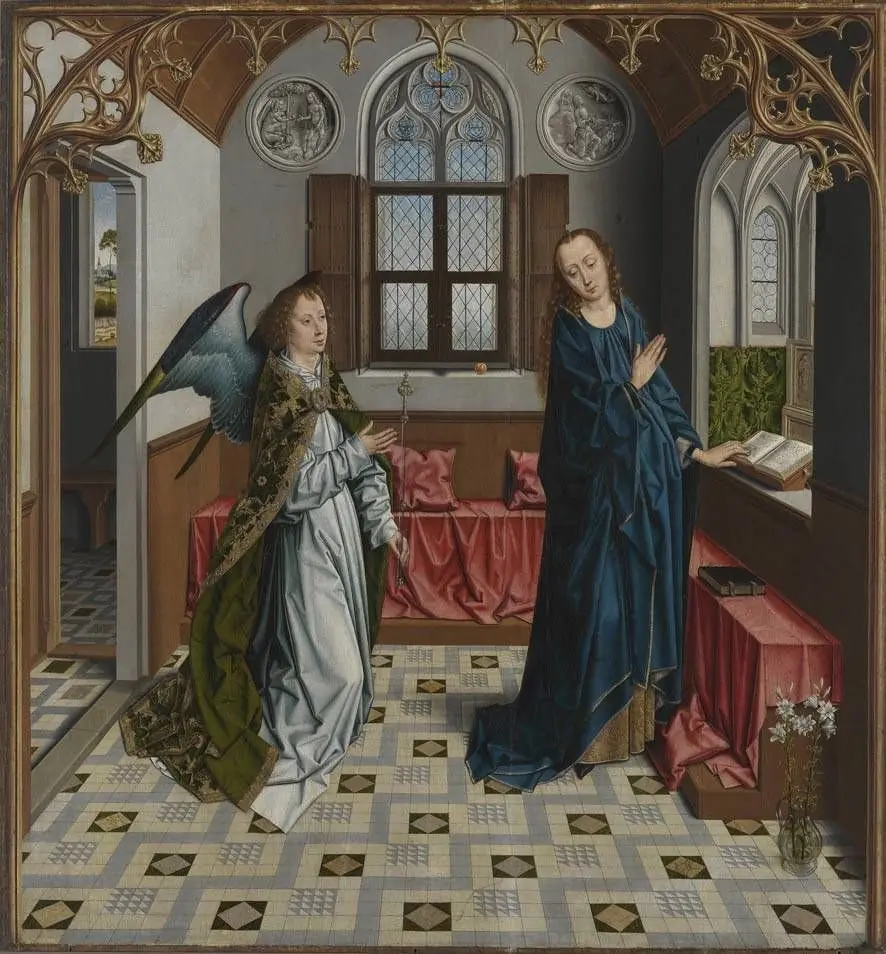
The painting shows the Annunciation moment when the Archangel Gabriel greets the Virgin Mary with the words "AVE GRATIA PLENA" inscribed upside-down, a device that makes the greeting readable to God. Mary is depicted reading a large book, traditionally identified as Isaiah, while a dove symbolising the Holy Spirit descends on seven rays of light that represent the seven gifts of the Spirit. The interior is a Romanesque-Gothic space filled with Old-Testament prefigurations, David slaying Goliath, Samson destroying the Philistine temple, and scenes of Moses, linking the Old Covenant to the New.
Symbolic elements such as lilies, an empty throne, and the triple-window motif reinforce the theological interpretation of the scene as the pivot between law and grace.
Technique & Style
Stylistically, the Early Netherlandish painting features a highly detailed church interior transitioning from dark Romanesque to illuminated Gothic forms.
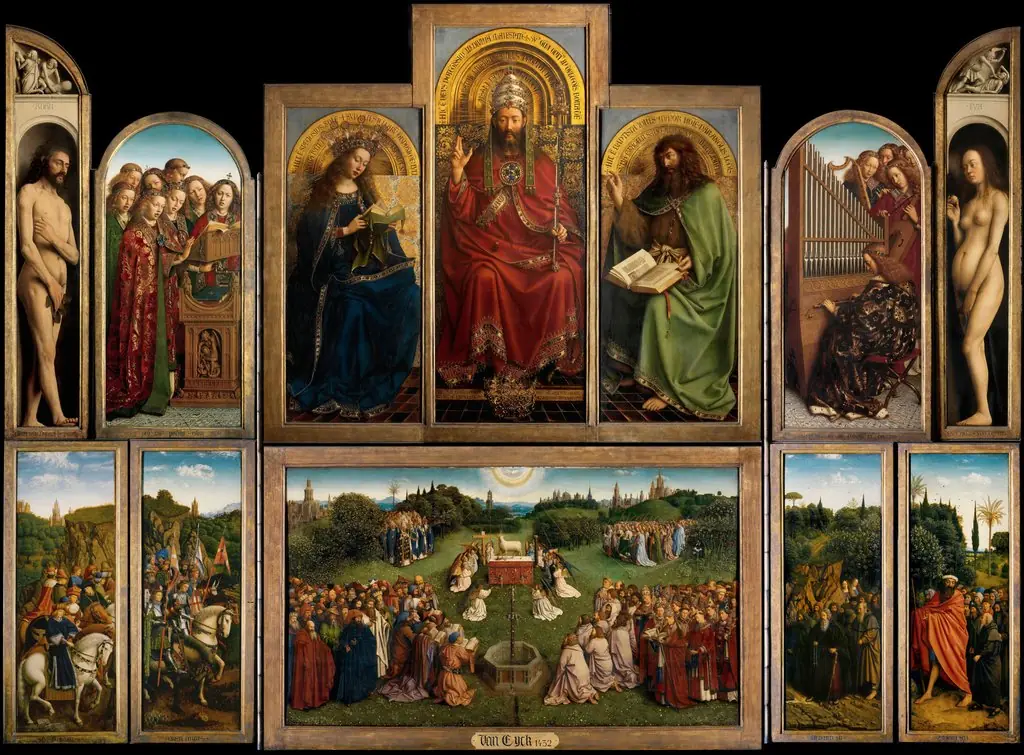
Jan van Eyck's Annunciation (c. 1434–1436) is executed in oil paint, originally on a wooden panel that was later transferred to a canvas support, likely between 1864 and 1870 while in the Hermitage Museum; the work measures approximately 90.2 × 34.1 cm. A 1994 technical investigation confirmed Van Eyck's authorship, noting that the layered painting technique and pigments, such as those in the Virgin's mantle, perfectly match those in the Ghent Altarpiece. Instead of applying actual gold leaf for Gabriel's brocade cope, Van Eyck painted the secular gold threads with remarkable illusionism, reserving genuine leaf gold for the divine rays emanating from God the Father. Stylistically, the Early Netherlandish painting features a highly detailed church interior transitioning from dark Romanesque to illuminated Gothic forms.
The figures are voluminous and richly colored, with Gabriel's jeweled cope contrasting Mary's simpler ermine-trimmed blue robe. Both figures lack halos, enhancing the realism. The composition employs a high horizon line, drawing the viewer into the meticulously rendered space, though the figures appear disproportionately large relative to the architecture.
History & Provenance
The Annunciation, painted by Jan van Eyck around 1435, was likely commissioned for the Chartreuse de Champmol near Dijon under Philip the Good, Duke of Burgundy. Executed in oil on panel and later transferred to canvas, it functioned as the left inner wing of an unfinished triptych. Its early ownership passed from the Chartreuse to Paris (1819), to Charles J. Nieuwenhuys, then to William II of the Netherlands and subsequently to The Hague, where it was sold in August 1850 to Bruni for Tsar Nicholas I. The work entered the Imperial Hermitage Museum, remaining there until 1930 when a consortium of dealers sold it to Andrew W. Mellon, who bequeathed it in 1937 to the National Gallery of Art, Washington, D.C., where it is held as part of the Andrew W. Mellon Collection under accession number 1937.1.39. The painting was also featured in the exhibition Van Eyck: An Optical Revolution.
Context
Scholars identify this work as a complex masterpiece of Early Netherlandish painting, noting its sophisticated iconography that bridges the Old and New Covenants through architectural symbolism transitioning from Romanesque to Gothic forms. Art historian Erwin Panofsky pioneered the analysis of its astrological and typological floor tiles, while technical examinations during a 1994 restoration confirmed Jan van Eyck's authorship through pigment analysis consistent with the Ghent Altarpiece. The painting is frequently contextualized within van Eyck's court service to Philip the Good, with some suggesting Mary's features resemble Isabella of Portugal.
Critics have long debated the figures' disproportionate scale relative to the interior, a trait potentially carrying specific theological weight. The work's status as a surviving wing of a lost triptych further complicates its art-historical classification, leaving its original full narrative context a subject of ongoing hypothesis.
Legacy
The Annunciation became a touchstone for the reception of Early Netherlandish painting in the modern era. Its documented journey from the Chartreuse of Champmol to the Hermitage, then to the Mellon collection and finally the National Gallery of Art illustrates the 19th- and 20th-century market for Northern Renaissance works. Inclusion in the Van Eyck: An Optical Revolution exhibition highlighted its technical innovation and cemented its status as a benchmark for scholarship.
Contemporary studies, notably the 1994 technical analysis that confirmed Van Eyck's authorship and revealed his use of gold leaf and layered pigments, have reshaped interpretations of the work's symbolism and influenced subsequent research on the artist's workshop. These factors have sustained the painting's reputation as a pivotal piece in the narrative of Western art history.
Overview
Jan van Eyck's painting, The Annunciation, created between approximately 1434 and 1436, is an oil on canvas work, originally executed on a wooden panel. This significant piece by the Early Netherlandish master is now housed at the National Gallery of Art in Washington, D.C. It is believed to have once formed the left inner panel of a larger altarpiece, whose other components have been lost to history since the early 19th century.
Artist & collection

Artist
Jan van Eyck ( van EYEK; Dutch: ; c. before 1390 – 9 July 1441) was an early Netherlandish painter active in Bruges who was one of the early innovators of what became known as Early Netherlandish painting, and one of…