Artwork
Madonna with Canon Joris van der Paele
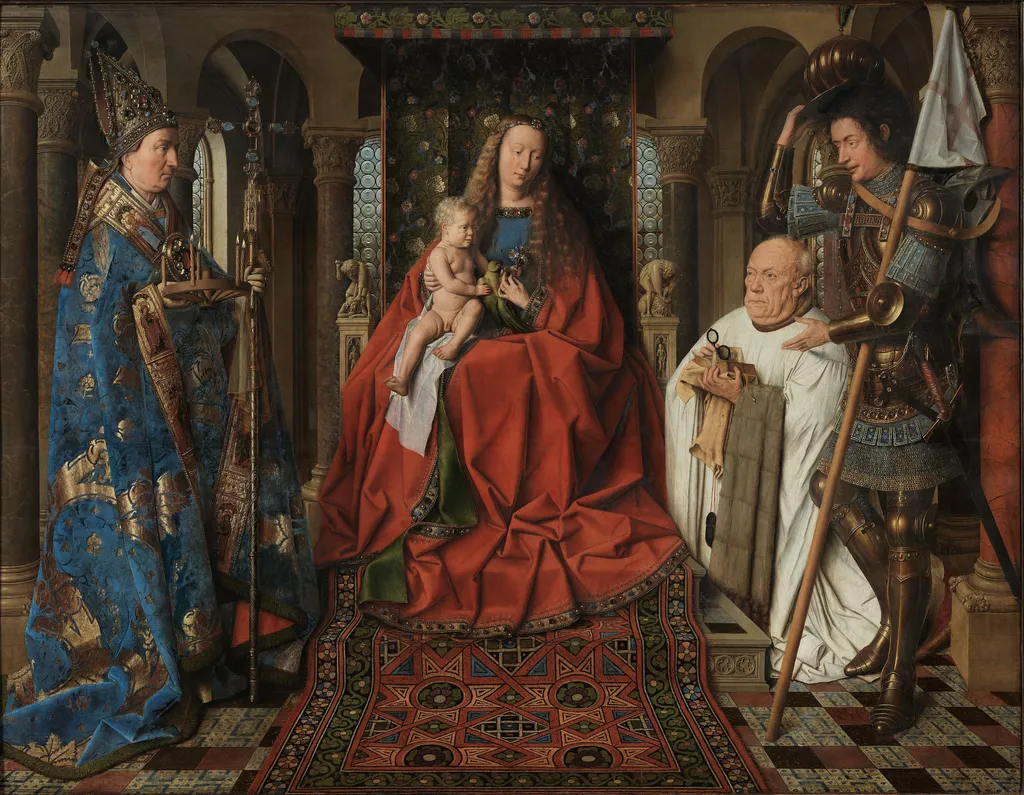
Madonna with Canon Joris van der Paele is an oil painting by the Northern Renaissance artist Jan van Eyck. It dates from 1436 and is held in the collection of the Groeningemuseum.
About this work
Technique & Style
The composition employs complex spatial illusionism within a semicircular church interior, featuring a sculptural throne adorned with Old Testament carvings.
Executed in oil on an oak panel, this work is Jan van Eyck's second largest extant painting, measuring 124.5 by 160 cm, or 141 by 176.5 cm including its original frame. The artist demonstrates masterful handling of the medium through varied brushstroke widths, achieving minute realism in the textures of brocades, furs, and the stubble on the donor's face. The composition employs complex spatial illusionism within a semicircular church interior, featuring a sculptural throne adorned with Old Testament carvings.
Light interacts physically with surfaces, notably reflecting the Virgin's red robe in Saint George's armor and capturing the artist's own reflection in the saint's shield. Although the Christ Child was later covered with a loincloth and his hand position altered, mid-20th-century restoration removed these overpaintings to reveal the original nude figure and gesture.
History & Provenance
Commissioned by Joris van der Paele, a wealthy canon of St. Donatian's in Bruges, this oil-on-oak panel was intended as a memorial altarpiece following the donor's illness around 1431. Van Eyck began the work in 1434, but the ambitious scale and the artist's high demand delayed completion until 1436, a timeline recorded in the original frame's inscription. Van der Paele likely retained the painting in his private chambers before donating it to the church either upon its completion or at his death in 1443.
The work remained in St. Donatian's Cathedral until the building's demolition in 1779, having been moved to the main altar after the Iconoclasm of 1566. During the French occupation, the panel was seized and acquired by the Louvre in 1794. It was returned to Bruges in 1816, initially entering the collections of the Flemish Academy before transferring to the municipal museum system, eventually finding its permanent home in the Groeningemuseum.
The painting is held in the Groeningemuseum in Bruges, Belgium, where it is displayed in Room 1 as part of the Flemish Art Collection. It carries the municipal inventory number O.161. Originally commissioned for the Cathedral of Saint Donatian in Bruges, the panel remained there until the church's demolition in the late 18th century.
During the French occupation, the work was seized and transferred to the Musée du Louvre in 1794. It was returned to Bruges in 1816 following the defeat of the French Empire, initially entering the collection of the Flemish Academy. The painting was subsequently housed at the Bogaerdeschool museum before moving to the Groeningemuseum upon its opening in 1930.
Historically, the work was featured in the Exposition des primitifs flamands à Bruges and was later included in the Europeana 280 initiative.
Context
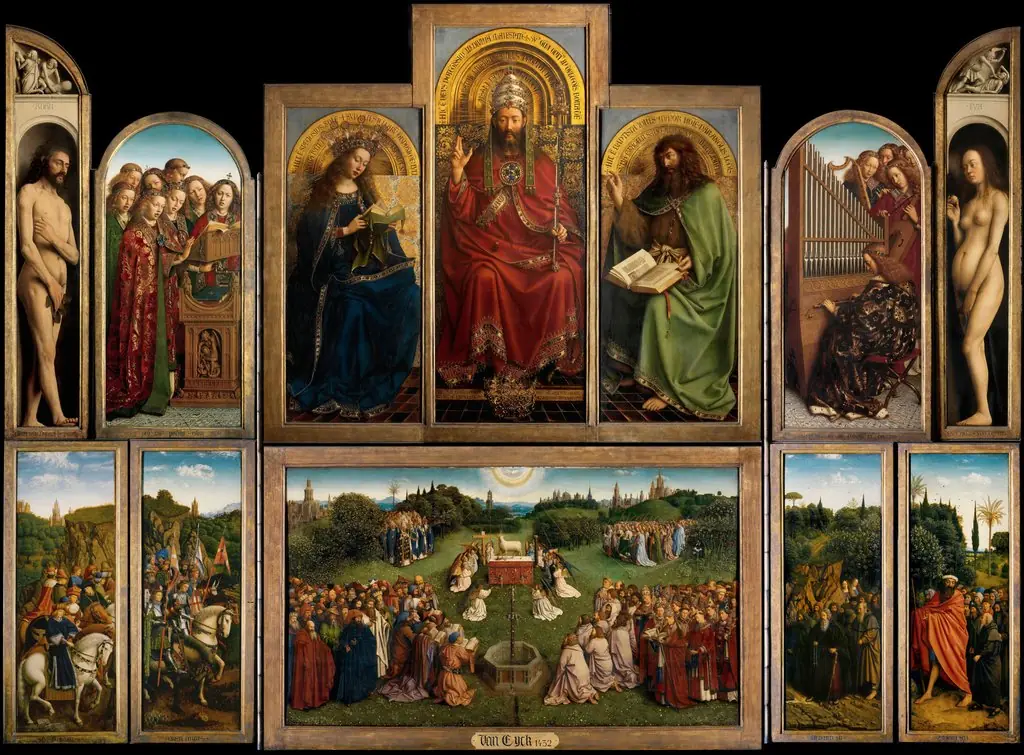
The panel is widely regarded as one of Jan van Eyck's most fully realised and ambitious works, described in the literature as a "masterpiece of masterpieces" and as the second-largest painting by the artist after the Ghent Altarpiece. It is considered one of the earliest examples of the sacra conversazione type north of the Alps, in which the Virgin and saints are united with a living donor in a single, illusionistic space rather than on separate panels.
The work belongs to Early Netherlandish painting and the Northern Renaissance, and is held in the Groeningemuseum in Bruges as part of the Vlaamse Kunstcollectie. Scholarship has highlighted its innovative spatial composition, the unusually frank depiction of the aging, ill donor, and the dense Old Testament typology carved into the Virgin's throne, all of which mark it as a pivotal monument in the development of fifteenth-century Flemish devotional painting.
Legacy
The Madonna with Canon Joris van der Paele is widely regarded as one of Jan van Eyck's most ambitious and fully realized works, described in scholarship as a "masterpiece of masterpieces." It is considered one of the earliest examples of the sacra conversazione format north of the Alps, in which the Virgin, Child, saints, and donor share a single unified pictorial space rather than appearing on separate panels. After remaining in the Church of St. Donatian in Bruges for centuries, the panel was acquired by the Louvre in 1794 during the French occupation of the Southern Netherlands, then returned to Bruges in 1816, where it entered the municipal collections and was transferred to the Groeningemuseum in 1930.
It remains one of only four authenticated van Eyck paintings still held in a Belgian collection and, after the Ghent Altarpiece, is the second largest of his surviving works.
Overview
Jan van Eyck's "Madonna with Canon Joris van der Paele," painted between 1434 and 1436, is a large oil-on-oak panel. It depicts the Virgin Mary enthroned with the Christ Child, surrounded by saints, alongside the kneeling donor, Joris van der Paele. Commissioned as an altarpiece and a personal memorial, the work integrates a contemporary figure into a sacred vision, characteristic of Early Netherlandish painting.
Subject & Meaning
The composition centers on the Virgin Mary, seated on a throne with the Christ Child in a semicircular space, likely representing a church interior. To her right stands Saint Donatian, while Saint George, the donor's patron saint, is positioned to her left. Canon Joris van der Paele kneels reverently before this holy apparition, his presence underscoring the painting's dual role as a devotional image and a personal commemoration.
Own this work as a print
Artist & collection

Artist
Jan van Eyck ( van EYEK; Dutch: ; c. before 1390 – 9 July 1441) was an early Netherlandish painter active in Bruges who was one of the early innovators of what became known as Early Netherlandish painting, and one of…

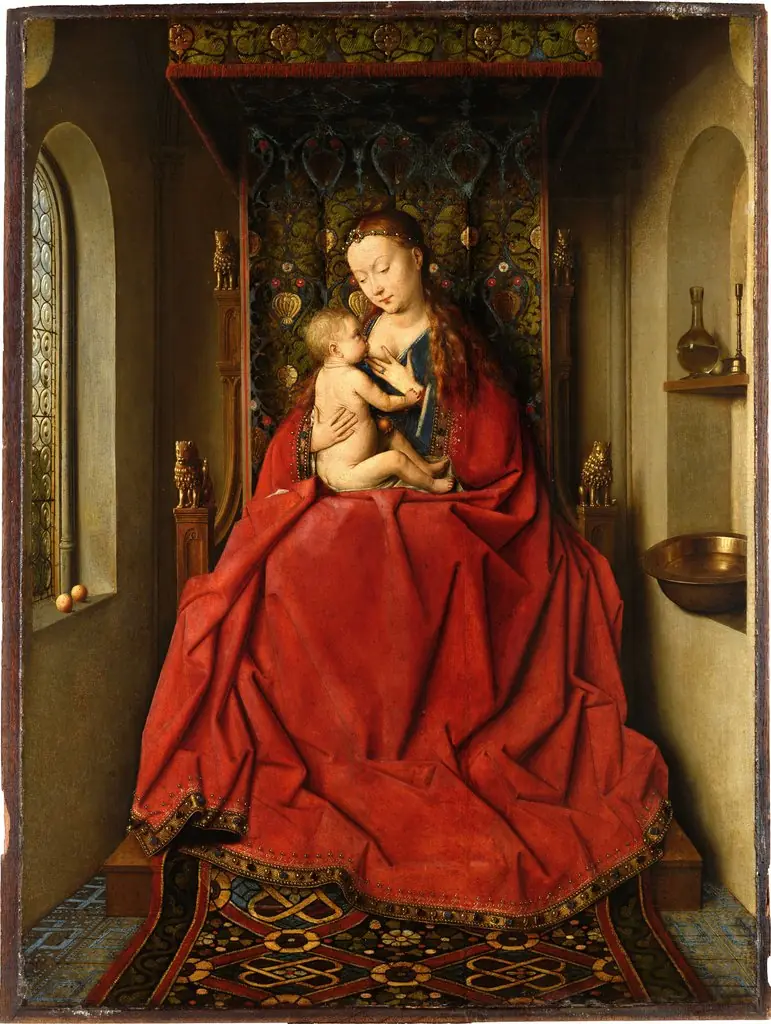 Lucca Madonna
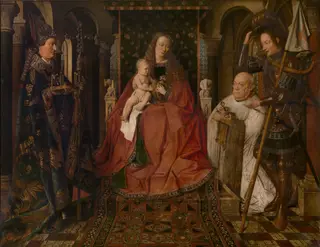 Madonna surrounded by Saint George, Saint Donatianus of Reims and the Donor Canon Van der Paele
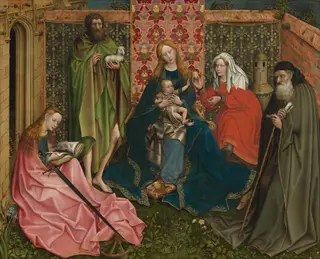 Madonna and Child with Saints in the Enclosed Garden
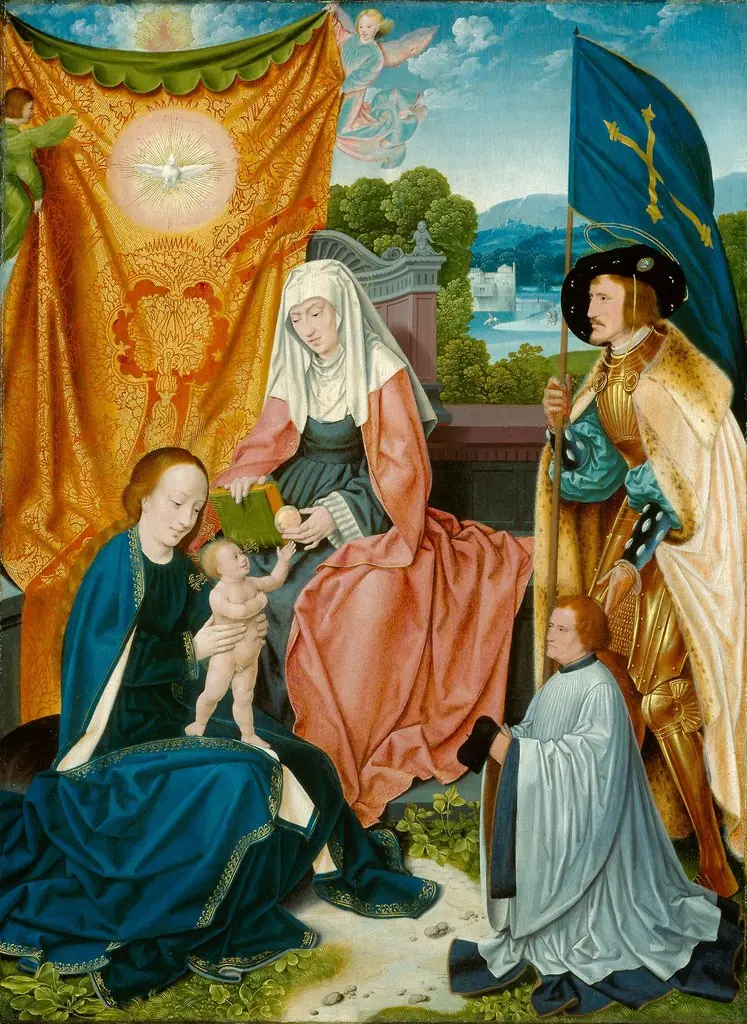 Virgin and Child with Saint Anne, Saint Gereon, and a Donor
 Dresden Triptych
 Lactatio of Saint Bernard of Clairvaux with Donors
 Madonna and Child with Angels
 Holy Kinship
 Enthroned Virgin and Child, with Angels
 Monforte Altarpiece