Artwork
The Madonna in the Church
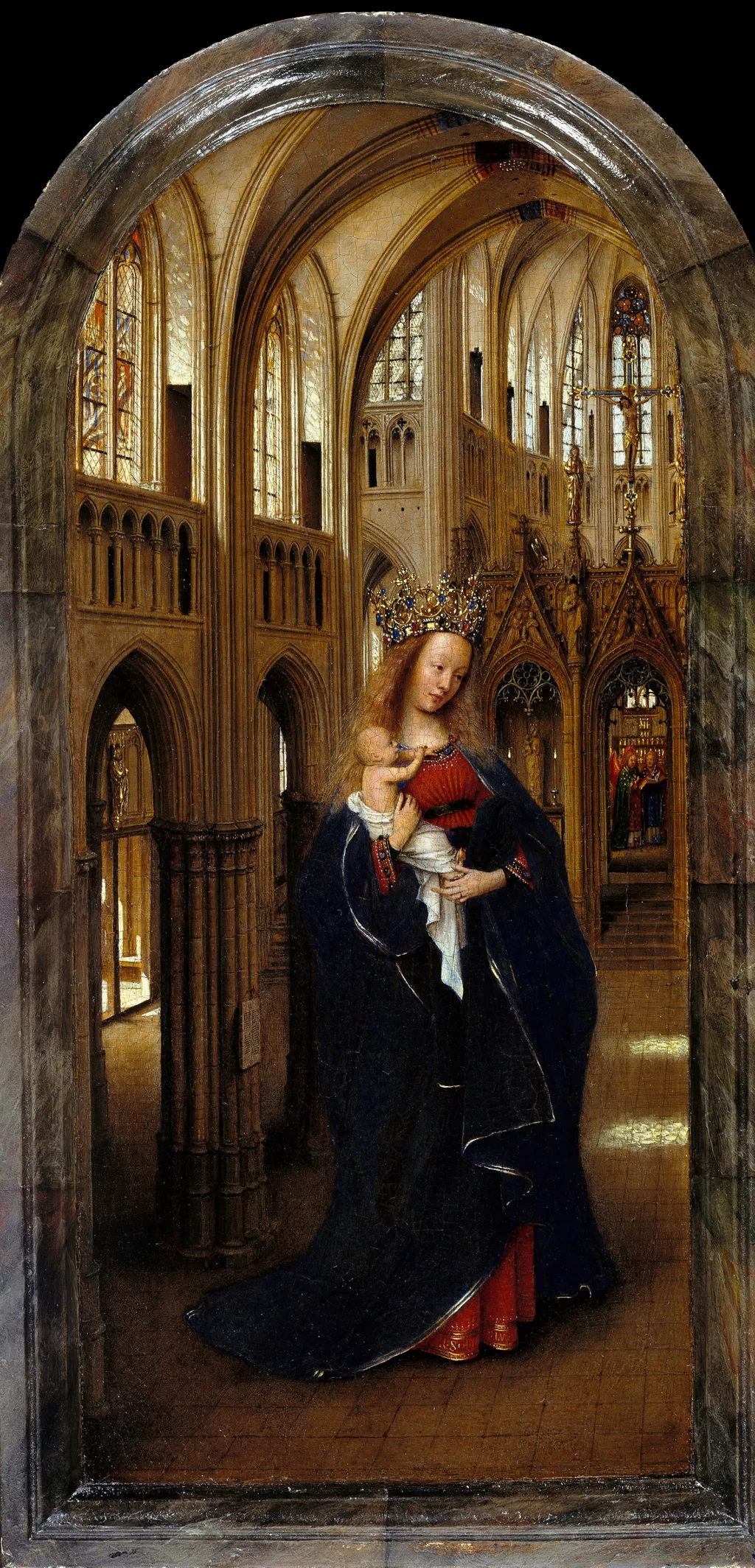
The Madonna in the Church is an oil painting by the Northern Renaissance artist Jan van Eyck. It dates from 1430 and is held in the collection of the Gemäldegalerie Berlin.
About this work
Technique & Style
The panel's original inscribed frame, bearing the Latin motto and a hymn text, was lost when the work was stolen from the Gemäldegalerie in 1877.
The Madonna in the Church is executed in oil paint on an oak panel, with the small support measuring 31 × 14 cm, proportions close to those of a miniature, in keeping with most fifteenth-century devotional diptychs. Mary wears a dark blue robe over a red dress of varied textured fabrics, with the hem embroidered in gold and inscribed with gilded lettering reading "SOL" and "LU", likely fragments of the Latin words for "sun" (sole) and "light" (lux). Her crown is elaborately tiered and jewel-studded, and the Christ Child is swaddled in a white cloth from the hips down.
The composition draws on the thirteenth-century Byzantine Eleusa (Virgin of Tenderness) tradition, presenting a monumental Mary unrealistically large in relation to the Gothic cathedral interior. Erwin Panofsky argued that the main figures appear as if the church sculptures had come to life. Closely observed beams of light flood through the cathedral windows and pool on the tiled floor, their angles rendered with a realism unusual for the early fifteenth century; Panofsky read this light as symbolic of divine presence rather than natural illumination.
Millard Meiss described the work's depiction of light as unsurpassed in Western art. The panel's original inscribed frame, bearing the Latin motto and a hymn text, was lost when the work was stolen from the Gemäldegalerie in 1877.
History & Provenance
The Madonna in the Church is held by the Gemäldegalerie in Berlin, where it is cataloged under inventory number 525c. The museum acquired the panel in 1874 as part of the purchase of the Barthold Suermondt collection. Shortly after its acquisition, the work was stolen in 1877; although it was quickly recovered, its original inscribed frame was lost during the incident and never retrieved.
The painting was first documented in 1851 by Léon de Laborde, who noted its presence in a village church near Nantes. Prior to its arrival in Berlin, the panel passed through the hands of collectors François Cacault and Théodore Nau before being purchased by Suermondt in the 1860s. The work is currently displayed in the room dedicated to German paintings from the 13th to 16th centuries.
Legacy
Since its reappearance in 1851, The Madonna in the Church has been treated as a touchstone of van Eyck’s oeuvre and a paradigm of Early Netherlandish devotion. Millard Meiss’s oft-cited judgment that its rendering of light is "unsurpassed in Western art" crystallized its canonical status in the modern canon, anchoring its reputation as a consummate example of northern oil technique and symbolic illumination.
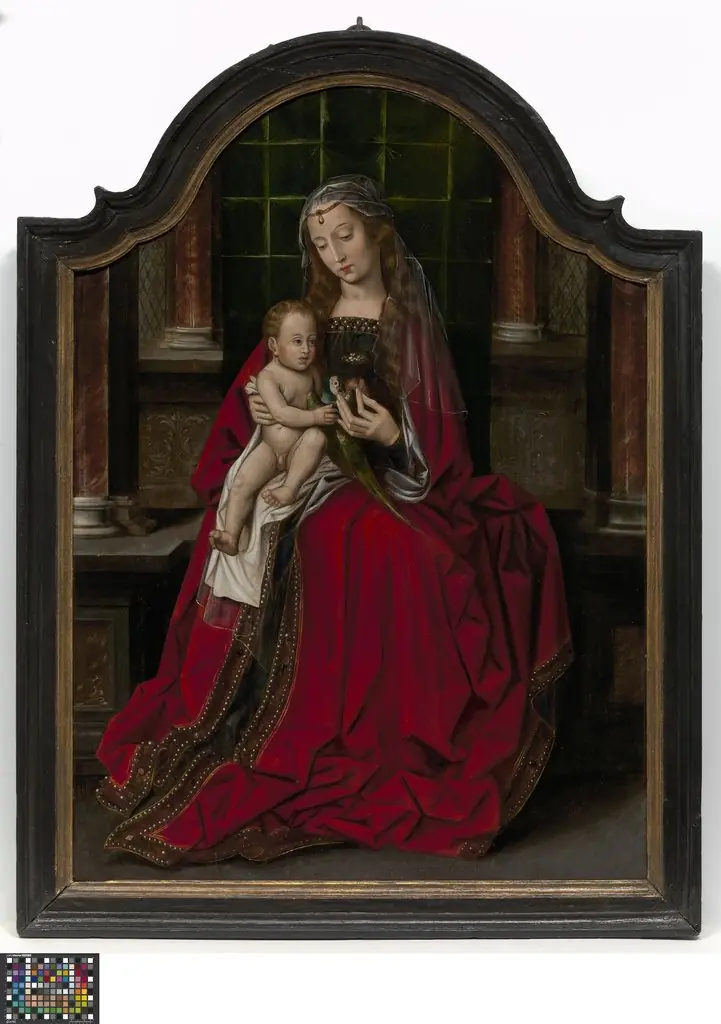
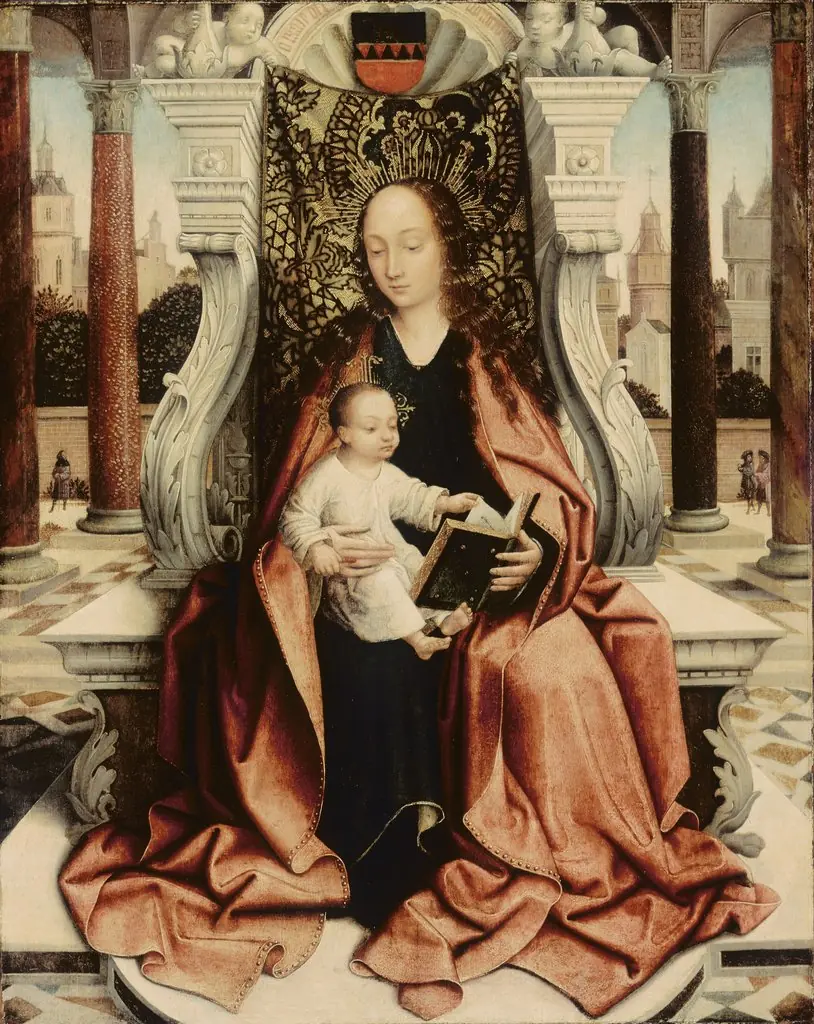
Copies made soon after van Eyck’s death, by the Master of 1499 and Jan Gossaert, attest to its immediate influence, though both altered the composition in ways critics have judged spiritually and aesthetically divergent from the original. Gossaert’s version, in particular, recasts the setting outdoors and pairs it with a donor, signaling how later artists adapted the Madonna’s hieratic form to new devotional formats while straining its distinctive interior light theology.
Overview
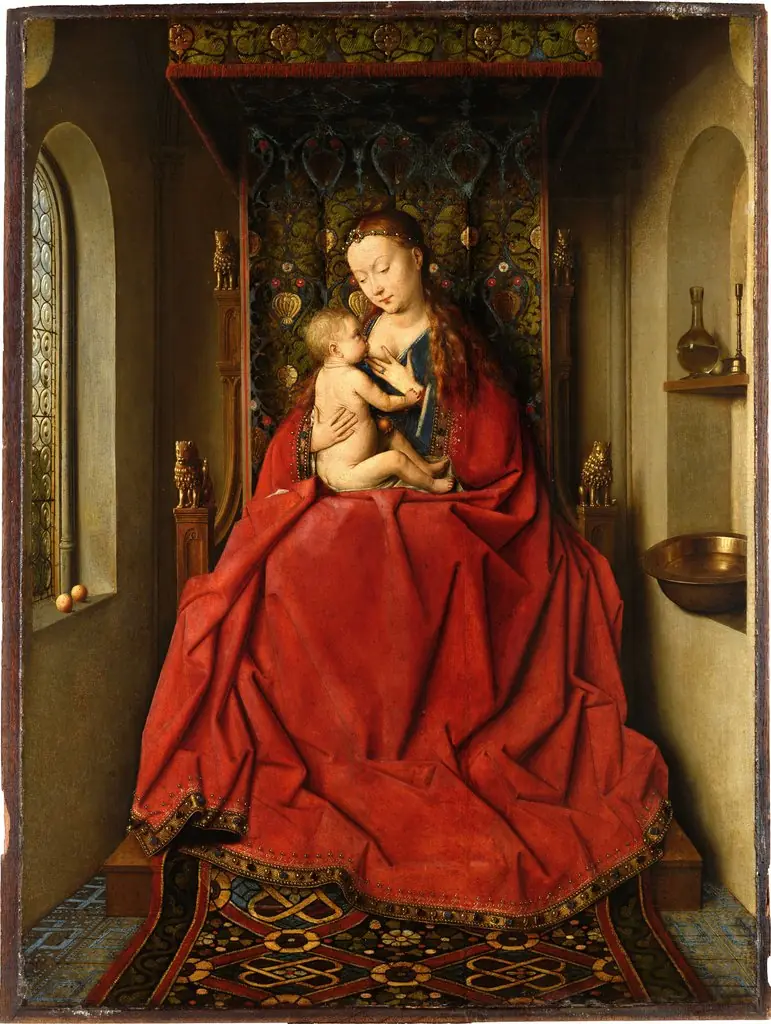
Jan van Eyck’s small panel, executed circa 1438–1440, presents the Virgin Mary seated within a Gothic cathedral, cradling the infant Christ. The composition foregrounds the figures against an interior illuminated by daylight streaming through stained‑glass windows, while architectural details such as tracery and a sculptural niche frame the scene.
Subject & Meaning
Mary is portrayed as the celestial queen, crowned with jeweled regalia and dressed in a vivid red mantle. The child’s playful grip on her neckline echoes the Byzantine Eleusa type, emphasizing tenderness and divine intimacy. Light that floods the nave is rendered symbolically, alluding to Mary’s purity and the presence of the divine.
Artist & collection

Artist
Jan van Eyck ( van EYEK; Dutch: ; c. before 1390 – 9 July 1441) was an early Netherlandish painter active in Bruges who was one of the early innovators of what became known as Early Netherlandish painting, and one of…