Artwork
Ghent Altarpiece
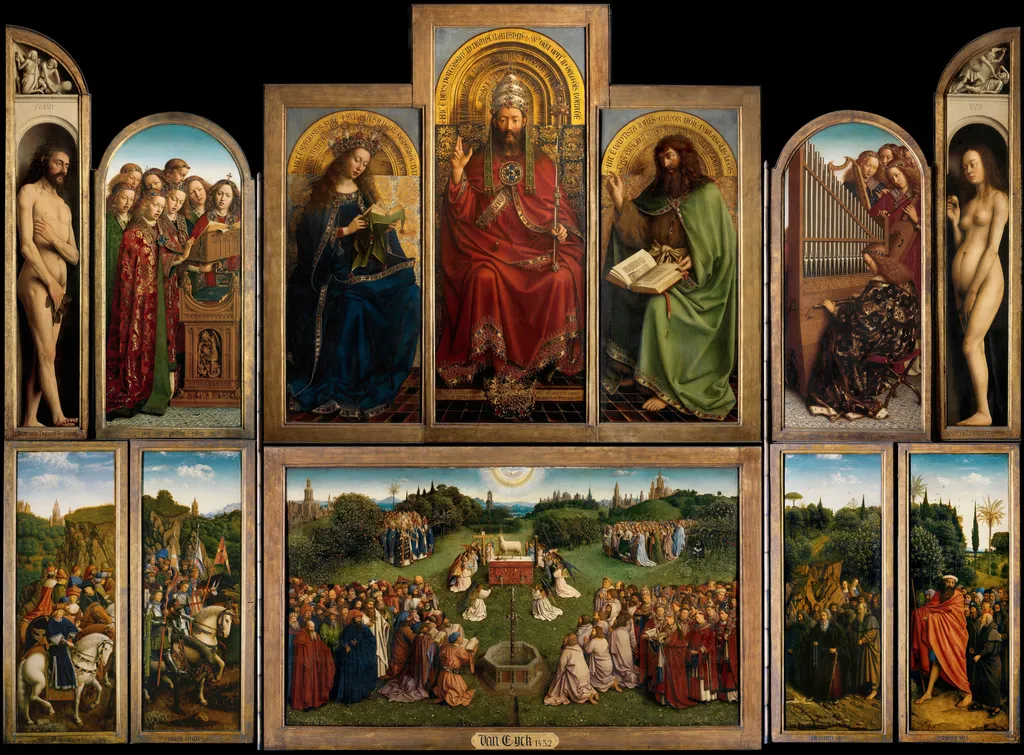
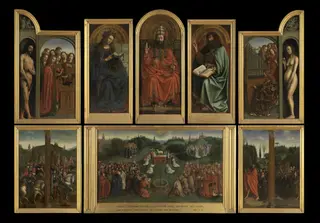
Ghent Altarpiece is an oil painting by the Northern Renaissance artist Jan van Eyck. It dates from 1432 and is held in the collection of the Solly Collection.
About this work
Subject & Meaning
The work represents a shift from medieval idealization to rigorous naturalism while maintaining deep symbolic layers regarding redemption and divine judgment.
The Ghent Altarpiece, also known as the Adoration of the Mystic Lamb, presents a complex theological narrative based on the Book of Revelation. When opened for major feast days, the interior reveals a dual register: the upper level depicts a heavenly Deësis with a central enthroned figure (interpreted as either God the Father or Christ the King) flanked by the Virgin Mary and John the Baptist, alongside singing and musical angels, Adam, and Eve. The lower register centers on the Lamb of God standing on an altar, surrounded by groups of saints, prophets, pilgrims, and soldiers, all overseen by the dove of the Holy Spirit. This vertical arrangement symbolizes the Trinity, connecting the Father, Spirit, and Son.
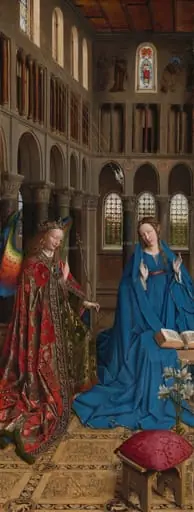
The closed exterior panels, visible on ordinary days, feature donor portraits of Joos Vijd and Elisabeth Borluut, grisaille statues of John the Baptist and John the Evangelist, and an Annunciation scene topped by prophets and sibyls holding prophetic banners. Specific iconographic details include Eve holding an etrog citrus fruit rather than a traditional apple, and John the Evangelist holding a chalice with a snake, referencing apocryphal legends. The work represents a shift from medieval idealization to rigorous naturalism while maintaining deep symbolic layers regarding redemption and divine judgment.
Technique & Style
The Ghent Altarpiece is a large polyptych executed in oil paint on oak panels, representing a seminal work of Early Netherlandish painting. The structure comprises twelve panels, eight of which are hinged to form foldable wings that reveal distinct interior and exterior scenes. When closed, the work measures approximately 375 by 260 cm, expanding to roughly 375 by 520 cm when fully opened.
Stylistically, the altarpiece marks a transition from medieval idealization to a rigorous observation of nature, utilizing atmospheric perspective rather than strict Italian linear perspective to suggest depth. The exterior features sculptural figures rendered in grisaille to mimic stone statues, contrasting with the vibrant colors of the interior registers. Although the original ornate carved frame was destroyed during the Reformation, the surviving panels display an exacting attention to optical effects and naturalistic detail.
History & Provenance
The Ghent Altarpiece was commissioned by the Ghent merchant and politician Joos Vijd and his wife Elisabeth (Lysbette) Borluut as the altarpiece for the Vijd Chapel in the church of Saint John (now St Bavo's Cathedral) in Ghent. According to a Latin quatrain inscribed on the original frame, Hubert van Eyck began the work and his brother Jan van Eyck completed it. Hubert, who is generally credited with the overall design, died in 1426; the bulk of the painting was executed between roughly 1430 and 1432.
The polyptych was officially installed on 6 May 1432, a date encoded in a chronogram on the frame and coinciding with a ceremony for Philip the Good. The richly carved outer frame, which may have included clockwork mechanisms for the wings, was destroyed during the Iconoclasm of 1566. In 1934 the lower-left panel, the Just Judges, was stolen and has never been recovered; it was replaced in 1945 by a copy.
Since 1986 the altarpiece has been displayed in a secured glass enclosure in the cathedral, moved in 2021 to the Sacrament Chapel.
The Ghent Altarpiece is permanently housed in St Bavo's Cathedral in Ghent, Belgium. It was originally installed in the Saint John's Church (now the cathedral) on 6 May 1432. Since 1986, the work has been displayed in a secured environment, initially within the cathedral's former baptistery, which was converted into a vault. In 2021, the altarpiece was relocated to the Sacrament Chapel within the same cathedral.
The work lacks a single modern museum accession number but has a documented history of ownership and movement. During the 19th century, it was owned by Lambertus Johannes Nieuwenhuys and later sold to Edward Solly. It subsequently entered the collection of Frederick William III of Prussia.
During the 19th and 20th centuries, the panels were temporarily held by the Royal Museums of Fine Arts of Belgium, the Bode Museum, and the Munich Central Collecting Point. One panel, The Just Judges, was stolen in 1934 and replaced by a copy; the original remains missing.
Context
The Ghent Altarpiece is widely recognized as a pivotal work marking the transition from Late Gothic to Early Netherlandish painting, celebrated for its technical innovation and complex iconography. Scholarship emphasizes its role as a foundational example of oil painting mastery and narrative depth, particularly through its use of naturalistic detail and symbolic storytelling. The work's reception has consistently highlighted its revolutionary impact on Western art, with art historians noting its synthesis of International Gothic, Byzantine, and Romanesque traditions into a new observational realism.
Its intricate design, attributed to Hubert van Eyck's conceptual framework and Jan van Eyck's execution, has been central to debates about authorship and artistic collaboration within the van Eyck workshop. The altarpiece's original placement in St. Bavo's Cathedral, commissioned by Joos Vijd and Lysbette Borluut for their private chapel, and its subsequent history of display and preservation, including 19th- and 20th-century restorations, underscore its enduring significance as both a devotional object and a landmark of artistic achievement.
Legacy
The Ghent Altarpiece is regarded as a cornerstone of European art history, described in scholarship as a prominent example of the transition from medieval to Renaissance art and identified by some as "the first major oil painting." It is considered a masterpiece of Early Netherlandish painting, in which the idealization of the medieval tradition gives way to exacting observation of nature and human representation. The work has long attracted sustained scholarly attention, including ongoing debate over the division of labor between Hubert and Jan van Eyck, and has been the subject of major conservation campaigns, with a multi-phase restoration underway since 2012 and continuing through 2026.
Its notoriety was heightened by the 1934 theft of the Just Judges panel, one of Belgium's most famous art crimes, which remains missing and was replaced by a 1945 copy. The altarpiece has also entered literary culture, featuring prominently in Albert Camus's novel La Chute, and its cultural reach is reflected in its inclusion in the Europeana 280 exhibition history.
Overview
The Ghent Altarpiece, also known as the Adoration of the Mystic Lamb, is a monumental polyptych that dominates the high altar of St Bavo’s Cathedral in Ghent, Belgium. Executed in oil on panels, it was begun in the mid‑1420s and finished by 1432 under the direction of the van Eyck brothers, Hubert and Jan. The work comprises a complex arrangement of hinged wings that open to reveal a richly populated religious narrative.
Own this work as a print
Artist & collection

Artist
Jan van Eyck ( van EYEK; Dutch: ; c. before 1390 – 9 July 1441) was an early Netherlandish painter active in Bruges who was one of the early innovators of what became known as Early Netherlandish painting, and one of…