Artwork
Augustus Listening to the Reading of the Aeneid
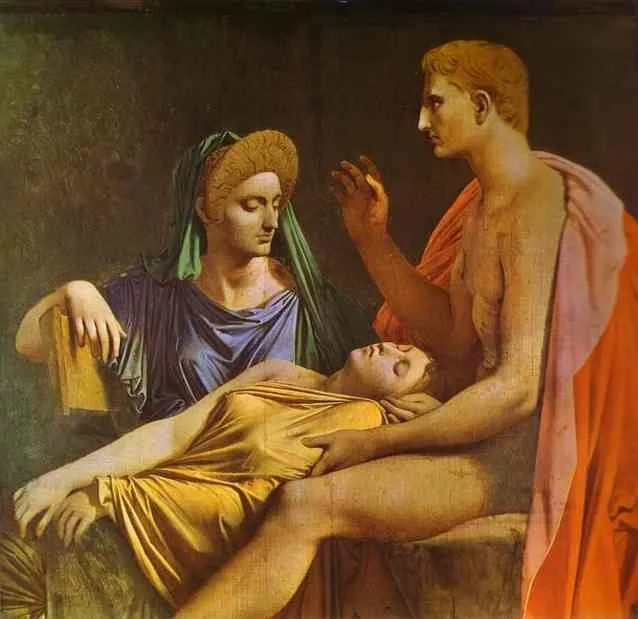
Augustus Listening to the Reading of the Aeneid is an oil painting by the Neoclassicist artist Jean Auguste Dominique Ingres. It dates from 1812 and is held in the collection of the Royal Museums of Fine Arts of Belgium.
About this work
Subject & Meaning
The narrative climax occurs when the text reveals the early death of Marcellus, the nephew and potential heir of Emperor Augustus.
The painting depicts the moment the poet Virgil reads a passage from the *Aeneid* to the imperial family, specifically the scene where Aeneas views the future souls of Rome in the underworld. The narrative climax occurs when the text reveals the early death of Marcellus, the nephew and potential heir of Emperor Augustus. Upon hearing these verses, Octavia, Marcellus's mother and Augustus's sister, faints into her brother's arms, while her sister-in-law Livia struggles to conceal her shock, as rumors suggested she orchestrated the boy's death to secure her own son Tiberius's succession. The composition includes onlookers such as Maecenas and Agrippa, who witness the emotional collapse. Ingres utilizes Pompeian-style decor and classical statuary references to evoke the antiquity of the event, emphasizing the tragic intersection of personal grief and political destiny.
Technique & Style
The painting is executed in oil paint on canvas, adhering to the neoclassical tradition of Jean-Auguste-Dominique Ingres. The larger version measures 302 cm in height and 325 cm in width, while a secondary version held in Brussels is smaller at 138 cm by 142 cm. Stylistically, the figures are rendered with a static, sculptural quality, appearing as idealized statues rather than dynamic actors. The composition employs a distinct color strategy, contrasting the cold, hard blues, yellows, and greens on one side with the warm, soft reds and pinks on the other. These primary and secondary hues are applied in a controlled manner without a background setting. The work underwent later intervention, as one of Ingres's disciples, likely a member of the Balze family, retouched the canvas under the master's supervision before it was eventually donated to the Musée des Augustins in Toulouse.
History & Provenance
The work was commissioned in 1812 by General Sextius Alexandre François de Miollis, then French governor of Rome, for his bedroom in the Villa Aldobrandini; its subject reflects Miollis’s enthusiasm for Virgil’s Aeneid. After Miollis’s ownership, the painting passed to Francesco Borghese before Ingres repurchased it in 1835 and brought it to Paris. Ingres later entrusted retouching to one of his pupils, likely Paul or Raymond Balze, under his supervision.
Ingres donated the painting to the Musée des Augustins in Toulouse, where it entered the collection in 1868 and underwent restoration by Pierre-Auguste Pichon, another of his disciples.
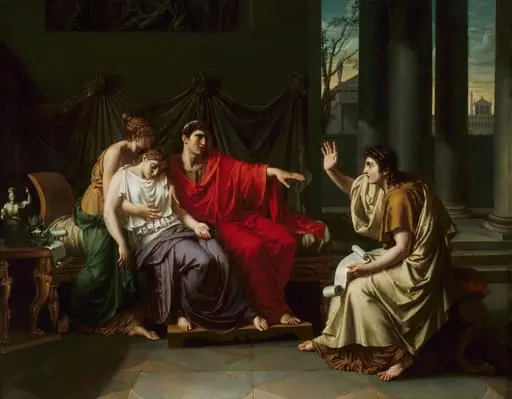
Jean-Auguste-Dominique Ingres created two distinct versions of this subject, each held in a different public collection. The larger composition, titled *Virgilio lee la Eneida a Livia, Octavia y Augusto*, is located in the Musée des Augustins in Toulouse, France, where it bears the inventory number RO 124. This work entered the museum in 1868 following the artist's donation. A second, smaller version measuring 138 by 142 cm is held by the Royal Museums of Fine Arts of Belgium in Brussels, specifically within the Oldmasters Museum. This Belgian variant was acquired by the museum after being purchased at auction following Ingres's death in 1867.
Context
Critical reception of Ingres' Augustus Listening to the Reading of the Aeneid emphasizes its neoclassical rigor and mythological gravitas, positioning it within the academic tradition while subtly foreshadowing romantic expression. Scholarship highlights the work's engagement with Augustan ideology, particularly the poignant depiction of Octavia's faintness as a narrative device reflecting Suetonius' account and Virgil's Aeneid (6.883), where the premature death of Marcellus shapes imperial succession. The painting's formal qualities, its stark color contrasts, idealized nudity, and archaeological precision in drapery and furniture, were noted by contemporaries like Amaury-Duval, who observed it in Ingres' studio, and later by Daniel Ternois, who linked it to a larger envisioned decoration for the Quirinal Palace. Its provenance reflects a complex journey: commissioned in 1812 by General Miollis, acquired by Borghese, reclaimed by Ingres, and ultimately donated to the Musée des Augustins in Toulouse in 1868, where it was restored by Pichon. This version, distinct from the smaller Brussels study (138 x 142 cm), was likely part of a planned decorative scheme for Napoleon's era, underscoring Ingres' role in bridging neoclassicism and emerging romantic sensibilities through historical narrative.
Artist & collection

Artist
Jean-Auguste-Dominique Ingres was a French Neoclassical painter. Ingres was profoundly influenced by past artistic traditions and aspired to become the guardian of academic orthodoxy against the ascendant Romantic…

Museum
Royal Museums of Fine Arts of Belgium
Continue through works from the same source collection.