Artwork
Christ in the House of Martha and Mary
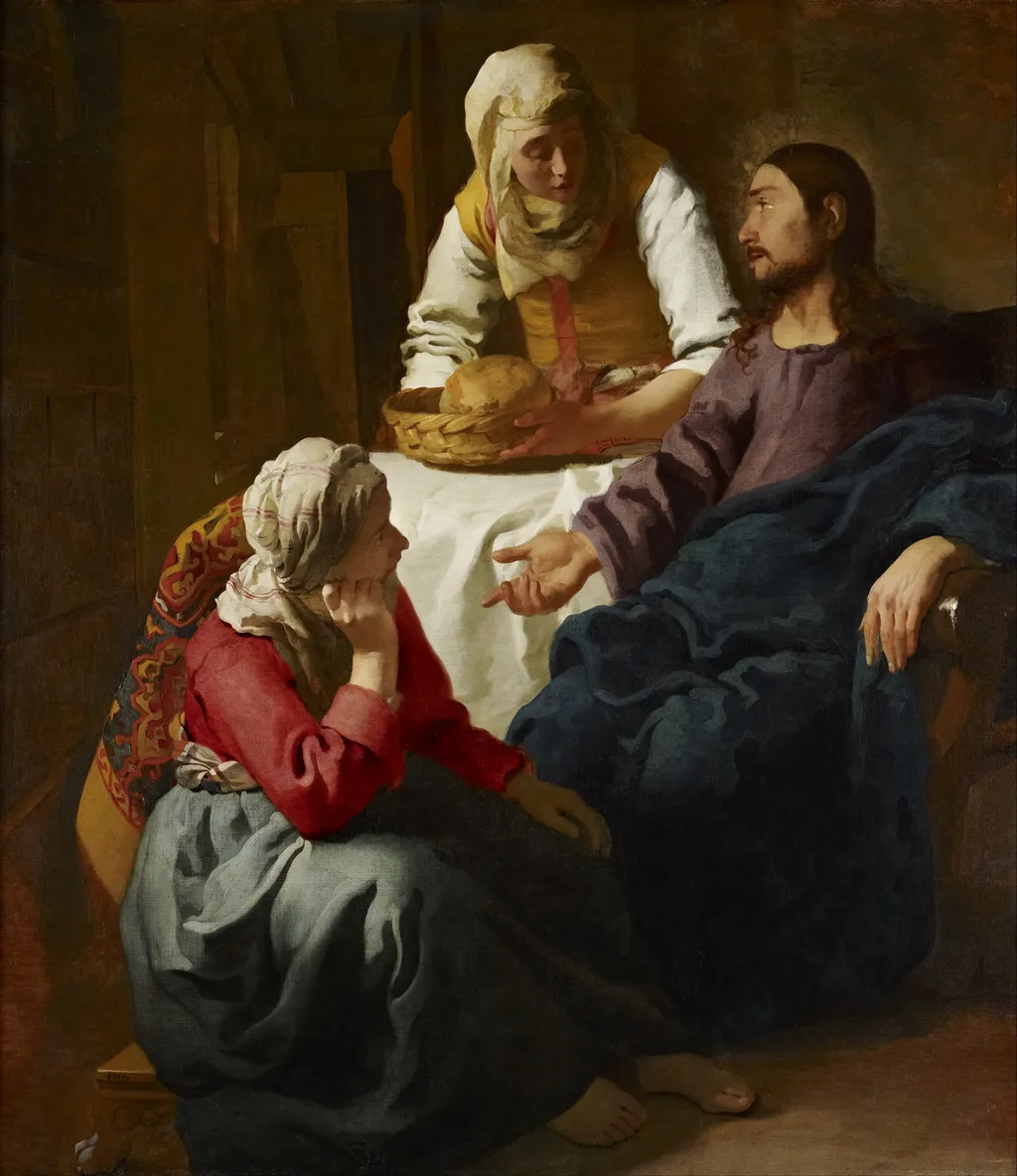
Christ in the House of Martha and Mary is an oil painting by the Dutch Golden Age artist Johannes Vermeer. It dates from 1650 and is held in the collection of the Scottish National Gallery.
About this work
Subject & Meaning
Mary is shown barefoot as a sign of humility, while Christ's outstretched arm points toward her, indicating that she has chosen the spiritually superior path.
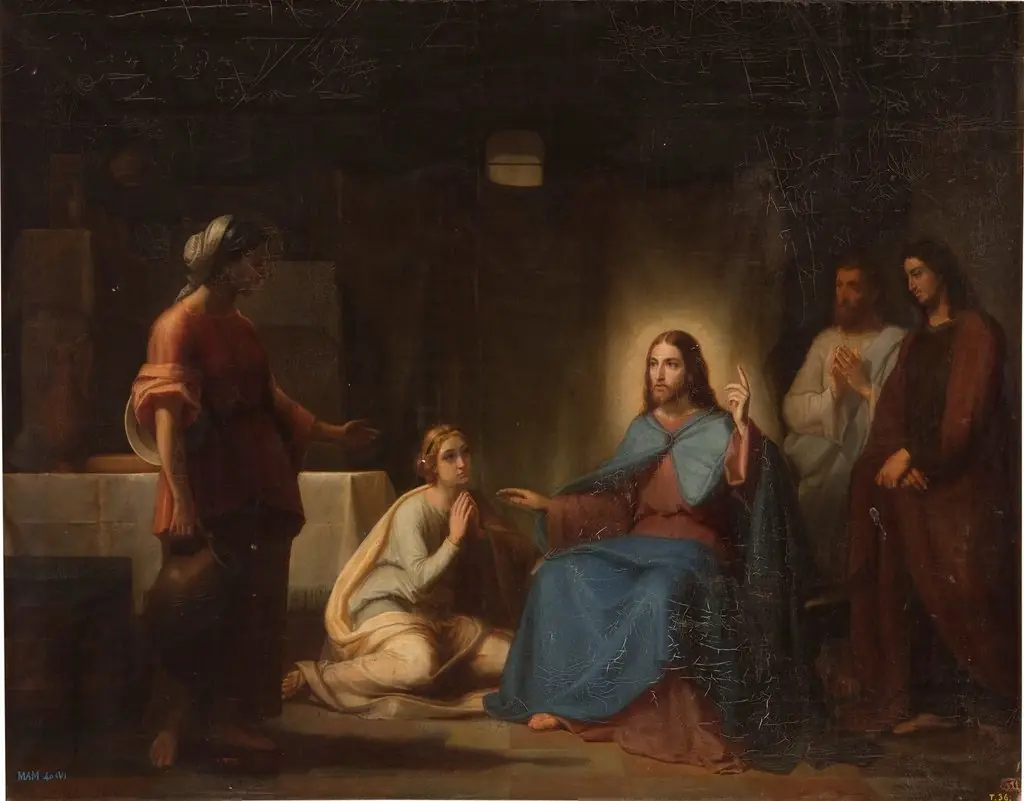
The painting depicts the New Testament episode from the Gospel of Luke (10:38–42) in which Jesus visits the household of Martha and Mary of Bethany, sisters of Lazarus. Vermeer captures the moment when Christ rebukes Martha for being distracted by domestic tasks and commends Mary, who sits at his feet listening to his words. The composition arranges the three figures in a pyramidal scheme: Martha stands behind the table holding a basket of bread, Christ sits on a chair with a faint halo, and Mary sits on a low stool in the foreground, her head resting on her hand in a gesture of contemplative attentiveness.
Mary is shown barefoot as a sign of humility, while Christ's outstretched arm points toward her, indicating that she has chosen the spiritually superior path.
The work is one of Vermeer's rare religious paintings and the only known canvas with an overt biblical subject, reflecting the influence of the Utrecht Caravaggisti, particularly ter Brugghen and Bloemaert. The bread in Martha's basket and the arrangement around a table have been read as evoking the Eucharist and the Last Supper. Primary-color contrasts of white, red, and blue underscore the spiritual hierarchy of the figures.
Technique & Style
Executed in oil on canvas, this work is the largest painting by Johannes Vermeer, measuring 158.5 cm in height and 141.5 cm in width. Pigment analysis confirms the use of baroque materials including madder lake, yellow ochre, vermilion, and lead white. Distinctively, the artist did not employ his preferred ultramarine for Christ's robe; instead, the garment is rendered using a mixture of smalt, indigo, and lead white.
The composition features bold color contrasts between the white tablecloth, Mary's red dress, and the blue of Christ's tunic. Stylistically, the painting exhibits a somber, grey background and a pyramidal arrangement of figures, reflecting the influence of Utrecht Caravaggists. The handling of light is subtle, with a faint halo around Christ's head and specific illumination on his open hand, diverging from the bright, airy interiors typical of Vermeer's later works.
Restoration work conducted in 1901 revealed the artist's signature, which had previously gone unrecognized. The surface displays a relatively simple spatial construction with wooden walls that avoid distracting details, focusing attention on the psychological intensity of the figures. The floor and background are rendered in dark, brown tones, creating a stark contrast to the brightly lit foreground where the primary action occurs.
History & Provenance
The painting was created by Johannes Vermeer around 1655, depicting a biblical scene from Luke 10:38–42. It entered the collection of William Allan Coats, who owned it by 1901, and was later gifted to the Scottish National Gallery in 1927 by his sons in memory of their father. Prior to Coats' ownership, the work was documented in the collection of the Abbot family in Bristol around 1880 and had been sold by an antiquarian in 1884.
The painting, Vermeer's largest surviving work, was acquired by Arthur Leslie Colley in 1901 for 140 pounds from Forbes & Paterson and subsequently passed to William Allan Coats.
The painting is held by the Scottish National Gallery in Edinburgh. Its accession number is NG 1670. It entered the collection in 1927 as a bequest from the sons of William A. Coats, presented in memory of their father.
The work has been exhibited in the gallery’s Vermeer exhibition, The Young Vermeer. Its dimensions are 158.5 cm in height and 141.5 cm in width.
Context
Vermeer’s Christ in the House of Martha and Mary stands apart in his oeuvre for its overt religious subject and scale, executed early in his career around 1654–1656. The painting’s composition and palette show the influence of Utrecht Caravaggisti such as Hendrick ter Brugghen and Abraham Bloemaert, evident in its strong chiaroscuro and figural arrangement. Critical commentary has noted the awkward foreshortening of Christ’s right shoulder and the abbreviated spatial setting, yet also praised the work’s warm, luminous harmony as a harbinger of the serene, blonde light that later defines Vermeer’s mature style.
The work’s reception has long centered on its theological resonance, the privileging of contemplation over domestic labor, reflecting Counter-Reformation emphases on inner devotion. Pigment analysis confirms the use of period materials including madder lake, yellow ochre, vermilion, and lead white, with Christ’s drapery rendered in smalt, indigo, and lead white rather than the artist’s customary ultramarine.
Overview
Completed in 1655, this oil on canvas by Johannes Vermeer measures roughly 63 by 56 inches, making it the artist’s largest known work. It is housed in the Scottish National Gallery, Edinburgh, and stands out among Vermeer’s oeuvre for its explicit biblical narrative, a rarity in his typically domestic scenes.
Own this work as a print
Artist & collection
Artist
Johannes Vermeer ( vər-MEER, vər-MAIR, Dutch:; see below; also known as Jan Vermeer; October 1632 – 15 December 1675) was a Dutch painter who specialized in domestic interior scenes of middle-class life.