Artwork
Untitled
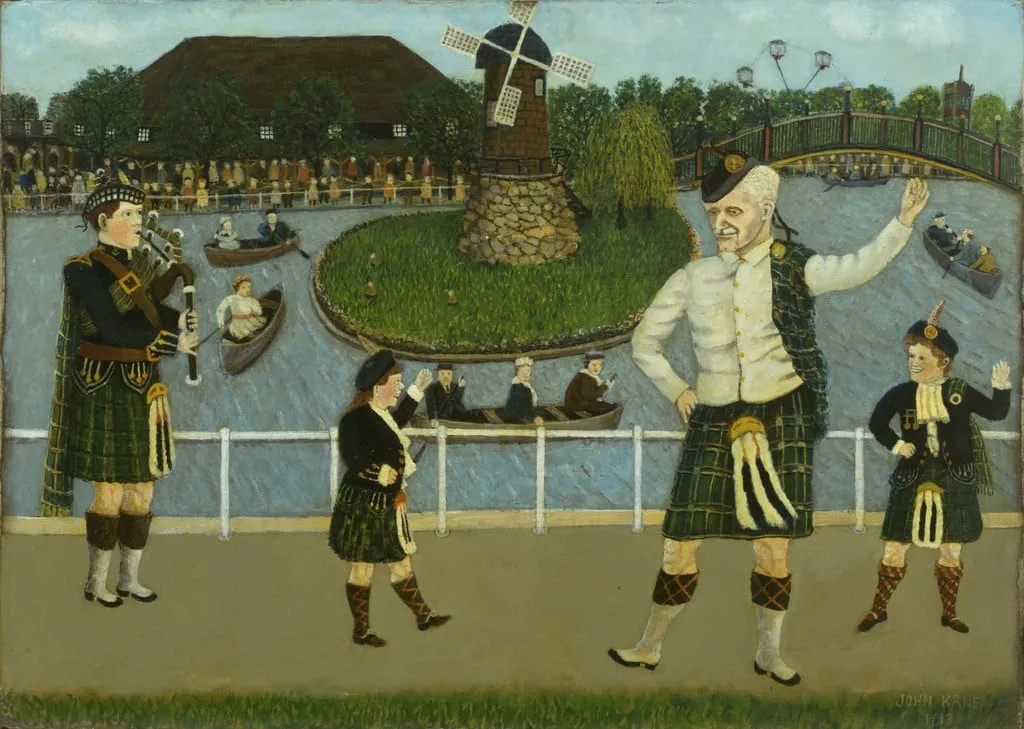
Untitled is an oil painting by the Regionalist artist John Kane. It dates from 1933 and is held in the collection of the Museum of Modern Art.
About this work
Overview
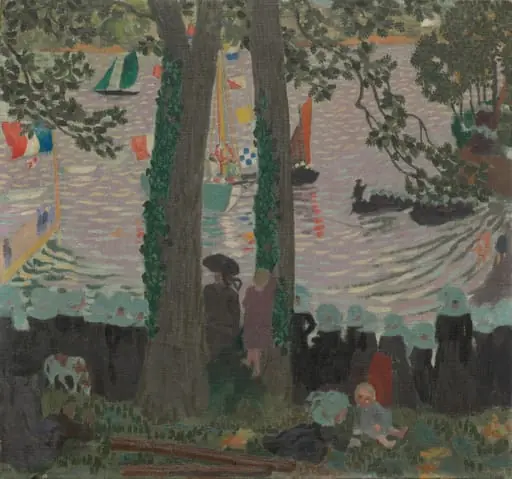
Painted in 1933, this oil on canvas work by John Kane is part of The Museum of Modern Art’s collection. It captures a moment of communal celebration in a Scottish-inspired setting, rendered with vivid color and unrefined spatial logic. The scene unfolds along a narrow waterfront promenade, where figures and landscape elements are arranged with rhythmic intensity rather than strict perspective.
Subject & Meaning
Four men in traditional Highland dress are depicted in active motion: one plays the bagpipes, another gestures outward, while the others stand attentively.
Four men in traditional Highland dress are depicted in active motion: one plays the bagpipes, another gestures outward, while the others stand attentively. Their attire, dark green kilts with yellow stripes, white shirts, and vests, suggests ceremonial dress. The presence of boats, a windmill, and a bridge implies a coastal village setting. The scene conveys a sense of shared cultural pride, possibly tied to a local festival or procession.
Technique & Style
Kane employed bold, flat areas of color and simplified forms to convey movement and emotion. Brushwork is direct and unpolished, with no attempt at academic realism. The sky, water, and figures are rendered with equal emphasis, creating a flattened pictorial space. This approach, rooted in folk sensibility, prioritizes expressive energy over spatial accuracy.
History & Provenance
Created during Kane’s mature period, the painting was acquired by The Museum of Modern Art shortly after its completion. Kane, a self-taught artist from Pittsburgh, gained recognition in the early 1930s for his depictions of working-class life and ethnic traditions. This work entered MoMA’s collection as part of a broader interest in American folk art during that decade.
Context
Kane’s work emerged amid a 1930s American interest in regional identity and vernacular culture. Though he never traveled to Scotland, his imagery drew from immigrant communities in Pittsburgh, where Scottish heritage was preserved in festivals and parades. His paintings reflect personal memory and community ritual rather than ethnographic accuracy.
Legacy
Kane’s paintings, including this one, helped expand the definition of American art in the early 20th century by validating non-academic modes of representation. His work influenced later generations of self-taught artists and contributed to the institutional recognition of folk art within major museums.
Artist & collection