Artwork
Watson and the Shark
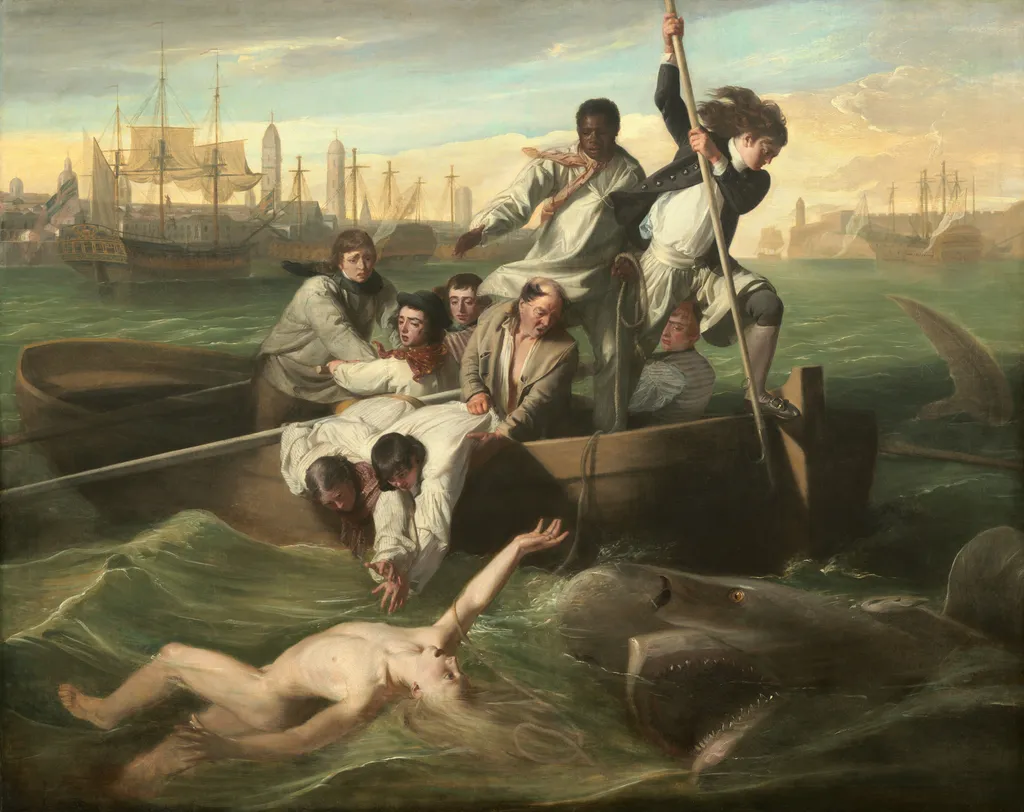
Watson and the Shark is an oil painting by the French Romanticist artist John Singleton Copley. It dates from 1790 and is held in the collection of the Museum of Fine Arts Boston.
About this work
Subject & Meaning
Watson commissioned it decades after surviving the ordeal as a lesson on integrity, exertion, and reliance on providence for the youth of Christ's Hospital.
The painting depicts the 1749 rescue of Brook Watson, a fourteen-year-old cabin boy, from a shark attack in Havana Harbour. Copley shows the final rescue attempt, with Watson naked and helpless in the water as a boatman prepares to spear the approaching shark with a pike pole. Though based on a real event in which Watson lost his right leg, Copley romanticized the scene by hiding the gruesome injury beneath the waves, revealing only a hint of blood.
The work functions as a moral allegory rather than a strict documentary record. Watson commissioned it decades after surviving the ordeal as a lesson on integrity, exertion, and reliance on providence for the youth of Christ's Hospital. Iconographically, Copley drew on diverse sources: Watson's pose references the classical Borghese Gladiator, while the rescuers' expressions of fear and courage draw on Charles Le Brun's theory of expression.
The composition also incorporates elements from Renaissance religious scenes and includes a Black sailor, a figure altered during the painting's development from an initial conception as a white man.
Technique & Style
Copley's 1778 oil on canvas presents a tightly orchestrated composition in which nine rescuers crowd a small boat, their postures and facial expressions, from terror to resolve, derived from Charles Le Brun's theory of expression. The central drama pivots on the nude youth, Brook Watson, floating between boat and shark, the wound's gore suppressed beneath the waves while a thin red streak tints the water. The shark, anatomically inconsistent with forward-facing eyes and "nostrils" exhaling air, was likely assembled from prints rather than observed life, while Morro Castle anchors the distant harbour.
Infrared reflectography reveals pentimenti: the boatswain was originally younger, and the Black sailor at the stern was reworked from a long-haired white figure, later realized as the subject of Copley's contemporaneous Head of a Negro. The handling combines smooth modelling of flesh and drapery with crisp detailing of rigging and oars, conveying palpable urgency within a controlled, stage-like space.
History & Provenance
Commissioned by Brook Watson roughly twenty-five years after he survived a shark attack in Havana Harbour in 1749, John Singleton Copley painted the first version of this history painting in London in 1778 and exhibited it at the Royal Academy that same year. On Watson's death in 1807 he bequeathed the canvas to Christ's Hospital in London as a moral lesson for youth; the school accepted it in 1819, installed it in its great hall, and later moved it to Horsham, Sussex. In 1963 the school sold it to the National Gallery of Art, Washington, D.C., where it is accessioned as 1963.10.1.
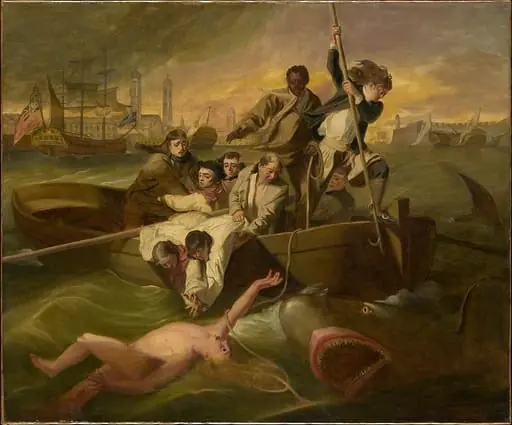
Copley produced two further versions: a full-size replica of 1778, kept for his own use, which passed through several collections before being donated to the Museum of Fine Arts, Boston, in 1889 (accession 89.364); and a smaller, vertically oriented variant of 1782, originally owned by Noël Desenfans, acquired by the Detroit Institute of Arts in 1946 (accession 46.32).
Context
Watson and the Shark (1778) marks a pivotal shift in Copley's career from portraiture to large-scale history painting after his move to London. It is recognized as a pre-Romantic work that dramatizes a contemporary event rather than a biblical or classical subject, following the precedent set by Benjamin West's The Death of General Wolfe. Copley synthesized diverse influences, modelling the victim on the Borghese Gladiator and echoing the emotional intensity of the Laocoön, while the boat's composition recalls works by Rubens and Raphael.
Though the shark's anatomy is fantastical, the painting established Copley's reputation for merging factual narrative with dramatic, romanticized spectacle.
Legacy
A mezzotint after the painting was published by Valentine Green in May 1779, extending its reach beyond the original canvas. Watson bequeathed the 1778 version to Christ's Hospital at his death in 1807, intending it as "a most useful Lesson to Youth"; the school placed it in its great hall in 1819 and later moved it to the Dining Hall at Horsham, Sussex, before selling it to the National Gallery of Art in 1963. Copley's second full-size replica was donated to the Museum of Fine Arts, Boston, in 1889, and the smaller 1782 version was acquired by the Detroit Institute of Arts in 1946.
The Metropolitan Museum of Art holds a related oil study, and copies after Copley survive in collections including the Birmingham Museums Trust, the Wellcome Collection, and the Beaverbrook Art Gallery in Fredericton.
Overview
John Singleton Copley’s oil work titled Watson and the Shark captures a moment of rescue in Havana Harbor, where a young cabin boy is being hauled from the sea while a shark clutches his leg. The composition places the struggling figure in the foreground, surrounded by several rescuers in a small boat, with distant ships and shoreline structures framing the scene.
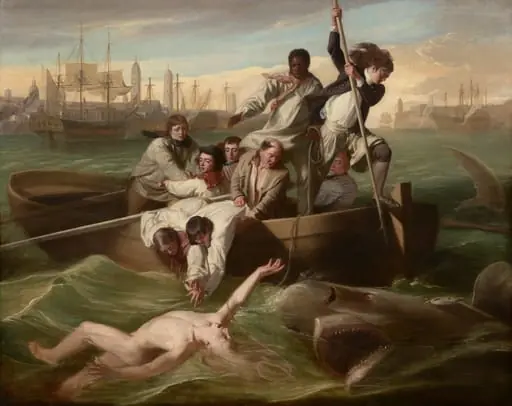
Own this work as a print
Artist & collection

Artist
John Singleton Copley (July 3, 1738 – September 9, 1815) was an American-born British painter active in both the Thirteen Colonies and England.




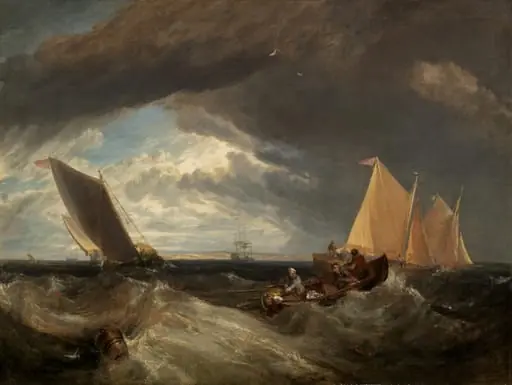 The Junction of the Thames and the Medway
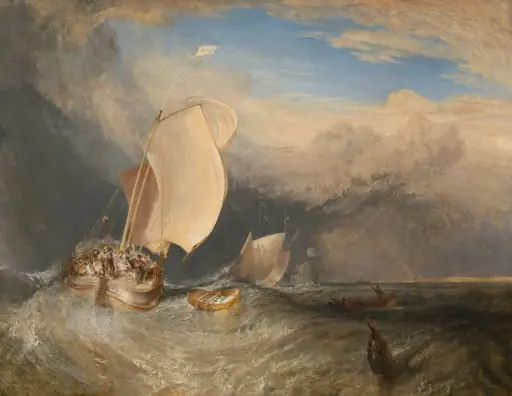 Fishing Boats with Hucksters Bargaining for Fish
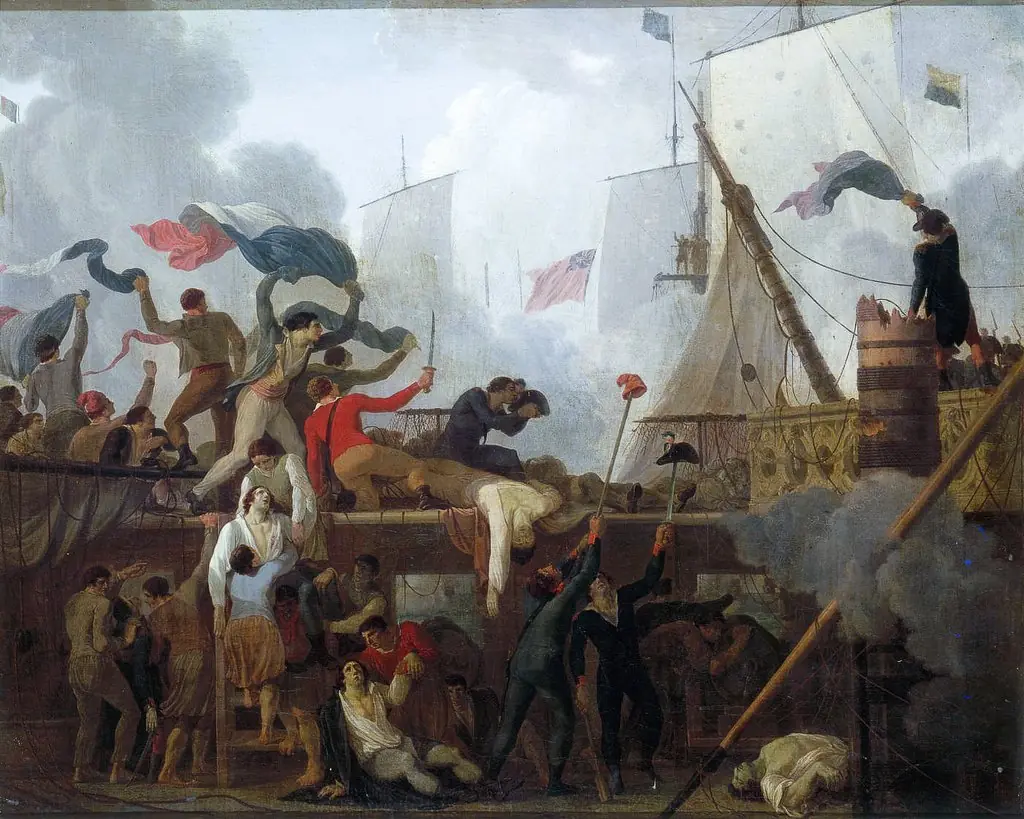 Héroïsme des marins du vaisseau Le Vengeur commandés par le capitaine Renaudin
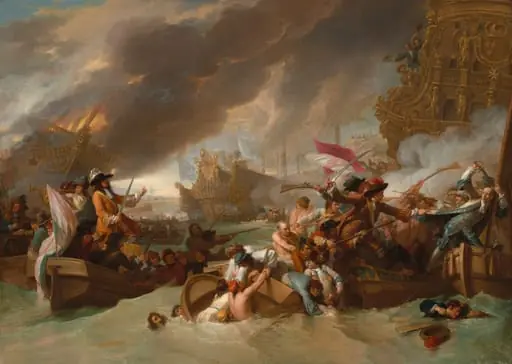 The Battle of La Hogue
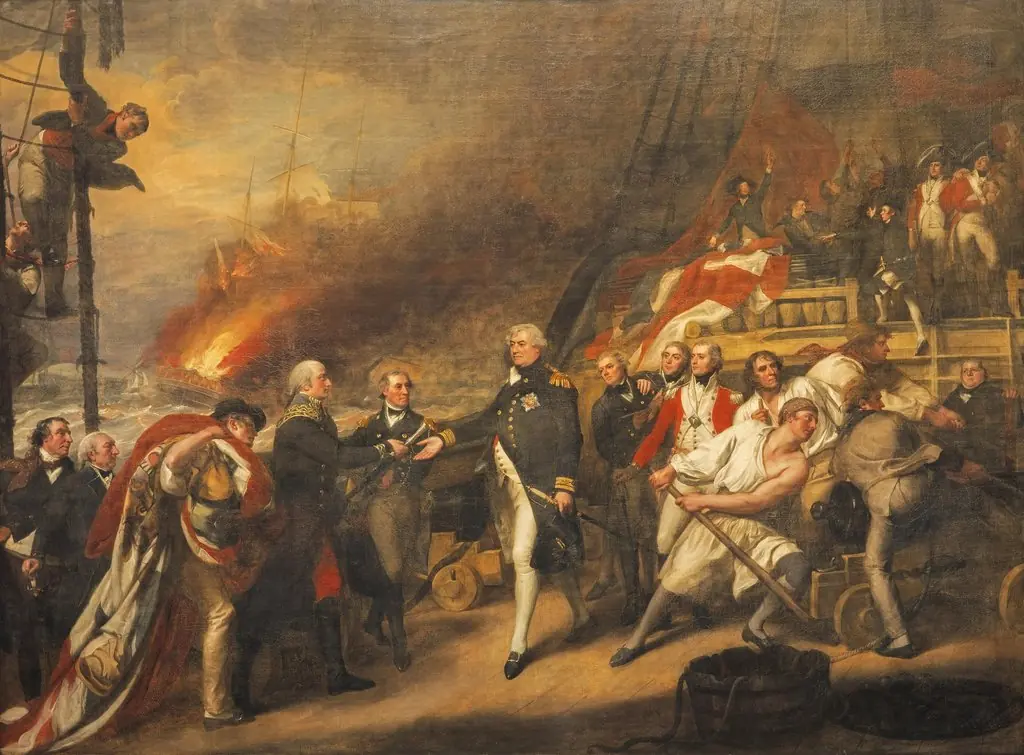 The Surrender of the Dutch Admiral de Winter to Admiral Duncan at the Battle of Camperdown (The Victory of Lord Duncan)
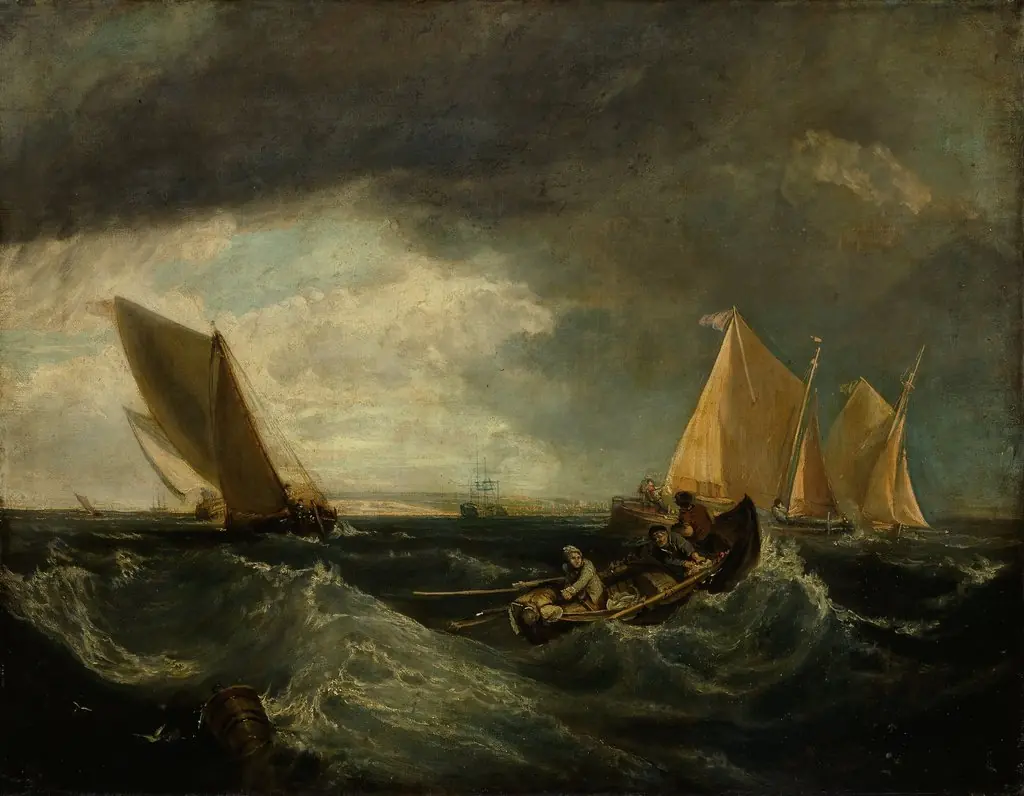 Sheerness and the Isle of Sheppey (after J.M.W. Turner)
 Rising of a Thunderstorm at Sea