Artwork
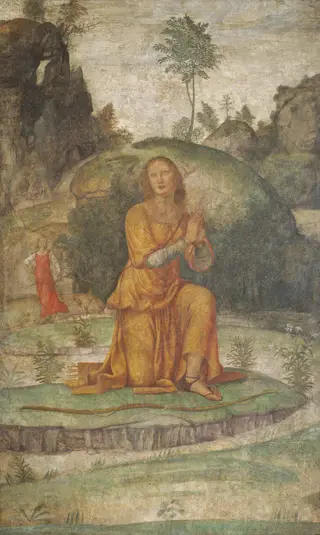
Procris and the Unicorn
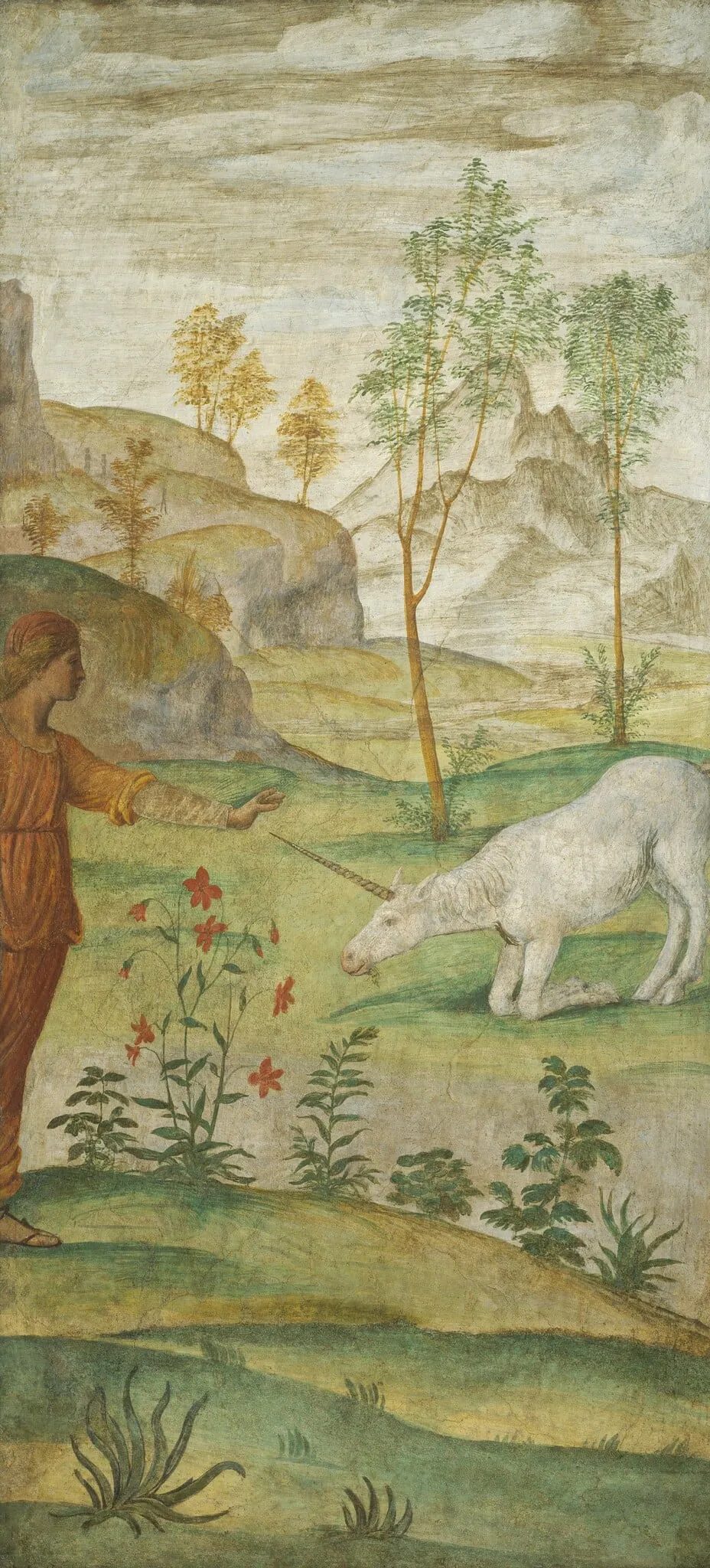
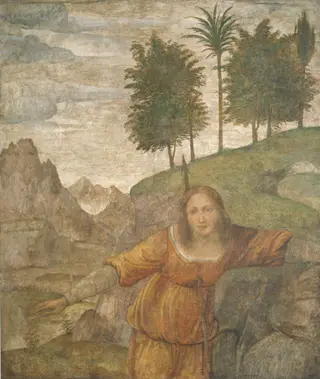
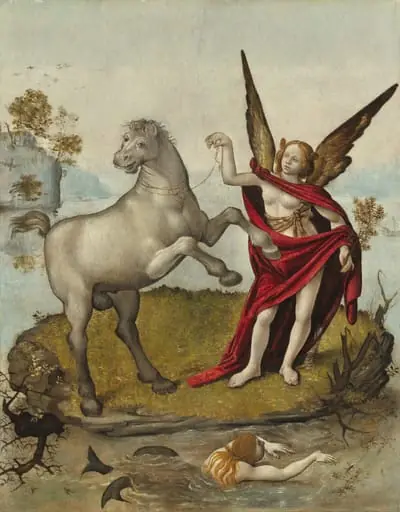
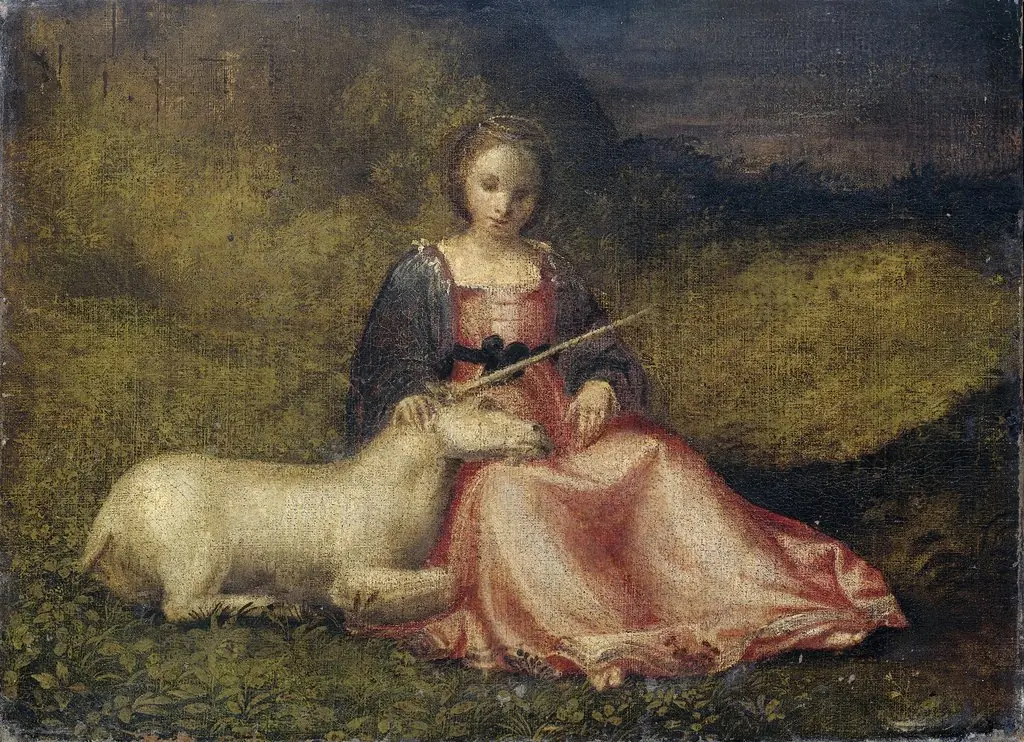
Procris and the Unicorn is a fresco painting by the Mannerist artist Luini Bernardino. It dates from 1521 and is held in the collection of the National Gallery of Art.
About this work
Subject & Meaning
The pairing with a unicorn, a creature of medieval and Renaissance lore associated with purity and rarity, lends the scene an air of symbolic gravity.
Bernardino Luini's fresco depicts the mythological figure Procris alongside a unicorn, as identified in the work's iconographic record. In Ovid's narrative, Procris was the wife of Cephalus, killed by her husband's javelin during a hunting encounter; her tragic story was a frequent subject in Renaissance art. The pairing with a unicorn, a creature of medieval and Renaissance lore associated with purity and rarity, lends the scene an air of symbolic gravity.
Luini's treatment reflects early sixteenth-century Lombard interest in classical Ovidian subjects rendered with delicate, Leonardesque grace. Commissioned by Gerolamo Rabia, the fresco was part of a decorative cycle intended for a domestic setting, where mythological narratives conveyed both humanist learning and moral reflection to elite patrons.
History & Provenance
Procris and the Unicorn was commissioned around 1522 by Gerolamo Rabia, either for the Casa Rabia on Milan's Piazza San Sepolcro or for his country house, La Pelucca, near Monza. According to Shapley, if the frescoes were installed in the Casa Rabia, the property passed out of the family around 1530, but the paintings remained in situ until approximately 1800; subsequent owners of the house included the Palletta and Silva families. The fresco later entered the collection of the Milanese lawyer Michele Cavaleri, who assembled what became known as the Cavaleri Museum and sold the entire collection to Enrico (Henri) Cernuschi on 13 April 1873.
Cernuschi, based in Paris and Menton, retained the work until at least 1895. It subsequently passed through Charles Sedelmeyer by 1897 and Rodolphe Kann by 1900, entering Kann's estate and being sold in 1907 to Duveen Brothers. In 1942 the Duveen firm sold it to the Samuel H. Kress Foundation, which gifted it to the National Gallery of Art in 1943.
The fresco Procris and the Unicorn, painted by Bernardino Luini around 1520, entered the National Gallery of Art in Washington, D.C., as part of the Samuel H. Kress Collection; it is accessioned under that collection. The museum acquired the work in 1942 from the Duveen Brothers and received it as a gift in 1943. Its earlier history follows a documented provenance that begins with a commission by Gerolamo Rabia in the 1520s, passes through the Cavaleri collection and the ownership of Enrico Cernuschi, and later includes sales to Rodolphe Kann and Duveen before the Kress Foundation obtained it.
Context
Bernardino Luini’s fresco Procris and the Unicorn (c. 1520) exemplifies High Renaissance narrative painting in Lombardy. Originally commissioned circa 1522 for the Casa Rabia in Milan, the work later entered the collection of Enrico Cernuschi and was acquired by the Samuel H. Kress Foundation in 1942, eventually gifting to the National Gallery of Art in 1943. Scholars such as Fern Rusk Shapley and Luca Beltrami have documented its provenance and artistic significance, situating it within Luini’s synthesis of Leonardo‑inspired composition and Venetian colorism.
The fresco’s mythological subject, rendered in fresco technique, reflects the cultural patronage of Milanese elites and underscores the diffusion of unicorn iconography in Renaissance art.
Legacy
The fresco remained in private hands through the 19th and early 20th centuries, passing from the Cavaleri collection to Enrico Cernuschi and later to Rodolphe Kann before being acquired by the Duveen brothers in 1907. In 1942 it was purchased by the Samuel H. Kress Foundation, New York, and the following year donated to the National Gallery of Art, Washington, D.C., where it forms part of the Kress Collection. Its continued presence in a major American museum has secured Bernardino Luini’s work a lasting place in the public consciousness and scholarly discourse.
Overview
This fresco, titled "Procris and the Unicorn," illustrates a moment from Greek mythology. It portrays Procris, a figure from Ovid's Metamorphoses, kneeling beside a unicorn. She holds the animal's horn while resting one hand on its neck.
A male figure, clad in green, stands observing the scene from behind, adding a layer of narrative tension to the composition.
Technique & Style
The painting was created using the fresco technique, which accounts for the remarkable preservation of its colors, remaining bright and vivid after approximately 500 years. Stylistically, the composition exhibits a relatively flat appearance. However, the artist skillfully employed sharp, defined shadows to introduce a degree of three-dimensionality and visual interest to the figures and their surroundings.
Artist & collection
Artist
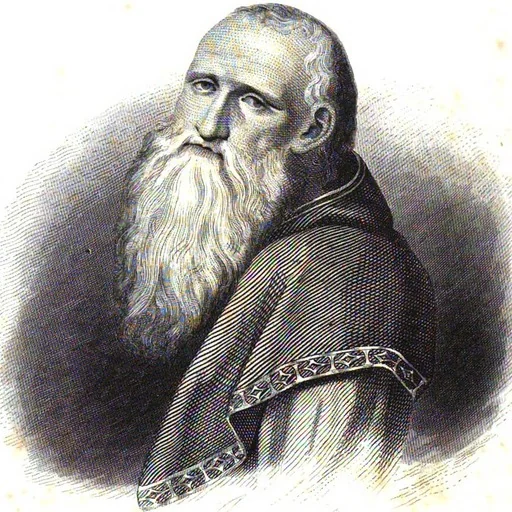
Bernardino Luini (c. 1480/82 – June 1532) was a north Italian painter from Leonardo's circle during the High Renaissance. Both Luini and Giovanni Antonio Boltraffio were said to have worked with Leonardo directly; he…