Artwork
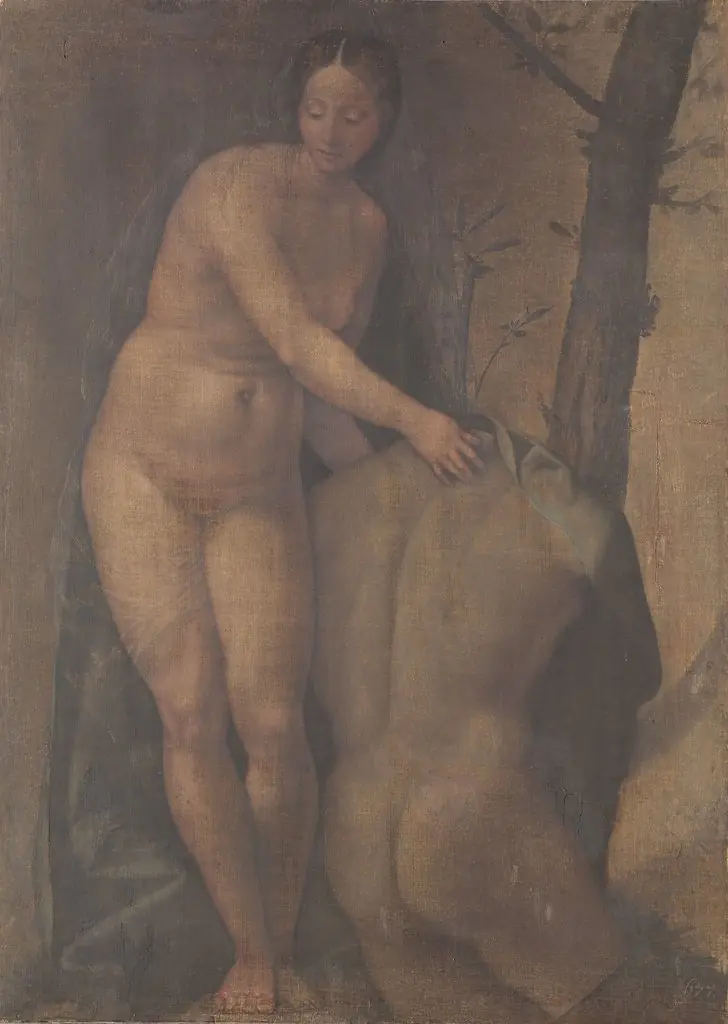
Procris Pierced by Cephalus' Javelin
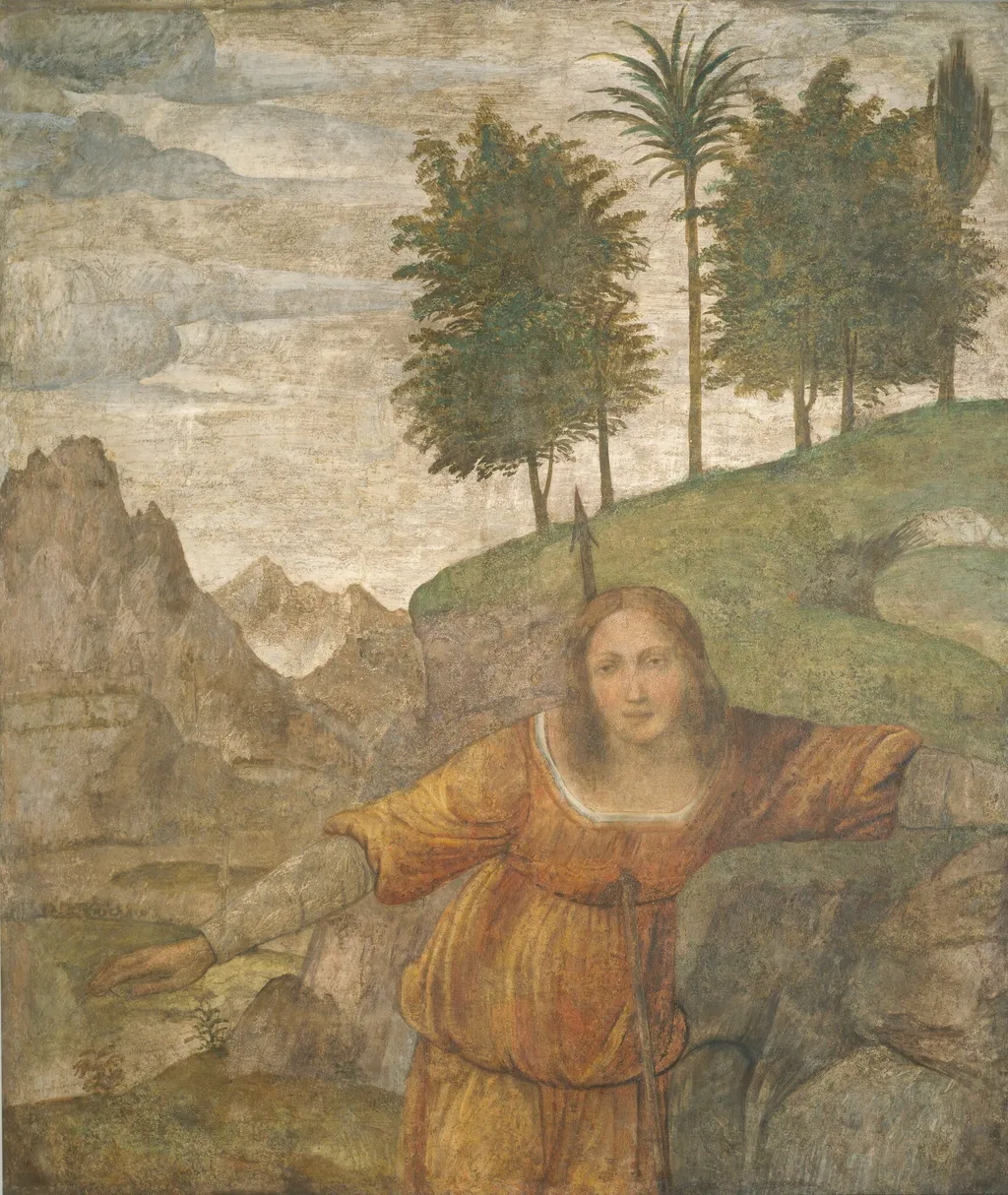
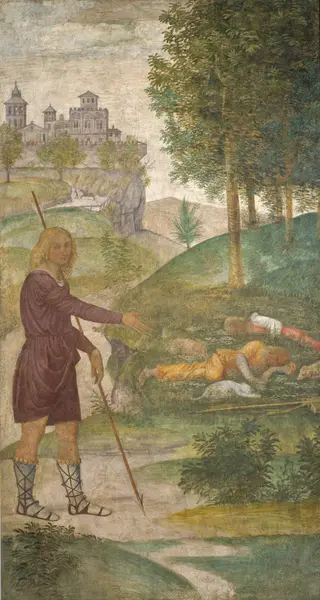
Procris Pierced by Cephalus' Javelin is a fresco painting by the Mannerist artist Luini Bernardino. It dates from 1521 and is held in the collection of the National Gallery of Art.
About this work
Subject & Meaning
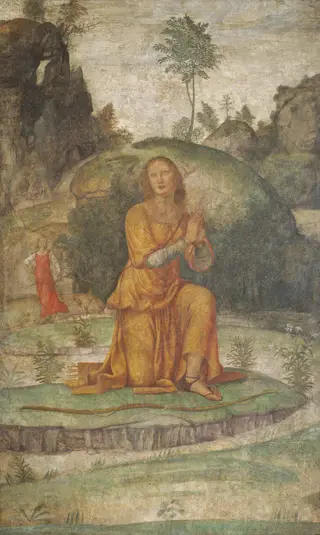
The fresco depicts the Ovidian myth of Procris, who is pierced by the javelin of her husband Cephalus during a hunting accident.
The fresco depicts the Ovidian myth of Procris, who is pierced by the javelin of her husband Cephalus during a hunting accident. Luini visualizes the moment in a wooded landscape where Cephalus, unaware of Procris's disguise, hurls his spear toward a rustling sound; Procris, concealed among trees, is struck and collapses. The composition emphasizes the tragic misunderstanding through the diagonal thrust of the spear and the staggered fall of Procris, while the surrounding foliage underscores the fatal collision between human error and natural setting.
The scene functions as a moral exemplum on the consequences of misjudgment and the fragility of life, aligning with Renaissance humanist readings of classical texts that warned against unchecked passion and careless action.
Technique & Style
Executed in 1521, this work is a fresco by Bernardino Luini, measuring approximately 144.1 centimeters in height and 123.2 centimeters in width. The composition sets the mythological narrative within a naturalistic landscape of mountains and trees, and centrally includes the spear referencing the fatal javelin from the story of Procris and Cephalus. As a fresco, the pigment was applied to wet plaster, a technique characteristic of Luini's large-scale decorative commissions.
The survival of the fragment indicates it was detached from its original architectural support before entering private collections in the nineteenth century.
History & Provenance
The fresco Procris Pierced by Cephalus' Javelin was commissioned around 1521 by Gerolamo Rabia for his Milanese residence, Casa Rabia, or his country house La Pelucca near Monza. It remained in situ until about 1800, after which it was removed. By 1873 it had passed to Michele Cavaleri, a Milanese collector, who sold it that year to Enrico Cernuschi.
By 1897 it was with Charles Sedelmeyer in Paris, and by 1900 it entered the collection of Rodolphe Kann. Following Kann's death in 1905, the fresco was sold in 1907 to Duveen Brothers, then acquired in 1942 by the Samuel H. Kress Foundation, which donated it to the National Gallery of Art, Washington, D.C., in 1943, where it remains as part of the Samuel H. Kress Collection. The sources do not list public exhibition histories or an accession number.
Legacy
Bernardino Luini's Procris Pierced by Cephalus' Javelin (1521) became a reference for later interpretations of Ovidian tragedy within nineteenth-century collecting circles. Its acquisition by Enrico Cernuschi in 1873 and subsequent display in Paris elevated its status among European connoisseurs, reinforcing interest in Lombard Renaissance mythological painting. Its entry into the Samuel H. Kress Collection in 1942 and later the National Gallery of Art cemented its reputation as an example of early Cinquecento narrative art and of the broader Milanese school.
Overview
This fresco painting, titled Procris Pierced by Cephalus' Javelin, portrays a tragic moment from Greek mythology. It depicts the figure of Procris, having been struck by a javelin, situated within a tranquil natural environment. The composition highlights the stark contrast between the violent event and the peaceful backdrop of mountains and trees, drawing the viewer's attention to the emotional weight of the scene.
Own this work as a print
Artist & collection

Artist
Bernardino Luini (c. 1480/82 – June 1532) was a north Italian painter from Leonardo's circle during the High Renaissance. Both Luini and Giovanni Antonio Boltraffio were said to have worked with Leonardo directly; he…