Artwork
The Misfortunes of Cephalus
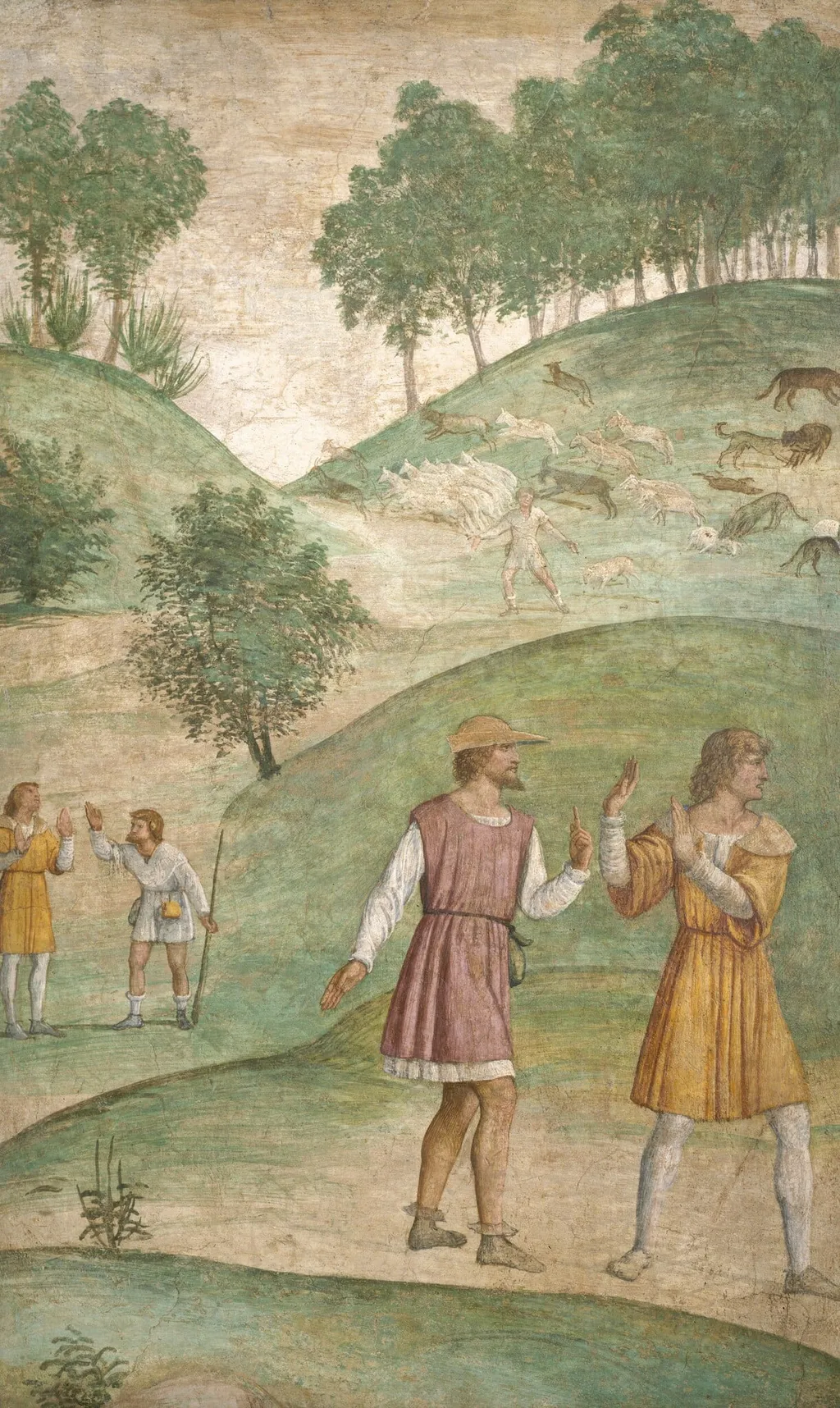
The Misfortunes of Cephalus is a fresco painting by the Mannerist artist Luini Bernardino. It dates from 1521 and is held in the collection of the National Gallery of Art.
About this work
Subject & Meaning
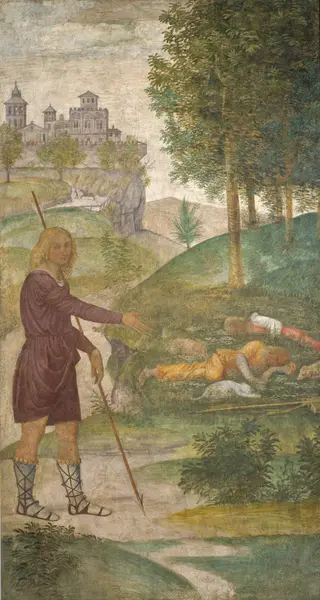
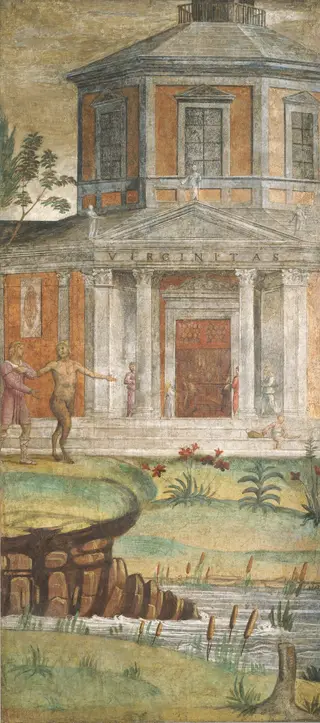
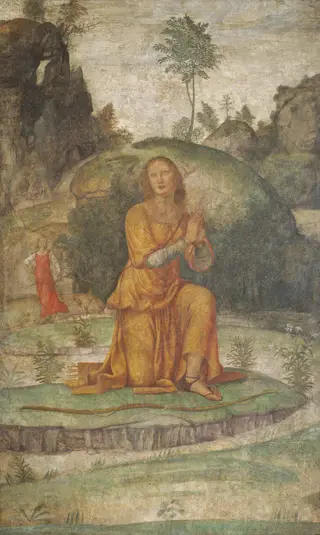
The fresco depicts Ovid’s tale of Cephalus, a youth of striking beauty whose wife Procris suspects him of infidelity and secretly follows him into the woods.
The fresco depicts Ovid’s tale of Cephalus, a youth of striking beauty whose wife Procris suspects him of infidelity and secretly follows him into the woods. In the scene, Procris hides in the bushes, observing Cephalus as he rests beneath a tree with the nymph Eos, who pursues him despite his loyalty to Procris. The composition emphasizes the moment of tension, with Procris’s concealed presence and Cephalus’s unaware repose underscoring themes of jealousy and misplaced trust.
Symbolically, the forest setting and the presence of Eos introduce the forces of nature and desire, while Procris’s hidden gaze embodies suspicion and the destructive potential of unchecked emotion. The fresco’s iconography aligns with Renaissance interpretations of classical myths as moral allegories, using Ovid’s narrative to explore human frailty and the consequences of unchecked emotions.
Technique & Style
The Misfortunes of Cephalus is executed in fresco, a technique that aligns with Bernardino Luini's documented practice of mural painting in early sixteenth-century Lombard settings. The work's dimensions, as recorded by the National Gallery of Art, are 176.2 cm in height by 107.3 cm in width, indicating a vertically oriented composition suited to a wall surface. As a fresco, the image was painted onto wet plaster, binding pigment into the wall itself rather than onto a portable support such as canvas or panel.
The vertical format and fresco medium are consistent with the work's original commission for a domestic interior, either the Casa Rabia in Milan or La Pelucca near Monza, where such mural cycles were typical.
History & Provenance
The fresco was commissioned around 1522 by Gerolamo Rabia for either the Casa Rabia in Milan or his country house, La Pelucca near Monza. It remained in place until about 1800 and passed through the hands of the Palletta and Silva families. In 1873, it entered the collection of Enrico Cernuschi in Paris, later moving to Rodolphe Kann by 1900 and his estate.
The work was sold in 1907 to Duveen Brothers and then acquired by the Samuel H. Kress Foundation in 1942, finally being gifted to the National Gallery of Art in 1943.
The fresco is held at the National Gallery of Art in Washington, D.C., where it is accessioned as part of the Samuel H. Kress Collection. It was originally commissioned around 1522 by Gerolamo Rabia for either the Casa Rabia in Milan or his country house, La Pelucca, near Monza. The work entered the collection of Enrico Cernuschi by 1873, then passed to Rodolphe Kann by 1900 and his estate, before being sold to Duveen Brothers in 1907.
In 1942 it was acquired by the Samuel H. Kress Foundation and gifted to the National Gallery of Art in 1943.
Overview
Bernardino Luini’s fresco titled The Misfortunes of Cephalus dates from around 1521. Executed on a wall surface, the work presents a compact narrative scene set on a craggy slope, where a winged male figure brandishes a spear opposite a woman who turns away and shields herself. Dark, rolling clouds dominate the sky, suggesting an imminent storm.
Context
Luini, a Lombard painter influenced by Leonardo da Vinci, worked during a period when frescoes were common in both public and private interiors. This work reflects the era’s fascination with classical mythology as moral exempla, integrating narrative content with the decorative demands of wall painting.
Legacy
The Misfortunes of Cephalus illustrates Luini’s willingness to experiment with figure rendering, offering a visual link between High Renaissance ideals and the more expressive tendencies that would emerge later. Its distinctive blend of smooth modeling and angular contour continues to attract scholarly attention for its role in the evolution of Italian fresco painting.
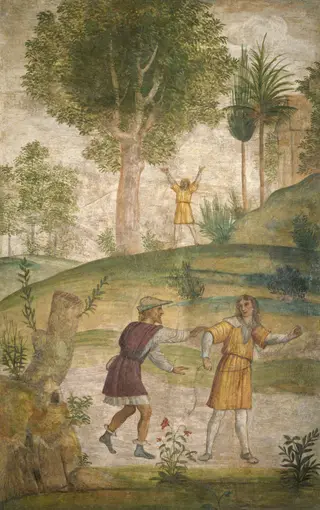
Own this work as a print
Artist & collection
Artist
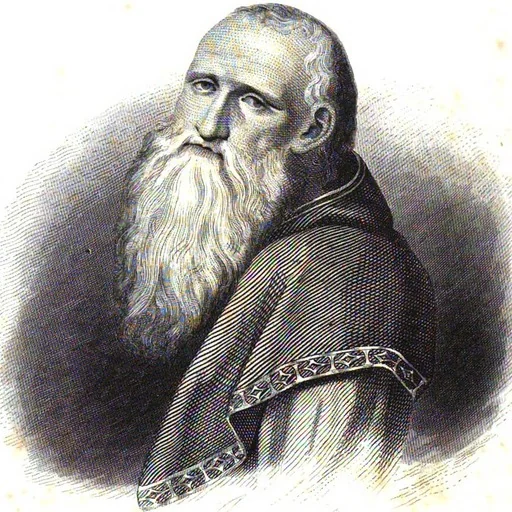
Bernardino Luini (c. 1480/82 – June 1532) was a north Italian painter from Leonardo's circle during the High Renaissance. Both Luini and Giovanni Antonio Boltraffio were said to have worked with Leonardo directly; he…

 The Marriage of Jason and Medea
 Kriegszug Kaiser Karls V. gegen Tunis (1535): Plünderung von Tunis
 The Hunt in the Forest
 The Story of Nastagio Degli Onesti, part three
 drawing from Ionides Album
 Young Mercury Stealing Cattle from Apollo's Herd
 The Stag Hunt
 Dante Lost in the Wood: Escaping and Meeting Virgil, Canto I