Artwork
The Story of Nastagio Degli Onesti, part three
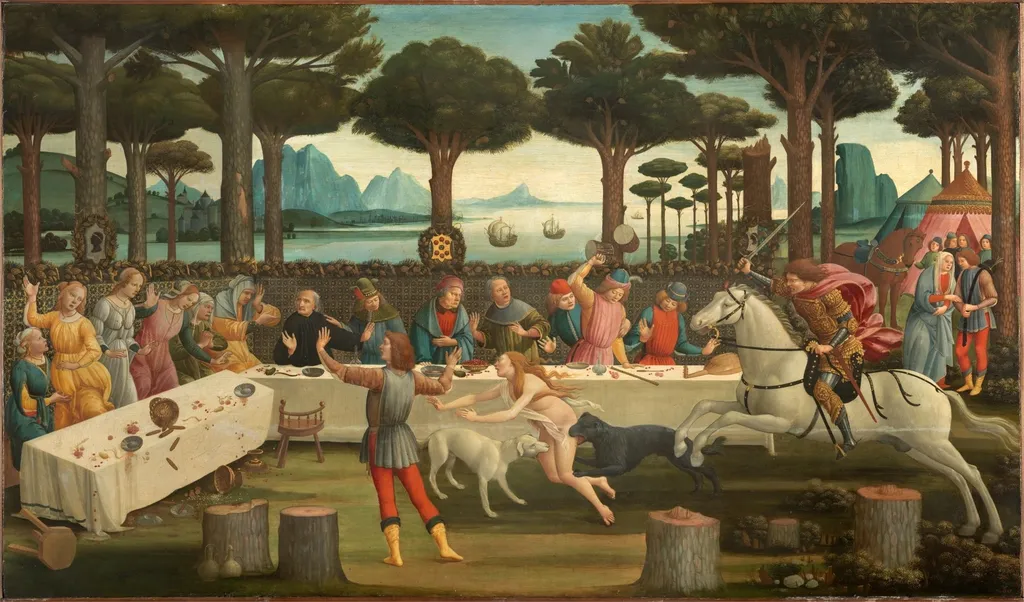
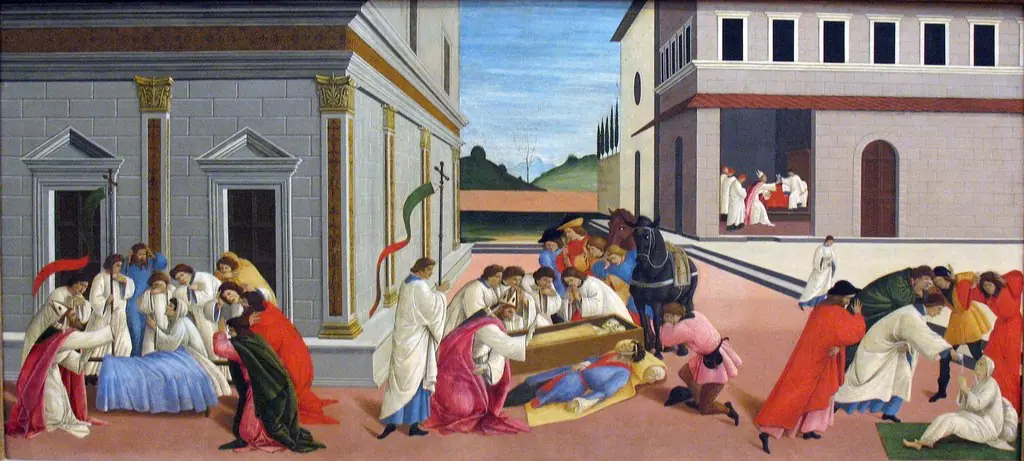
The Story of Nastagio Degli Onesti, part three is a tempera painting by the Early Renaissance artist Sandro Botticelli. It dates from 1492 and is held in the collection of the Museo del Prado.
About this work
Subject & Meaning
The work combines dramatic tension with formal elegance, characteristic of Early Renaissance narrative painting.
The third episode of Nastagio degli Onesti depicts a scene from Boccaccio's Decameron, specifically the eighth tale of the fifth day, which illustrates a cruel yet ultimately successful pursuit of love. Set in a pine grove near Ravenna, the painting shows Nastagio organizing a banquet to demonstrate the eternal punishment of two damned souls to the family of the woman he loves, hoping she will change her mind. The composition includes symbolic elements such as the Pucci, Medici, and Pucci-Bini coats of arms displayed on trees, a banquet table replacing cut trees, and the sudden appearance of the pursued woman being attacked by two dogs while a golden-armored knight watches.
Two simultaneous moments are rendered: the attack and the banquet, requiring Nastagio to be depicted twice. The narrative emphasizes the fusion of pagan imagery with moral themes, rendered with meticulous detail in clothing, furniture, and domestic objects, reflecting contemporary Florentian material culture. The work combines dramatic tension with formal elegance, characteristic of Early Renaissance narrative painting.
The scene draws directly from Boccaccio's Decameron, where Nastagio stages this recurring Friday spectacle to reform his beloved, using the visual punishment as a catalyst for her eventual acceptance of marriage. The painting's dual narrative and symbolic heraldry underscore themes of love, justice, and social order, while its complex spatial arrangement and vivid coloration reflect Botticelli's stylistic mastery within the Early Renaissance tradition.
Technique & Style
The panel is executed in tempera on wood, with reported dimensions of approximately 83 × 142 cm (sources vary slightly between 82 and 84 cm in height). It belongs to a series of four panels conceived by Botticelli, though critics attribute much of the execution to workshop assistants, particularly Bartolomeo di Giovanni for the first three scenes and Jacopo del Sellaio for the last.
Stylistically, the work shows meticulous attention to detail, especially in the depiction of tableware and furniture, which carries historical interest. The composition simultaneously presents two successive narrative episodes, requiring the doubling of the figure of Nastagio. The forest is rendered with tall, rigid vertical trunks that form a screen-like grid against a lagoon, opening onto a horizontal maritime background with boats receding into atmospheric perspective.
The palette is described as vivid and cleanly applied, and the natural setting is measured and harmoniously unified across the series. Drama coexists with formal elegance in the slender, gracefully moving figures and animals, producing an atmosphere that blends fable and reality.
History & Provenance
Sandro Botticelli created this tempera-on-panel work in 1483 as part of a four-piece series commissioned by Lorenzo de' Medici. The set was intended as a nuptial gift for the marriage of Giannozzo Pucci and Lucrezia Bini, with the family coats of arms of the Pucci, Medici, and the union of Pucci-Bini visible within the composition. Originally housed in the Palazzo Pucci in Florence, the panels remained there until their sale in 1868.
Following their dispersal into various private collections, three of the four panels were acquired in 1929 by Francisco de Asís Cambó from the heirs of Joseph Spiridon. Cambó subsequently donated these three works to the Museo del Prado in Madrid in 1941, where the third episode is currently held.
The third episode of The Story of Nastagio degli Onesti is held in the Museo del Prado in Madrid. The work arrived at the museum in 1941 as a donation from Francisco de Asís Cambó, who had purchased three panels from the series in 1929. Prior to this acquisition, the four panels remained in the Palazzo Pucci in Florence until their sale in 1868.
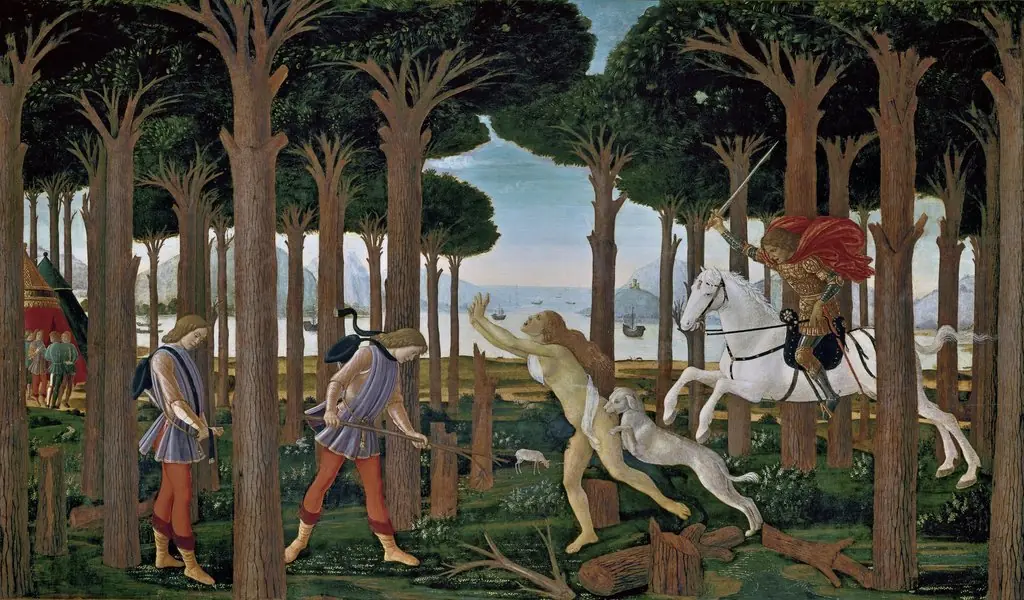
While three of the paintings have been part of the Prado's collection since the mid-20th century, the fourth panel, depicting the wedding banquet, reappeared in Florence in 2004 after being held in the Watney Collection in London and is currently located in the Palazzo Pucci.
Context
Created in 1483, this tempera panel forms part of a four-piece series commissioned by Lorenzo de' Medici for the wedding of Giannozzo Pucci and Lucrezia Bini. The work illustrates Day 5, Tale 8 of Boccaccio's Decameron, depicting a scene near Ravenna where the protagonist stages a banquet to witness a supernatural punishment. Art historical consensus attributes the overall conception to Sandro Botticelli, though scholarship suggests the execution of the first three scenes was largely delegated to his assistants, specifically Bartolomeo di Giovanni, with Jacopo del Sellaio likely responsible for the final panel.
The painting is celebrated for its narrative complexity, which employs a medieval technique of showing successive moments within a single frame, requiring the duplication of the main character. Critics note the harmonious spatial arrangement and the juxtaposition of dramatic violence with the elegant, elongated figures typical of the Early Renaissance style.
Overview
Created in 1492, this tempera panel by Sandro Botticelli forms the third episode of the narrative series "The Story of Nastagio Degli Onesti." The work is part of the Early Renaissance canon and is currently displayed in the Museo del Prado. It presents a complex outdoor banquet scene, rendered in the luminous yet restrained palette characteristic of Botticelli’s late 15th‑century practice.
Artist & collection
Artist
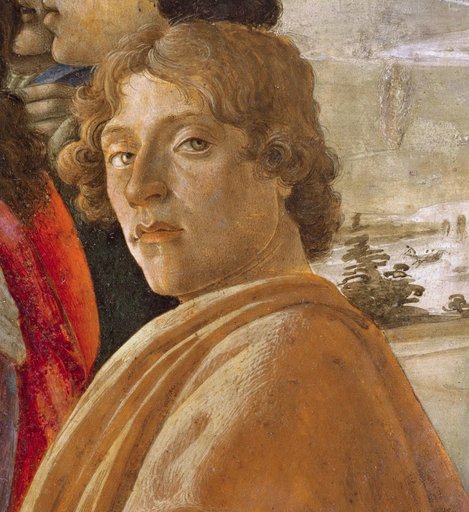
Alessandro di Mariano di Vanni Filipepi, better known as Sandro Botticelli or simply Botticelli, was an Italian painter of the Early Renaissance.