Artwork
People by the Blue Lake
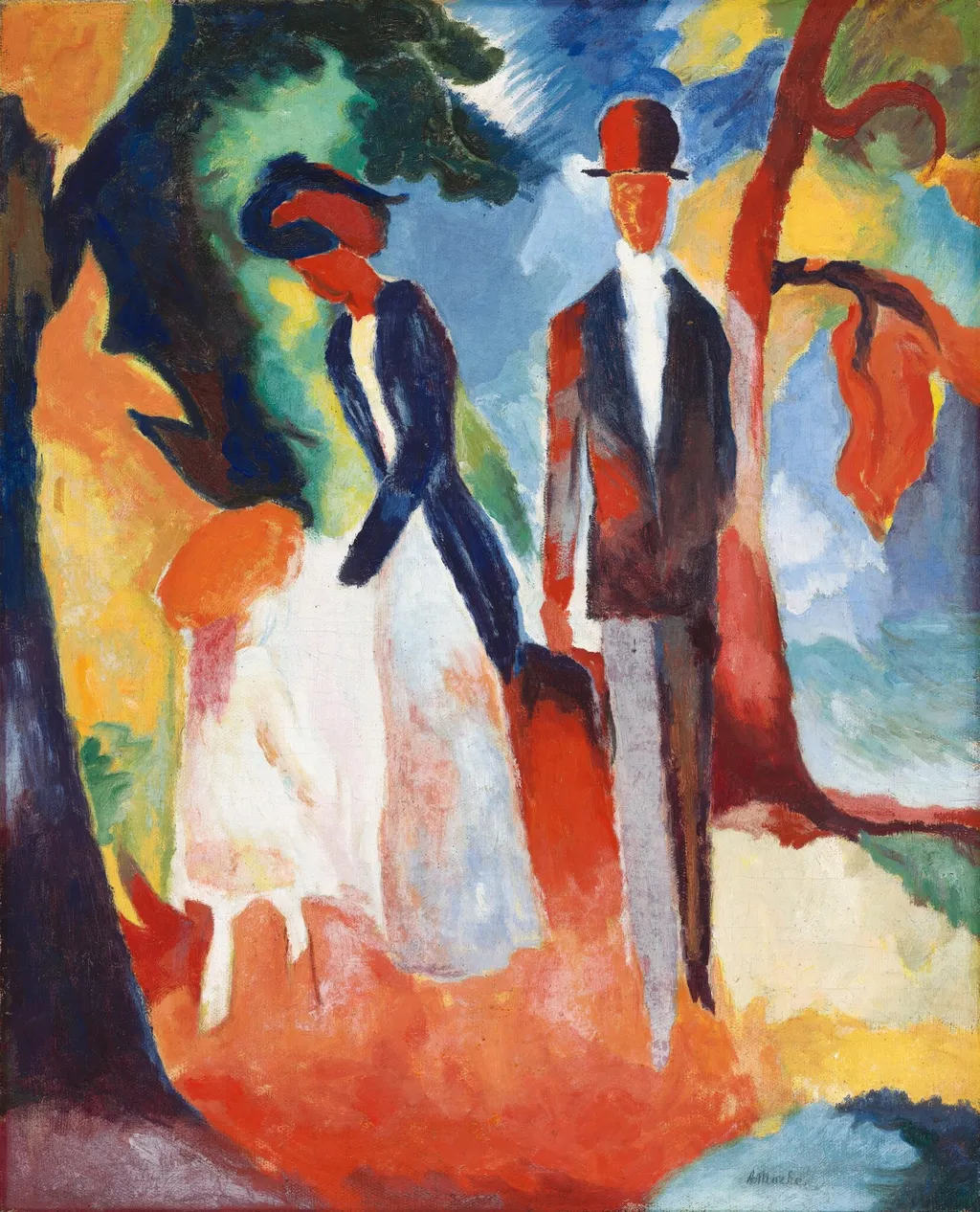
People by the Blue Lake is an oil painting by August Macke. It dates from 1913 and is held in the collection of the National Gallery of Art.
- Inscription
- Inscribed:lower right: AMacke
About this work
Overview
People by the Blue Lake (Leute am blauen See) is an oil-on-canvas painting created in 1913 by the German Expressionist artist August Macke.
People by the Blue Lake (Leute am blauen See) is an oil-on-canvas painting created in 1913 by the German Expressionist artist August Macke. Measuring 60.32 by 48.26 cm (23 3/4 by 19 in.), the work depicts three figures in a lakeside landscape and is now held at the National Gallery of Art in Washington, D.C., Smithsonian Institution, following its acquisition in 2020. The painting represents a pivotal moment in Macke's brief but influential career, synthesizing French modernist color theory with his own distinctive approach to form and leisure subjects.
Subject & Meaning
The painting presents a man, a woman, and a small child strolling beside a lake, a motif rooted in the tradition of genre painting and particularly reminiscent of Georges Seurat's Sunday leisure scenes. The woman at left wears a dark blue jacket, long white skirt, and wide-brimmed hat with a dark feather, her gaze directed downward and slightly toward the male figure, who stands in a dark suit with white shirt, gray trousers, and black bowler hat facing forward. The child, positioned between them, completes the familial grouping. Despite the generic, almost universal quality of the scene, the painting reflects Macke's personal circumstances during a vacation on Lake Thun, where he stayed from late September 1913 until spring 1914, a period described as particularly happy for the artist and his wife. The idyll carries undertones of paradise and joie de vivre, with Macke focusing on leisure as a central theme. The autumn foliage and lakeside setting evoke tranquility, though the work was painted on the eve of World War I, which would claim Macke's life at age 27 in 1914.
Technique & Style
Executed in oil on canvas, People by the Blue Lake demonstrates Macke's mature handling of color and form. The composition is built from broad, visible brushstrokes of unblended color laid side by side, creating a flattened picture plane with little traditional modeling or perspective. The palette is high-key and saturated, dominated by orange, red, blue, and green, with the figures standing on a bright orange-red ground against a backdrop of deep blue and green tree forms, a vivid red curving tree trunk, and patches of yellow, turquoise, and blue suggesting sky and foliage. Macke's technique reflects his fascination with the decomposition of white light into spectral colors, arranging red, orange, yellow, green, blue, and violet in relationships that demonstrate both harmonious and disharmonious combinations. As his wife Elisabeth Macke noted, the artist sought to convey dynamics through the play of shades within single colors, striving for vibration and life without relying on red accents within green passages. The large, equally sized color fields reduce spatial depth while cool and warm tones of different spatial and sculptural effects stand in dynamic tension, preserving two-dimensional unity. The signature AMacke appears in the lower right corner.
History & Provenance
The painting was probably started and finished in Hilterfingen during Macke's Lake Thun sojourn. Following the artist's death, the work entered a private collection in the United States. Arnold A. Saltzman (1916-2014) and Joan R. Saltzman (1919-2019) of Sands Point, New York, owned the painting before gifting it to the National Gallery of Art in 2020, where it received accession number 2020.112.10. The work was exhibited publicly in 2001-2002 as part of German Expressionist Paintings from the Saltzman Family Collection at the National Gallery of Art, Washington. It is currently displayed in the East Building Mezzanine, Gallery E217.
Context
August Macke served as a crucial mediator of French painting to German modernism, belonging to the circle of the Blauer Reiter (Blue Rider) while developing his own visual language. People by the Blue Lake occupies a significant position in this trajectory, expanding the boundaries of Impressionist and Fauvist influence in his work. The painting has been associated with the Orphism movement, characterized by its emphasis on pure abstraction and bright colors. Macke's theoretical concerns during this period centered on the simultaneous and sequential nature of perception, the eye wandering through the composition as color relationships unfold. His pursuit of harmony and generalization through pure color coordination represented a distinctive path within German Expressionism, one that prioritized the liveliness of integral perception over perspective construction or volumetric modeling. The work exemplifies Macke's cubist-informed simplification of form, modeling in simple shapes while maintaining a commitment to color as the primary vehicle of expression.
Legacy
People by the Blue Lake stands as one of the most accomplished expressions of Macke's final phase, created during his last productive year before his death on the battlefield in Champagne in 1914. The painting's journey from a private American collection to the National Gallery of Art has secured its place within a major public institution, ensuring broader scholarly and public access. Macke's emphasis on leisure, color harmony, and the joyous aspects of modern life, even as Europe descended into war, has contributed to his reputation as a singular voice within German Expressionism, one whose optimism and formal innovations were cut tragically short. The work continues to attract critical attention for its synthesis of French color theory and German modernist aims, representing a bridge between movements that influenced subsequent developments in twentieth-century painting.
Own this work as a print
Artist & collection
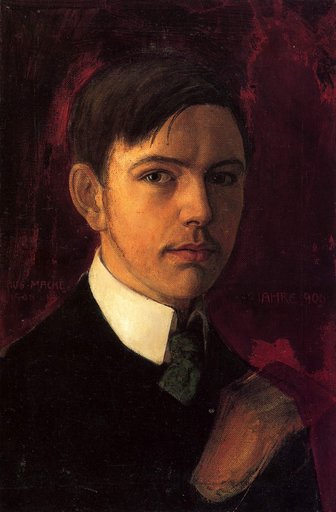
Artist
August Robert Ludwig Macke was a German Expressionist painter. He was one of the leading members of the German Expressionist group Der Blaue Reiter. He lived during a particularly active time for German art: he saw the…