Artwork
A Village among Trees
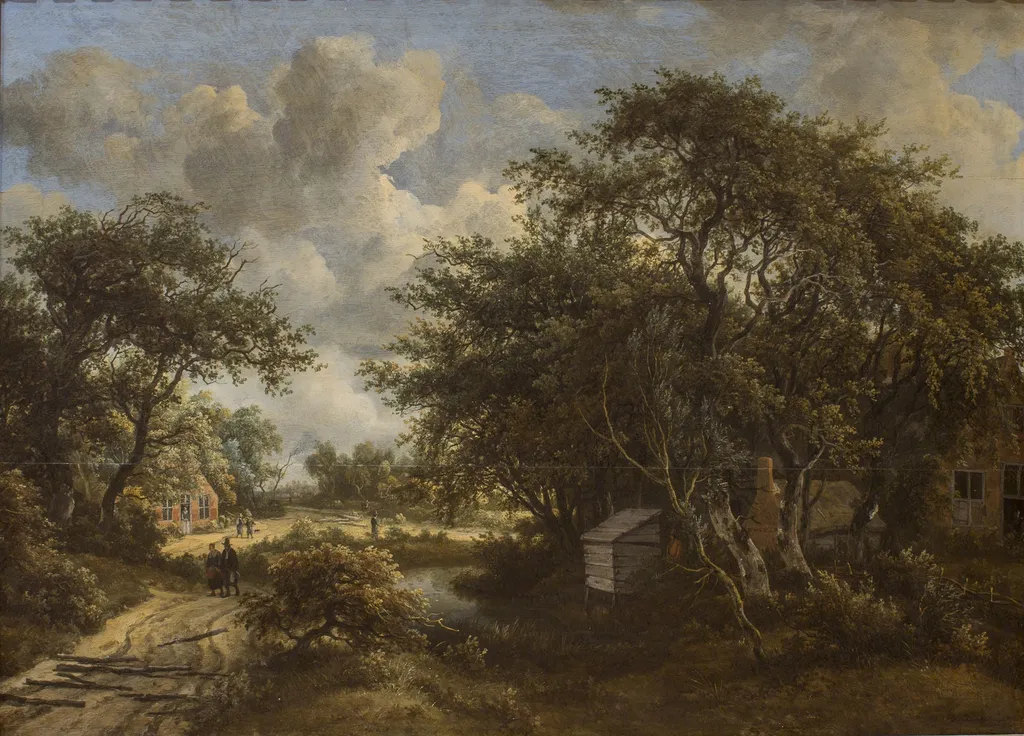
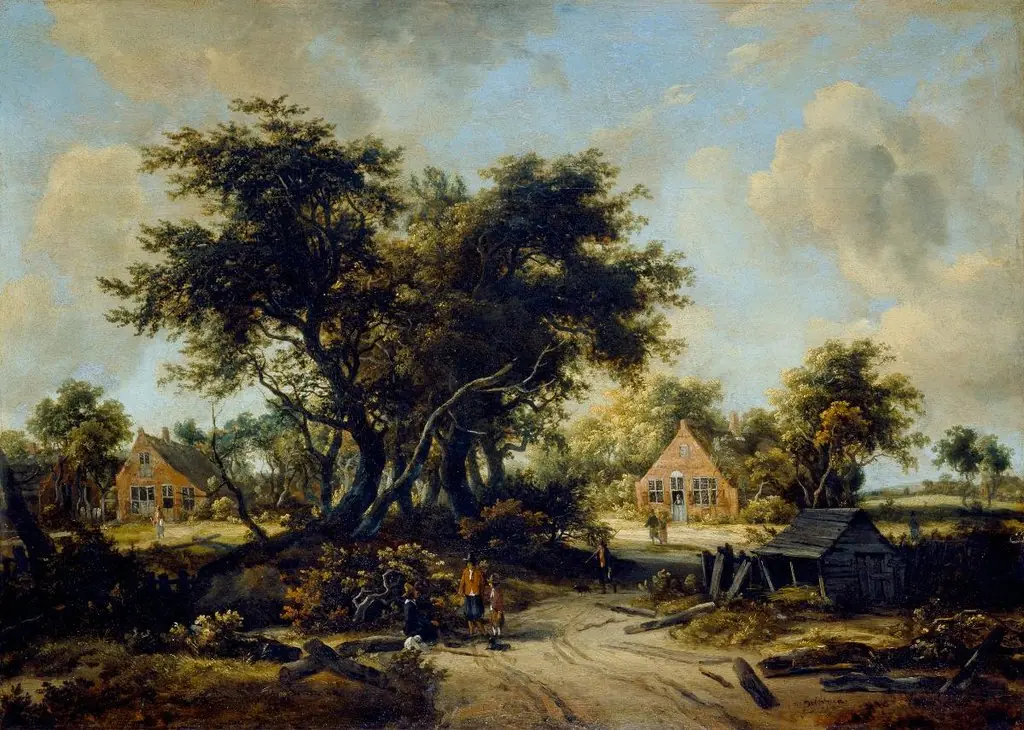
A Village among Trees is an oil painting by the Dutch Golden Age artist Meindert Hobbema. It dates from 1670 and is held in the collection of the Statens Museum for Kunst.
About this work
Overview
A Village among Trees is an oil painting on panel by the Dutch Golden Age landscape painter Meindert Hobbema, dated to 1670.
A Village among Trees is an oil painting on panel by the Dutch Golden Age landscape painter Meindert Hobbema, dated to 1670. Measuring 60 by 82 centimeters, the work is held in the collection of the Statens Museum for Kunst in Copenhagen, having entered through the holdings of the Danish noble Moltke family. The painting belongs to Hobbema's most characteristic invention: the village-among-trees composition, which merges detailed observation of Dutch rural architecture with a poetic treatment of woodland settings. It matters as a significant late example of Hobbema's art, produced after his 1668 marriage and subsequent appointment as wine gauger for the Amsterdam city government, when his painting output declined dramatically.
Subject & Meaning
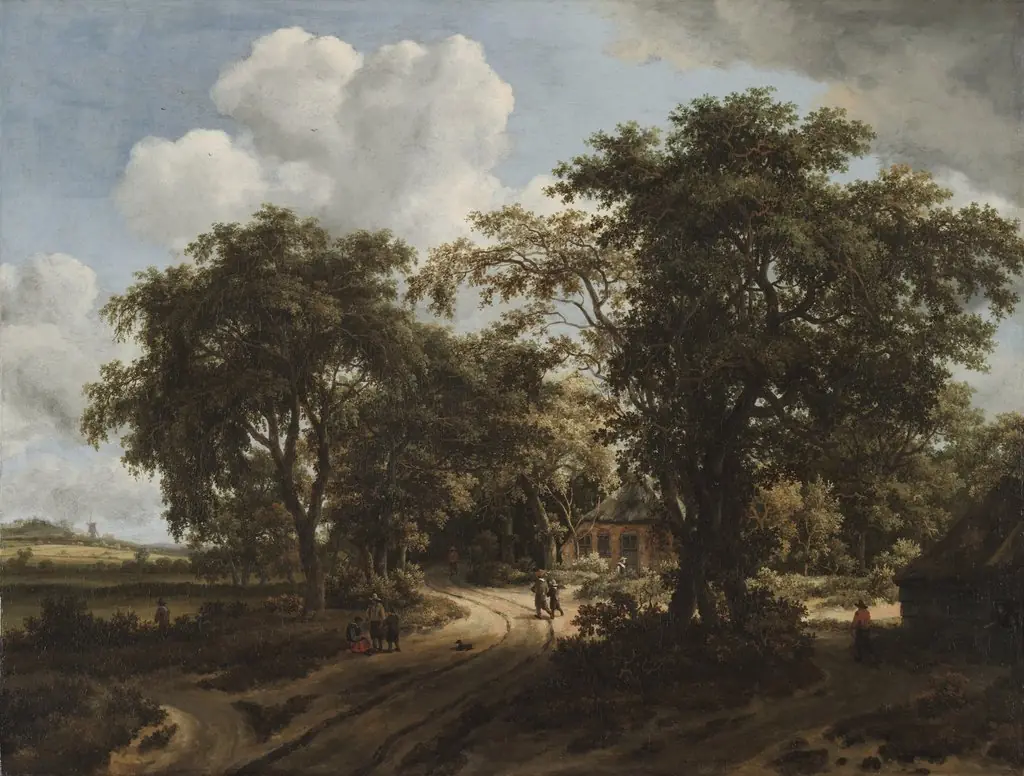
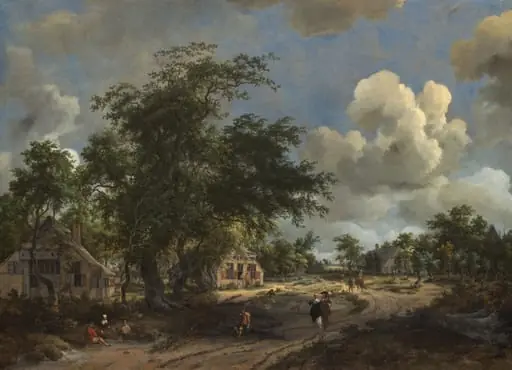
The painting presents a broad rural landscape split between a cloud-filled upper half and a wooded lower half. A winding dirt path enters from the lower left and recedes toward the center, populated by several small figures: two stand close together in the left foreground, while others walk farther down the road. To the left sits a brick building with white-framed windows nestled among trees. At center right, a small wooden shed stands beside a still pond, with a brick chimney and thatched structure partially visible behind it; another building with a window appears at the far right edge. The scene does not represent a real locale but rather assembles motifs drawn from Hobbema's imagination and earlier compositional patterns. The iconography speaks to an idealized vision of Dutch rural life, where human presence is subordinate to nature's dominance, and the winding path invites contemplative passage through a tranquil, ordered natural world.
Technique & Style
Hobbema executed the work in oil on panel, employing a palette of earthy browns and greens for foliage and ground, warm tans for the path, and soft blues and grays for the sky. Light falls from the upper left, illuminating the clouds and the left side of the scene while casting the right foreground into shadow. His distinctive technique builds foliage from individual touches of green, yellow-green, and brown to create a sense of leaves catching light at different angles. The brushwork shows fine detail in leaves and branches, with smoother handling in the sky. The village buildings receive careful attention to brick, timber, and thatch, reflecting the precision of Dutch architectural painting. A faint horizontal line crosses the middle of the painting, and light filtering through the trees creates dappled patterns on the ground that demonstrate Hobbema's mastery of natural illumination. This minute realism and fidelity to subject matter ran directly counter to his teacher Jacob van Ruisdael's more visionary approach to the landscape as an integrated entity.
History & Provenance
The painting was created in 1670, during a period when Hobbema's activity as a painter had already diminished considerably following his 1669 appointment as comptroller of wine and oil in Amsterdam. The work was owned by Adam Gottlob Moltke and subsequently by Frederik Moltke, members of the prominent Danish Moltke family, before entering the collection of the Statens Museum for Kunst in Copenhagen, where it remains today. Its acquisition through this noble Danish line reflects the international reach of Dutch landscape painting during and after the Golden Age.
Context
Hobbema (1638-1709) was a pupil of Jacob van Ruisdael in Amsterdam from around 1657 to 1660, and the two men became friends. He belonged to a circle of Dutch artists including Salomon van Ruysdael, Aelbert Cuyp, and Ruisdael himself, who turned to landscape painting in dissatisfaction with more populist genre styles. Until around 1664, Hobbema followed closely in Ruisdael's footsteps, drawing inspiration from his teacher's compositions. After 1664, his style developed toward a minute realism that presented forms down to the last detail, lacking the sense of infinity and vast vistas found in Ruisdael's work. His obsessive search for technical perfection sometimes led to stereotyped variations on familiar themes. The Village among Trees compositions represent his most characteristic invention, combining Dutch architectural precision with woodland poetry. Despite leaving a modest imprint on the art of his own country during his lifetime, Hobbema is now recognized as one of the greatest of late Dutch Realist artists and an important contributor to the Dutch Baroque.
Legacy
Hobbema's work exerted a significant impact on both early nineteenth-century English landscape painting and on the naturalism of the Barbizon School of Landscape Painting (1830-75). In England, those most influenced by him included Richard Wilson, Samuel Scott, John Crome, John Sell Cotman, Patrick Nasmyth, and John Constable. The precise naturalism and intimate poetry of his woodland scenes, with their characteristic melancholy emerging from cold greens and dark waters, provided a model for subsequent generations of landscape painters. His village-among-trees compositions, of which this 1670 panel is a prime late example, established a type that resonated across European landscape traditions.
Own this work as a print
Artist & collection
Artist
Meindert Lubbertszoon Hobbema (bapt. 31 October 1638 – 7 December 1709) was a Dutch Golden Age painter of landscapes, specializing in views of woodland, although his most famous painting, The Avenue at Middelharnis…