Artwork
Chalice of Saint John the Evangelist [reverse]
![Chalice of Saint John the Evangelist [reverse], by Hans Memling, oil, 1472](https://artifactworldgallery.com/img/hans-memling--chalice-of-saint-john-the-evangelist-reverse--580c913dda322f89-w1024.webp)
Chalice of Saint John the Evangelist [reverse] is an oil painting by the Northern Renaissance artist Hans Memling. It dates from 1472 and is held in the collection of the National Gallery of Art.
About this work
He often made small religious objects look real through careful glazing, layering thin, see-through paint.
This painting shows a gold cup with a gem-studded foot. Light hits the cup’s curves and glassy surface. The background fades to black, putting all focus on the chalice.
Hans Memling painted this tiny panel around 1470. He often made small religious objects look real through careful glazing, layering thin, see-through paint. The effect makes the gold glow like it’s lit from inside.
Look for Memling’s other goldsmith scenes.
Technique & Style
The work is executed in oil on a wooden panel, a support typical of Early Netherlandish practice in the late fifteenth century. Hans Memling employed thin glazes and fine brushwork to achieve a luminous surface and precise detail, characteristic of the movement’s emphasis on naturalistic rendering and devotional clarity. The painting’s composition, depicting Saint John the Evangelist, follows the conventions of religious panel paintings of the period, with careful attention to texture and spatial depth.
History & Provenance
Hans Memling painted the work in 1470 in oil on panel. The provenance traces initially to Bernardo Bembo of Venice or Verona (d. 1519), whose son Cardinal Pietro Bembo (1470–1547) of Padua likely inherited it; a 1502 letter from Carlo Bembo to Isabella d'Este accompanied a loan of paintings, and Marcantonio Michiel's later notes identify the poet Pietro Bembo as owner of what appears to be this diptych.
The work later passed to Prince Nicolai Nikitich Demidov of San Donato (1773–1828) near Florence, then to his son Anatoly Nikolaievich Demidov (1812–1870), at whose Paris sale of 3 March 1870 it appeared as lot 204 with an etching by Rajou. After time in a private Italian collection until about 1928, it was handled by Matthiesen Gallery and Paul Cassirer in Berlin. Baron Heinrich Thyssen-Bornemisza (1875–1947) owned it by 1930 at Schloss Rohoncz and later Villa Favorita, Lugano-Castagnola.
Consigned in 1950 through M. Knoedler & Co., New York, it was purchased in 1951 by the Samuel H. Kress Foundation and gifted by exchange to the National Gallery of Art in 1952.
The work is held by the National Gallery of Art in Washington, D.C., where it is part of the Samuel H. Kress Collection. It entered the museum in 1952 through a gift by exchange from the Samuel H. Kress Foundation, having previously been owned by the Demidov family, sold in Paris in 1870, and later acquired by Baron Heinrich Thyssen‑Bornemisza. Its inventory is recorded under the Kress Collection designation. No exhibition history is documented in the provided sources.
Context
Critical studies of Hans Memling’s Chalice of Saint John the Evangelist [reverse] situate the panel within the early Netherlandish tradition, noting its circa 1470 date and oil‑on‑panel technique. Scholarship traces the work’s provenance from the Bembo family in Venice, documented by Carlo Bembo’s correspondence and Marcantonio Michiel’s inventory, to its later ownership by the Thyssen‑Bornemisza collection and the Kress Foundation before its donation to the National Gallery of Art. The diptych’s iconography of Saint John has been analyzed as a devotional image reflecting contemporary Venetian patronage and Memling’s synthesis of Netherlandish detail with Italian compositional balance, marking a pivotal phase in his mature output.
Overview
Hans Memling, a German-Flemish painter, created the Chalice of Saint John the Evangelist [reverse] around 1470-1472. This small oil-on-panel work exemplifies the detailed religious imagery characteristic of the Northern Renaissance. It showcases the artist's skill in rendering sacred objects with a lifelike quality, a hallmark of Early Netherlandish painting, focusing intently on a single, symbolic form.
Subject & Meaning
The painting depicts a golden chalice, a significant religious symbol. Its presence here specifically alludes to Saint John the Evangelist, for whom the cup is an attribute. The careful rendering of the object elevates its spiritual meaning, inviting contemplation of its sacred function and the saint it represents within Christian tradition.
Own this work as a print
Artist & collection

Artist
Hans Memling was a German-Flemish painter who worked in the tradition of Early Netherlandish painting.

![Saint Veronica [obverse], by Hans Memling](https://artifactworldgallery.com/img/hans-memling--saint-veronica-obverse--5a649fd8b09c96b9-w320.webp)


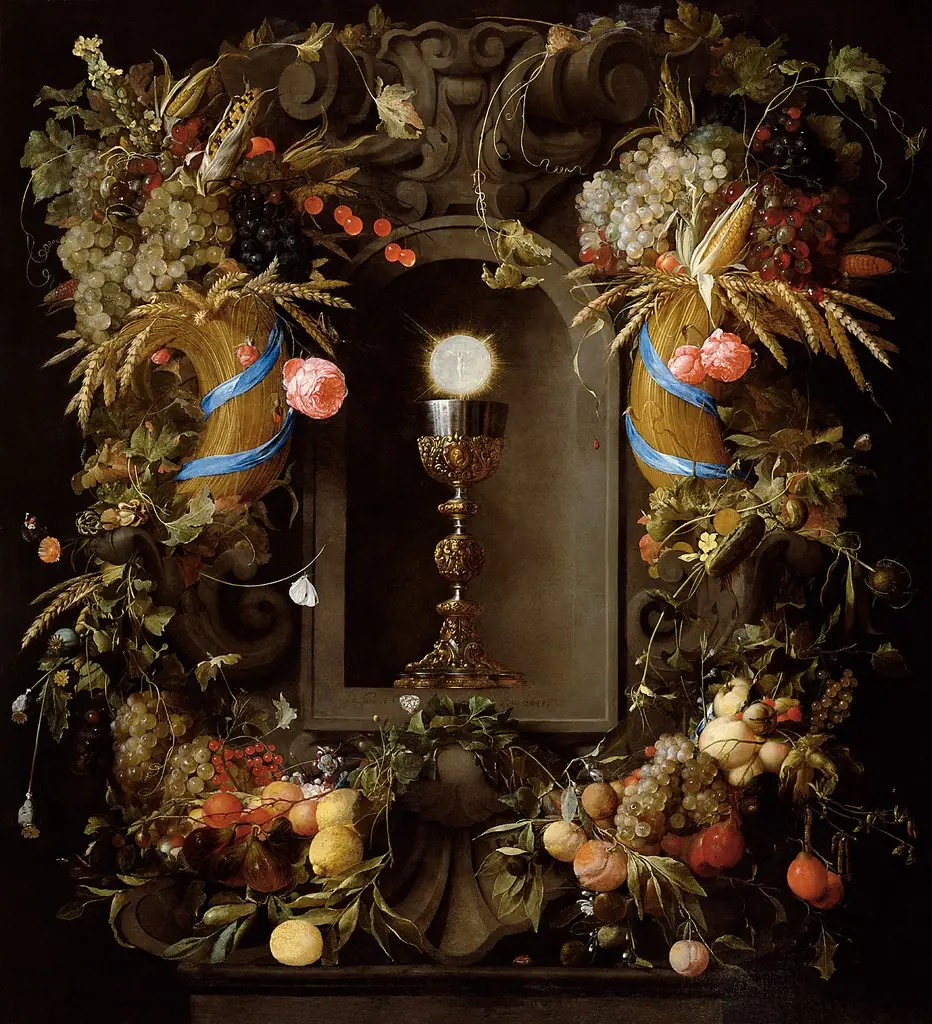 Chalice and Host in a Niche, within a Cartouche of Roses and Fruit
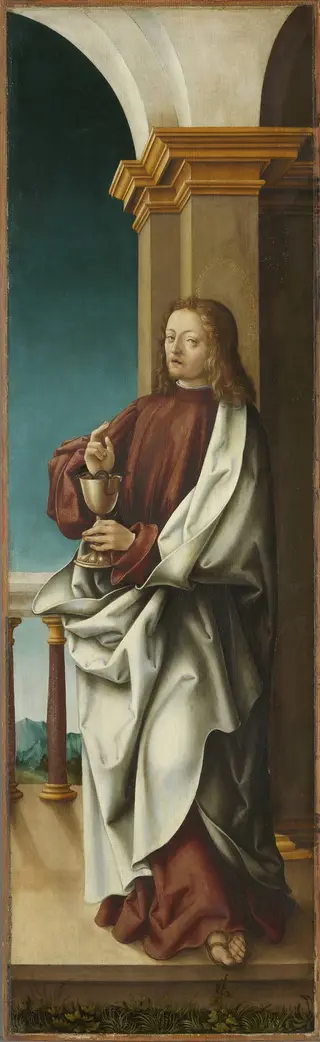 Johannesaltar, Flügelaußenseite: Hl. Johannes der Evangelist
![Saint Barbara [left wing exterior], by Master of the Starck Triptych](https://artifactworldgallery.com/img/master-of-the-starck-triptych--saint-barbara-left-wing-exterior--dc6b24dbebc95d32-w320.webp) Saint Barbara [left wing exterior]
Saint Barbara [left wing exterior]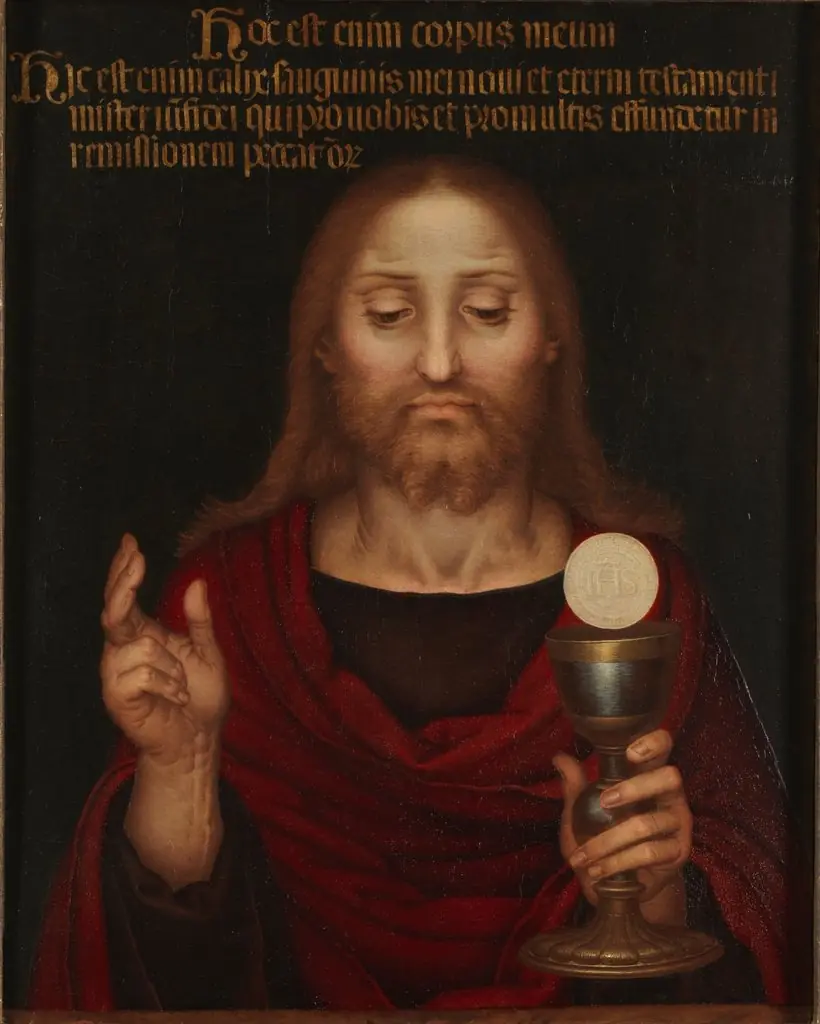 The Eucharistic Christ
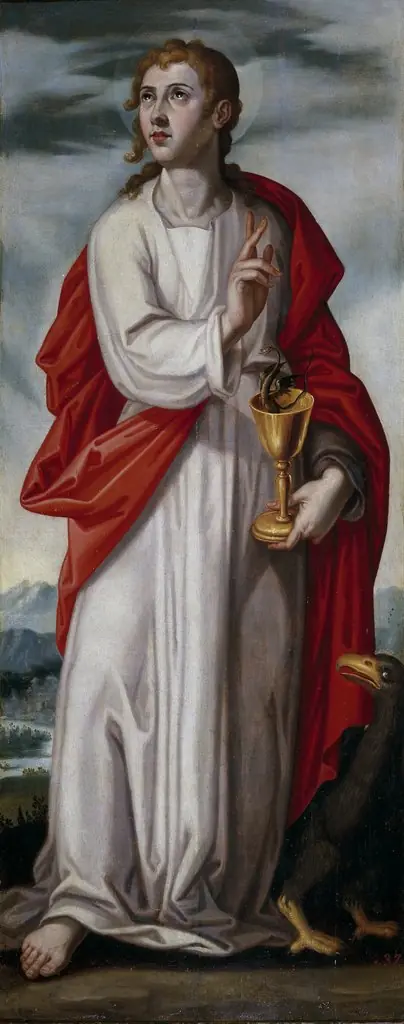 San Juan Evangelista
 Still Life with Orange and Venetian Glass
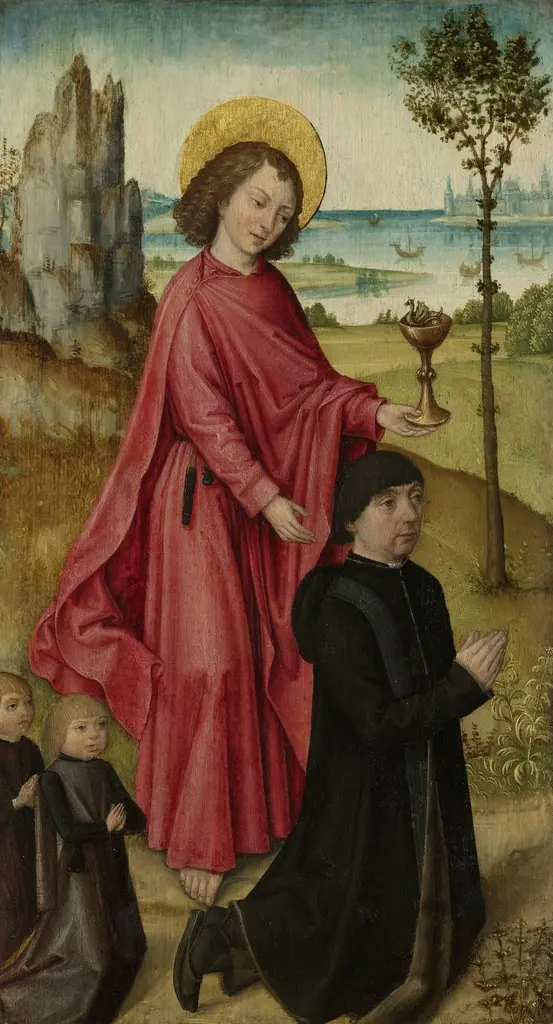 Inner left wing of a triptych with the donor, his two sons and St John the Evangelist
 Head of Christ
 The Great Chalice Adorned with Figures
 Vanitas Still-Life
 Saint Bartholomew Altarpiece: Saint John the Evangelist and Margaret
- The evangelist John