Artwork
Self Portrait
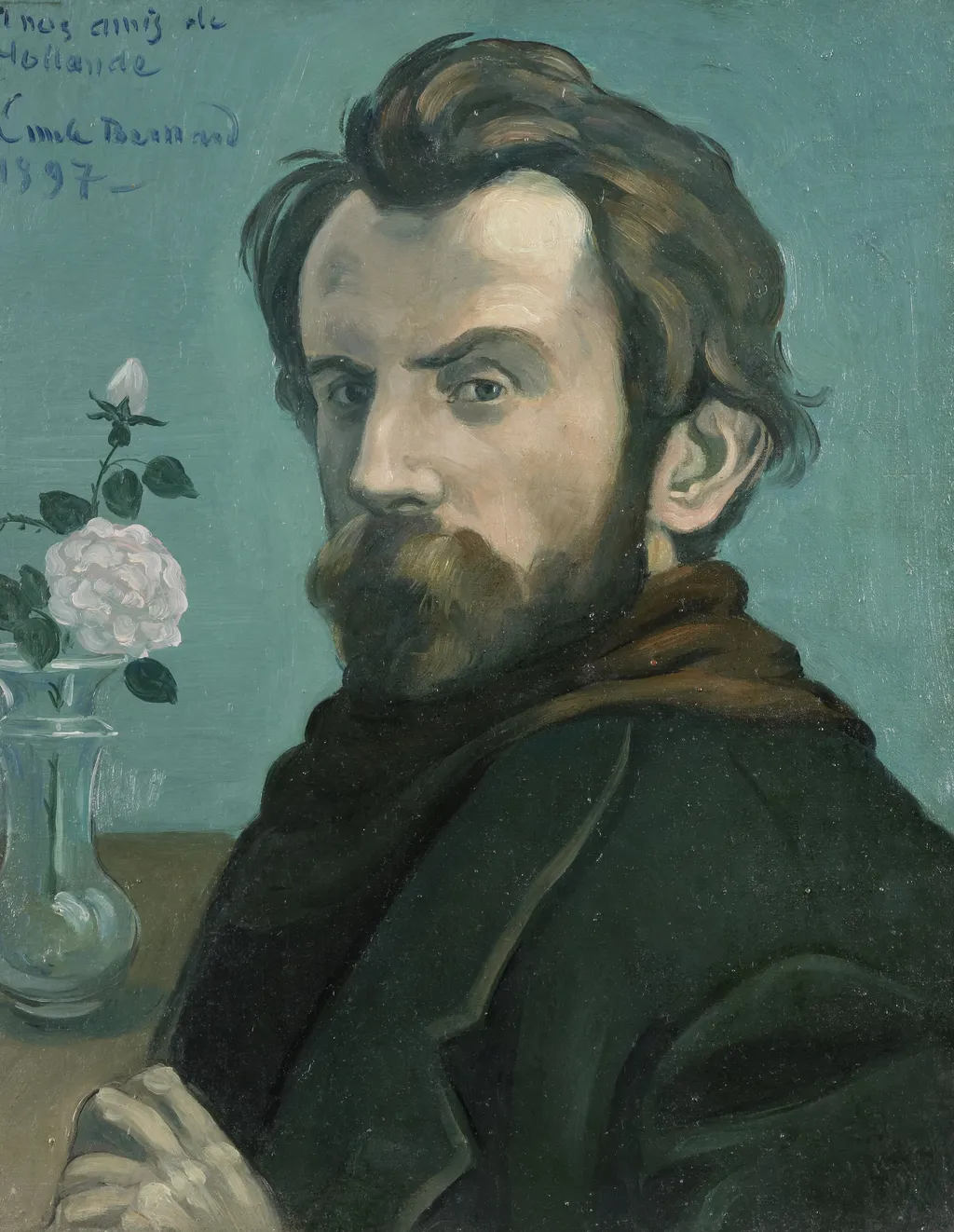
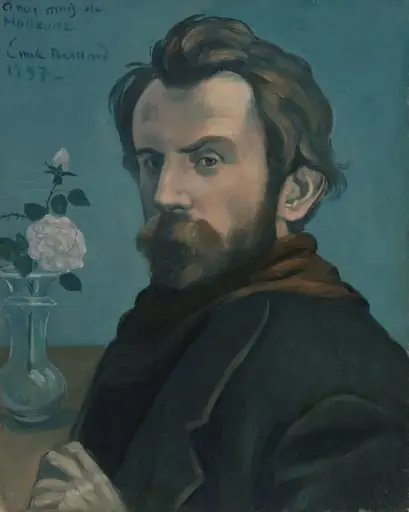
Self Portrait is an oil painting by the Cloisonnist artist Émile Bernard. It dates from 1899 and is held in the collection of the Rijksmuseum.
About this work
Subject & Meaning
An inscription in the upper left corner dedicates the work to the Dutch collector Andries Bonger and includes Bernard's signature and the year 1897.
The painting shows the artist himself, rendered in bust form against a blue wall, with a vase of flowers placed nearby. An inscription in the upper left corner dedicates the work to the Dutch collector Andries Bonger and includes Bernard's signature and the year 1897. This self‑portrait reflects Bernard's involvement with synthetism and cloisonnism, movements emphasizing flattened color and symbolic arrangement. It is housed in the Rijksmuseum in Amsterdam.
Technique & Style
The work is an oil painting on canvas, created in 1897 as part of the synthetist and cloisonnist movements, featuring a vertical format that presents the artist in bust form beside a solitary flower, rendered in a blue-walled interior with a dedication inscription to collector Andries Bonger and the artist's signature. The surface exhibits flat planes of color and outlined contours typical of cloisonnism, while the handling emphasizes a tightly composed, frontal presentation of the figure, reflecting Bernard's approach to self-representation within his symbolic repertoire.
History & Provenance
Émile Bernard painted Self Portrait in 1897, an oil on canvas measuring 52 cm by 42 cm, created as a vertical composition depicting the artist in bust form beside a single flower against a blue wall. The work was dedicated to the Dutch collector Andries Bonger and bears his signature and the year of execution. It entered the collection of the Rijksmuseum in Amsterdam, where it remains on display.
Context
Émile Bernard's 1897 Self Portrait is recognized as a significant work within the Synthetism and Cloisonnism movements, reflecting his pivotal role in developing these Post-Impressionist styles. The painting serves as a historical document of the artist's mature phase, characterized by bold outlines and flat areas of color. Its inclusion in the Rijksmuseum collection underscores its importance in the canon of late 19th-century French art.
The work also functions as a personal artifact of international artistic exchange, featuring an inscription dedicated to the Dutch collector Andries Bonger's family with the phrase "to our friends in Holland."
Legacy
Émile Bernard's 1897 Self Portrait played a pivotal role in shaping early 20th-century artistic developments through its synthesis of synthetism and cloisonnism, influencing peers and successors in the evolution of modernist painting. The work's distinctive composition and symbolic use of color contributed to Bernard's reputation as a key figure in post-Impressionist circles, particularly within the broader Nabi network. Its inclusion in the Rijksmuseum collection ensures continued scholarly attention to Bernard's innovative approach, reinforcing his legacy within the narrative of avant-garde experimentation in fin-de-siècle Europe.
Overview
Émile Bernard’s Self Portrait (1899) is an oil painting that presents the artist’s own likeness. Executed in the late nineteenth century, the work belongs to the collection of the Rijksmuseum. It measures a modest size and depicts Bernard seated before a plain blue backdrop, his features rendered with a loose handling of paint.
Own this work as a print
Artist & collection
Artist
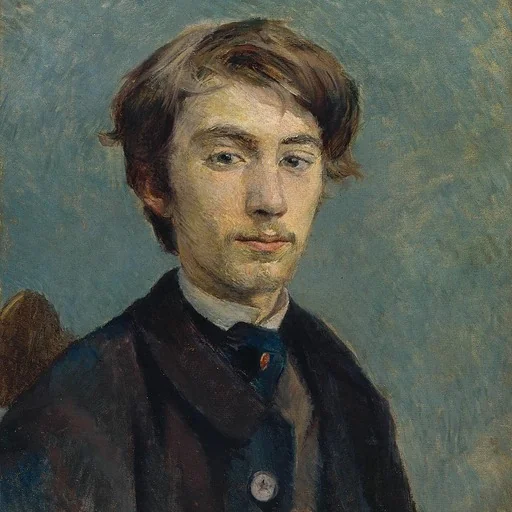
Émile Henri Bernard (French pronunciation:; 28 April 1868 – 16 April 1941) was a French Post-Impressionist painter and writer, who had artistic friendships with Vincent van Gogh, Paul Gauguin and Eugène Boch, and at a later time, Paul…