Movement
Cloisonnism
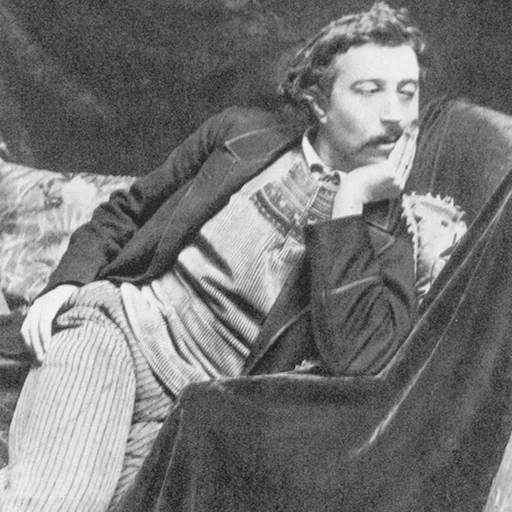
Cloisonnism is an art movement of the 1880–1900 period. The gallery holds 1 work in this movement, including works by Paul Gauguin, Émile Bernard and Meijer de Haan. Browse Cloisonnism paintings, portraits, pictures and artworks from the world's public-domain museum collections.
Cloisonnism emerged in Paris in the late 1880s as one of the boldest reactions against Impressionism's dissolving light and broken brushwork. Around 1887 the young painters Louis Anquetin and Émile Bernard, working in the orbit of Vincent van Gogh and the avant-garde studios of Montmartre, began constructing pictures from flat regions of unmodulated colour bounded by heavy dark contours. When their work appeared at the Salon des Indépendants in spring 1888, the Symbolist critic Édouard Dujardin gave the manner its name, comparing its compartmentalised colour to cloisonné enamel, in which thin metal strips—cloisons—separate fields of fused glass. Writing chiefly about Anquetin, Dujardin praised how 'outline, in quasi-abstract sign, gives the character of the object,' a credit that wounded Bernard and helped fracture the two friends' collaboration.
The style's defining traits follow directly from that metaphor. Cloisonnist canvases reject atmospheric perspective, chiaroscuro and three-dimensional modelling in favour of broad, emphatically two-dimensional planes of pure colour, each sealed by a firm black or blue line. The sources were eclectic and deliberately anti-academic: medieval stained glass, the cloisonné enamels Dujardin invoked, and above all the flat patterning and decorative contour of Japanese ukiyo-e woodblock prints, which circulated widely in Paris at the time.
Anquetin and Bernard were the originators, but Paul Gauguin became the style's most influential practitioner. Bernard's 'Breton Women in the Meadow' (1888) directly inspired Gauguin's 'Vision after the Sermon (Jacob Wrestling with the Angel)' (1888), painted at Pont-Aven in Brittany, with its visionary field of unbroken vermilion; Gauguin's 'The Yellow Christ' (1889) extended the approach. Anquetin's nocturnal 'Avenue de Clichy: Five O'Clock in the Evening' (1887) and his 'Reading Woman' (1890) remain its touchstones. Painters in Gauguin's Pont-Aven circle, including Paul Sérusier and the Dutch artist Meijer de Haan, absorbed its lessons.
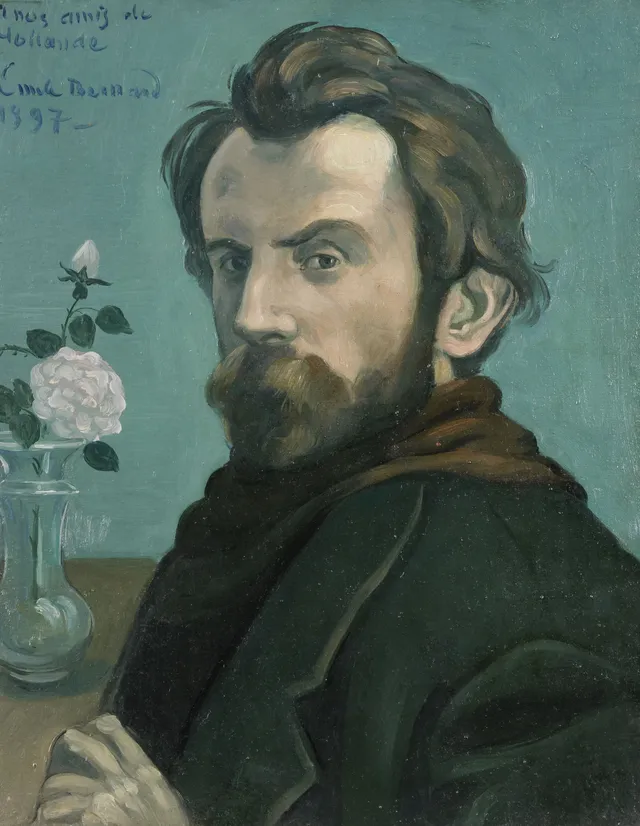
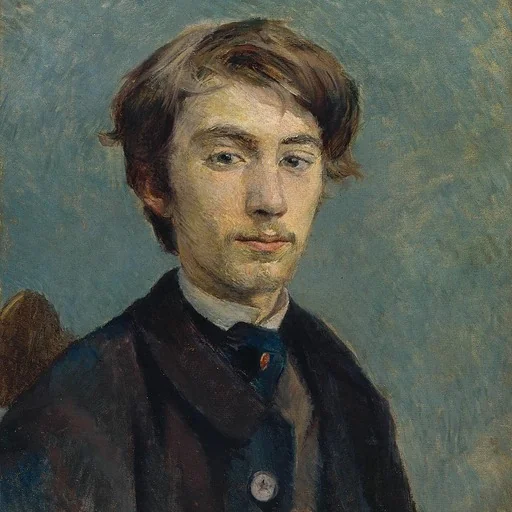
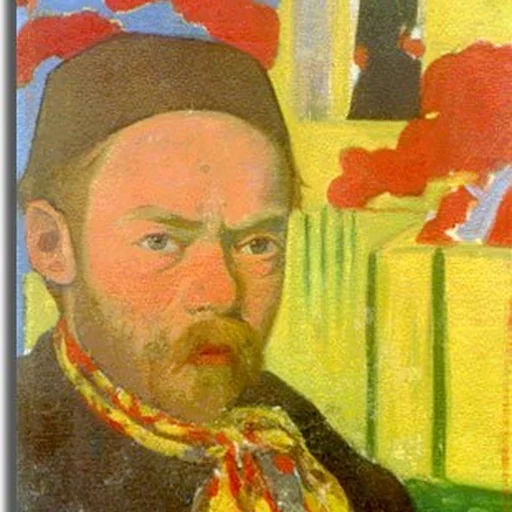
Cloisonnism quickly merged into the closely related Synthetism that Gauguin and Bernard forged together, which charged the same flat, outlined forms with greater emotional and symbolic intensity. Through Sérusier and the Nabis, and onward to Art Nouveau and the Fauves, its insistence that colour and contour could carry meaning independent of naturalistic description became foundational to modern art. The catalogue holds Bernard's 'Self Portrait' among works tied to the movement.
Key artists
Works
Frequently asked questions
What is Cloisonnism?
Cloisonnism is an art movement. A Post-Impressionist technique developed by Émile Bernard and Paul Gauguin around 1888 that uses flat areas of color bounded by dark outlines, recalling medieval cloisonné enamel and stained glass.
Who are the key Cloisonnism artists?
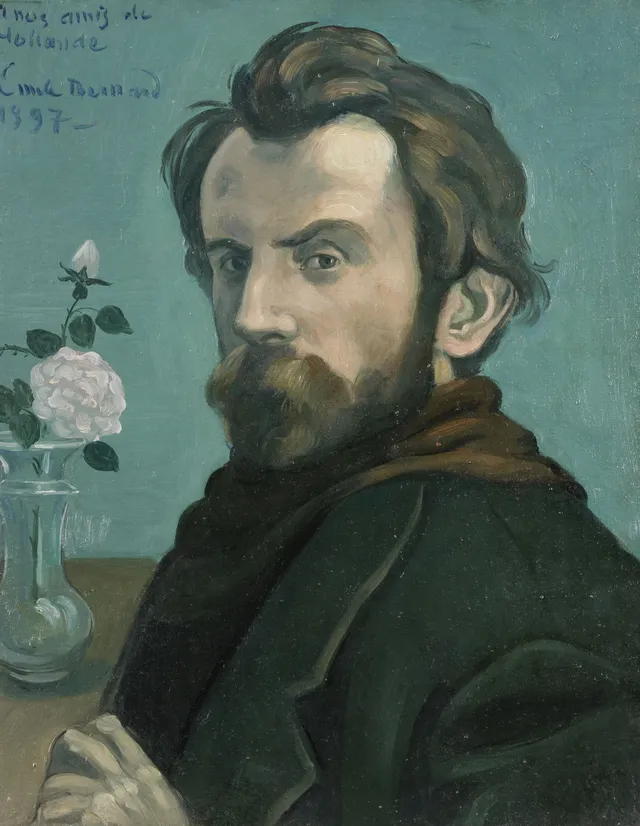
Key Cloisonnism artists in the collection include Paul Gauguin, Émile Bernard and Meijer de Haan.
When did Cloisonnism take place?
Cloisonnism dates from 1880–1900.
Where can I see Cloisonnism works?
Cloisonnism works in the collection are held by Rijksmuseum.