Artwork
Monkeys by a Stream
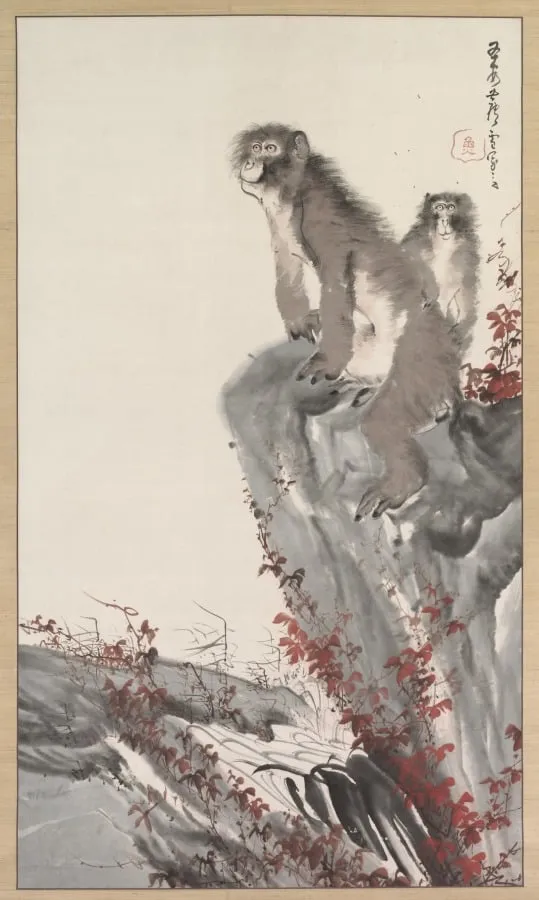
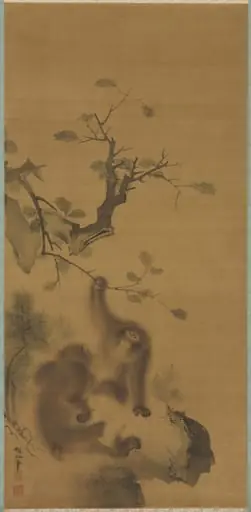
Monkeys by a Stream is an unspecified painting by the Nihonga artist Nagasawa Rosetsu. It dates from 1796 and is held in the collection of the Cleveland Museum of Art. The painting depicts two Japanese macaques perched on a rock that crowns a swift mountain stream.
- Accession no.
- 1985.192
- Credit line
- Leonard C. Hanna Jr. Fund
About this work
Look up more works from the Edo period (1615–1868) to see how other artists brought animals to life.
Two monkeys sit on a rock above a rushing stream. One swings a leg over the edge; the other stares straight at you.
Rosetsu painted them with quick, confident strokes, ink washes for the water, bold lines for fur. The monkeys feel alive, not posed. The scene is simple, but the way the light and dark shapes play together makes it feel deep.
Look up more works from the Edo period (1615–1868) to see how other artists brought animals to life.
Overview
The painting depicts two Japanese macaques perched on a rock that crowns a swift mountain stream. The larger monkey leans forward, its left leg hanging over the jagged edge, while the smaller one sits behind, gazing directly outward as if aware of an observer. The composition is concise, focusing on the interaction between the animals and the surrounding water.
Subject & Meaning
The work captures a moment of alert attention: the front macaque surveys the terrain beyond the water, suggesting vigilance, whereas the rear figure’s steady stare conveys a sense of being watched. Together they evoke the heightened mental engagement typical of primates in a natural setting, emphasizing observation and presence.
Technique & Style
Executed with swift, assured brushwork, the artist employs ink washes to render the flowing stream and applies bold, fluid lines for the monkeys’ fur. A limited palette of contrasting warm and cool hues heightens the visual tension, while the sweeping strokes impart a sense of immediacy and movement.
History & Provenance
Created during Japan’s Edo period (1615–1868), the painting reflects the era’s interest in realistic animal studies. It is attributed to the artist Rosetsu, known for his rapid, confident handling of ink and color in depictions of wildlife.
Context
Edo‑period artists frequently explored animal subjects, using them to demonstrate technical skill and to convey subtle narratives about nature and human observation. This piece aligns with that tradition, presenting a natural scene with minimal background while focusing on the expressive qualities of the macaques.
Artist & collection

Artist
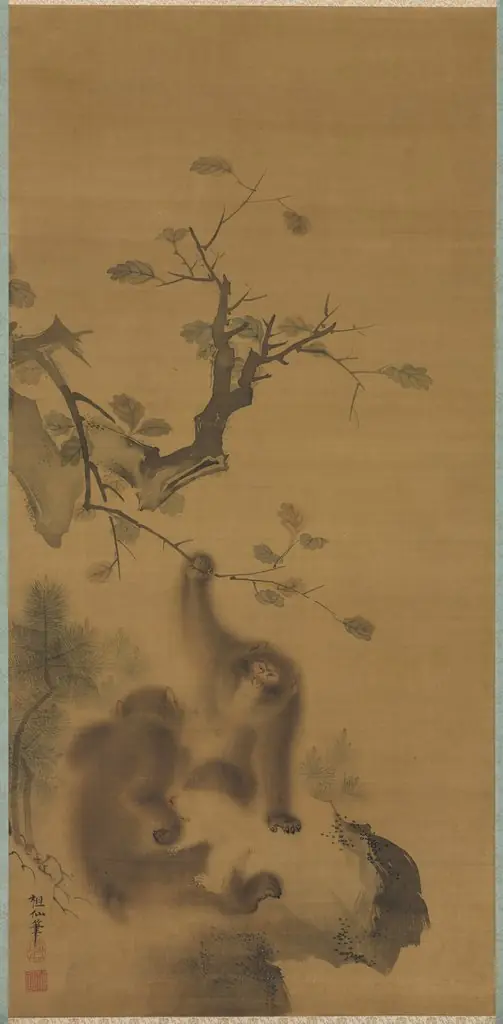
Nagasawa Rosetsu (長沢芦雪; 1754–1799) was a Japanese painter during the Edo period. A disciple of the Maruyama School, he was known for his versatile artistic style. He was born to the family of a low-ranking samurai. He…