Artwork
Crucifixion
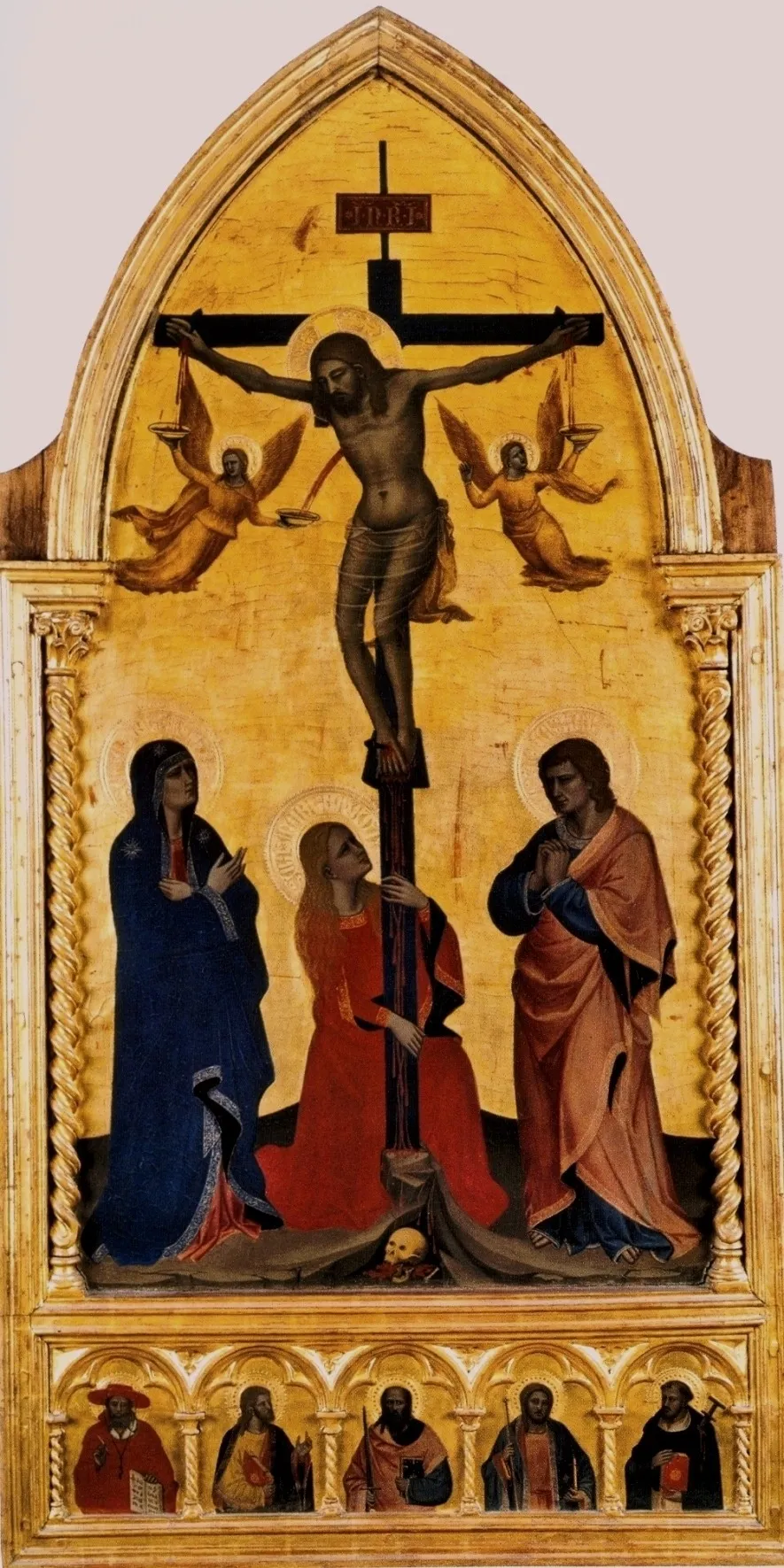
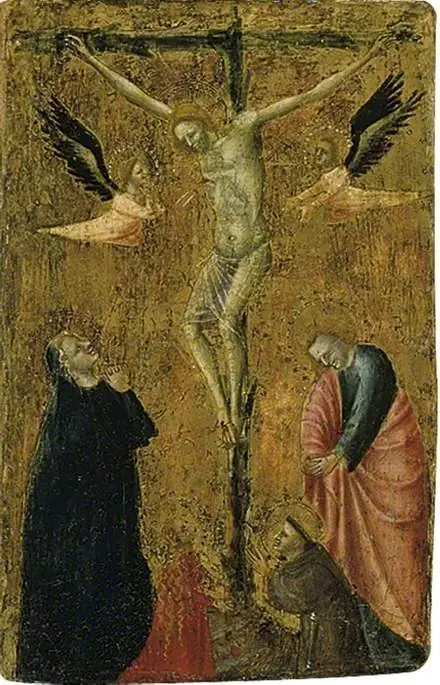
Crucifixion is a tempera painting by the Byzantine icon painting artist Nardo di Cione. It dates from 1350 and is held in the collection of the Uffizi Gallery.
About this work
Subject & Meaning
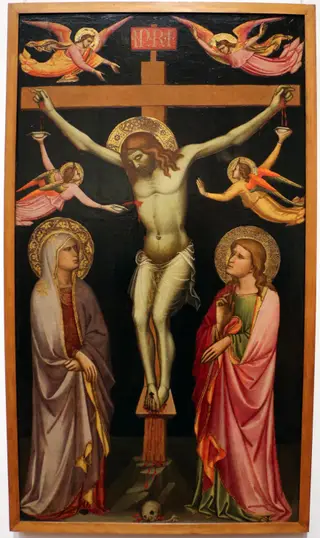
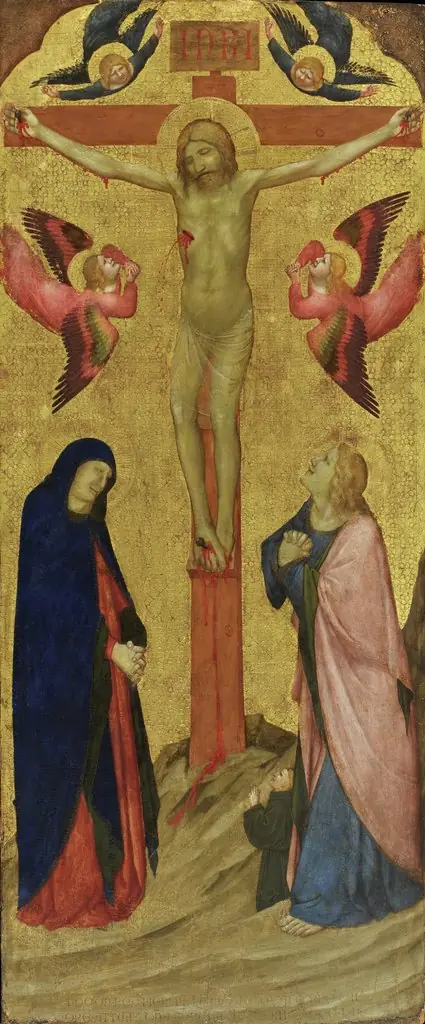
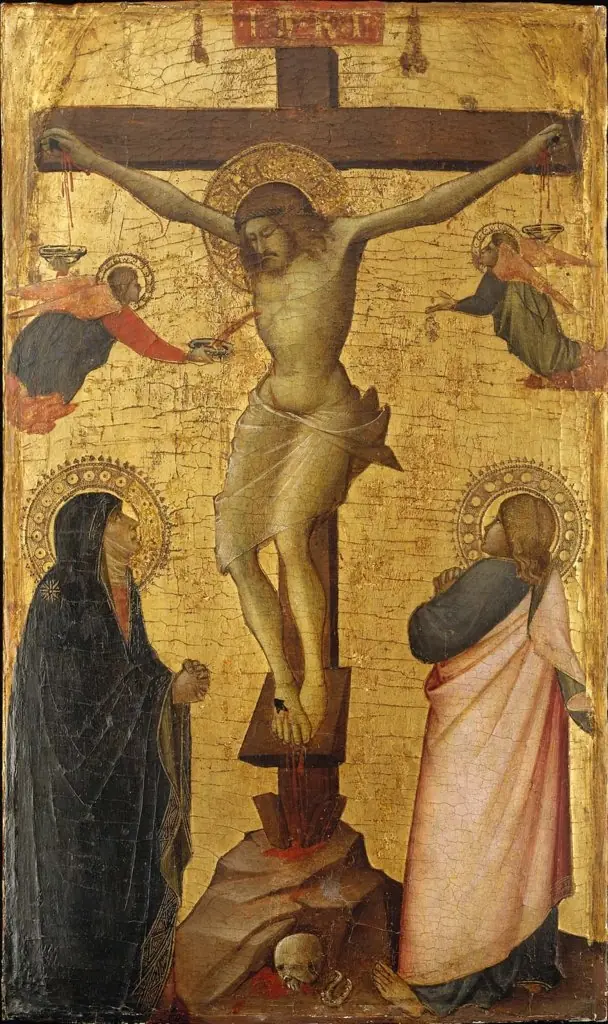
The iconography emphasizes dramatic and macabre details, specifically showing two angels collecting the copious blood flowing from Christ's wounds in basins.
The work depicts the Crucifixion of Jesus Christ as its central subject, set against a gold background with a minimal representation of Golgota at the base. The iconography emphasizes dramatic and macabre details, specifically showing two angels collecting the copious blood flowing from Christ's wounds in basins. This blood streams down the cross to reach a skull at the foot of the structure, a traditional symbol of Adam, yet notably avoids staining the hands of Mary Magdalene, who is shown embracing the cross.
Flanking the central figure are the three mourners: the Virgin Mary, the apostle John, and Mary Magdalene. Below the main scene, a predella-like section features five relief arches containing half-length figures of saints, including Jerome, an evangelist, Paul, James the Greater, and Anthony Abbot. The composition serves as a devotional focus on the physical suffering of Christ and the grief of his followers.
Technique & Style
The Crucifixion is executed in tempera on wooden panel, measuring 145 cm in height and 71 cm in width. The surface bears a gilded, cusped frame with twisted columns, and the composition is set against a gold background with a minimal landscape indication of Golgotha. The central figure of Christ is rendered with heavy emphasis on macabre details such as copious blood flowing from the wounds and onto a skull at the base, while angels collect the blood in basins.
Flanking the crucifix are the three ‘dolenti’, the Virgin Mary, Mary Magdalene embracing the cross, and Saint John, positioned beneath a predella of five trilobed reliefs depicting saints. The pigments have darkened over time due to alteration of the original egg‑based varnish, a condition that persisted after the 1994 restoration by Alfio Del Serra.
History & Provenance
The Crucifixion is a tempera painting on panel measuring 145 by 71 centimeters, created around 1350 by Nardo di Cione. It was likely the central panel of an unknown-origin tabernacle and entered the Galleria dell'Accademia in 1842 before moving to the Uffizi in 1948 following a reorganisation of Florentine collections. The work was attributed to Nardo di Cione by Sirèn and is presently housed in the Uffizi Gallery in Florence.
Its provenance reflects a documented chain of ownership within Florentine institutions, with no earlier recorded patrons prior to its 19th-century institutional adoption.
The painting Crucifixion by Nardo di Cione is held in the Uffizi Gallery in Florence, Italy, with the inventory number that corresponds to its accession into the collection, though the exact accession number is not specified in the provided sources. It was originally part of an uncertainly documented tabernacle and entered the Galleria dell'Accademia in 1842 before being transferred to the Uffizi in 1948 following the reorganization of Florentine collections. The work was attributed to Nardo di Cione by the scholar Sirèn, recognizing him as a prominent member of the Orcagna family.
The artwork measures 145 cm in height and 71 cm in width, and has been exhibited in museum settings as part of the Uffizi's curated displays, including featured presentations in scholarly publications such as Gloria Fossi's 2004 work on the Uffizi.
Exhibition history is not detailed in the provided sources, but the painting has been part of institutional viewings within the Uffizi Gallery, particularly in contexts related to 14th-century Florentine art and religious painting. Its conservation, including a 1994 restoration by Alfio Del Serra, reflects ongoing efforts to preserve its condition.
The work remains accessible through the Uffizi's official catalog, as referenced in their Polymuseale system.
Context
The Crucifixion by Nardo di Cione has been situated within the broader production of the Orcagna workshop, where the artist is noted for a more expressive figural style compared to his brothers. Scholarly attribution to Nardo was consolidated by Osvald Sirén, who distinguished the panel’s heightened emotional tenor within the context of mid-fourteenth-century Florentine painting.
The work’s original function as the central panel of a tabernacle remains conjectural, yet its later institutional trajectory reflects Florence’s collection reorganizations: after entering the Accademia in 1842, it was transferred to the Uffizi in 1948. Technical observations, including the darkened egg-white varnish noted in a 1994 restoration by Alfio Del Serra, underscore the altered chromatic and material conditions that complicate modern readings of its original visual impact.
Overview
Nardo di Cione's Crucifixion is a tempera painting from circa 1350, depicting the central event of Christian faith. The work is part of the Uffizi Gallery's collection.
Artist & collection


![Saint John the Evangelist [right panel], by Nardo di Cione](https://artifactworldgallery.com/img/nardo-di-cione--saint-john-the-evangelist-right-panel--fdd92c8ff7afceaf-w320.webp) Saint John the Evangelist [right panel]
Saint John the Evangelist [right panel]![Saint Peter [left panel], by Nardo di Cione](https://artifactworldgallery.com/img/nardo-di-cione--saint-peter-left-panel--df6a39da35a16159-w320.webp) Saint Peter [left panel]
Saint Peter [left panel]![Madonna and Child, with the Man of Sorrows [middle panel], by Nardo di Cione](https://artifactworldgallery.com/img/nardo-di-cione--madonna-and-child-with-the-man-of-sorrows-middle-panel--5ab4de48523071e4-w320.webp) Madonna and Child, with the Man of Sorrows [middle panel]
Madonna and Child, with the Man of Sorrows [middle panel]![Madonna and Child, with Saints Peter and John the Evangelist, and Man of Sorrows [entire triptych], by Nardo di Cione](https://artifactworldgallery.com/img/nardo-di-cione--madonna-and-child-with-saints-peter-and-john-the-evangelist--a57f261be4c5dd48-w320.webp) Madonna and Child, with Saints Peter and John the Evangelist, and Man of Sorrows [entire triptych]
Madonna and Child, with Saints Peter and John the Evangelist, and Man of Sorrows [entire triptych] the Saints John the Baptist, Egidius, Gerard of Villamagna, Paul and Catherine (or Miniato)
 the Saints Peter, Benedict, Julian (?), Stephan (?), and a holy bishop (Nicholas of Bari?)
 Christ Blessing