Artwork
The Crucifixion of Christ
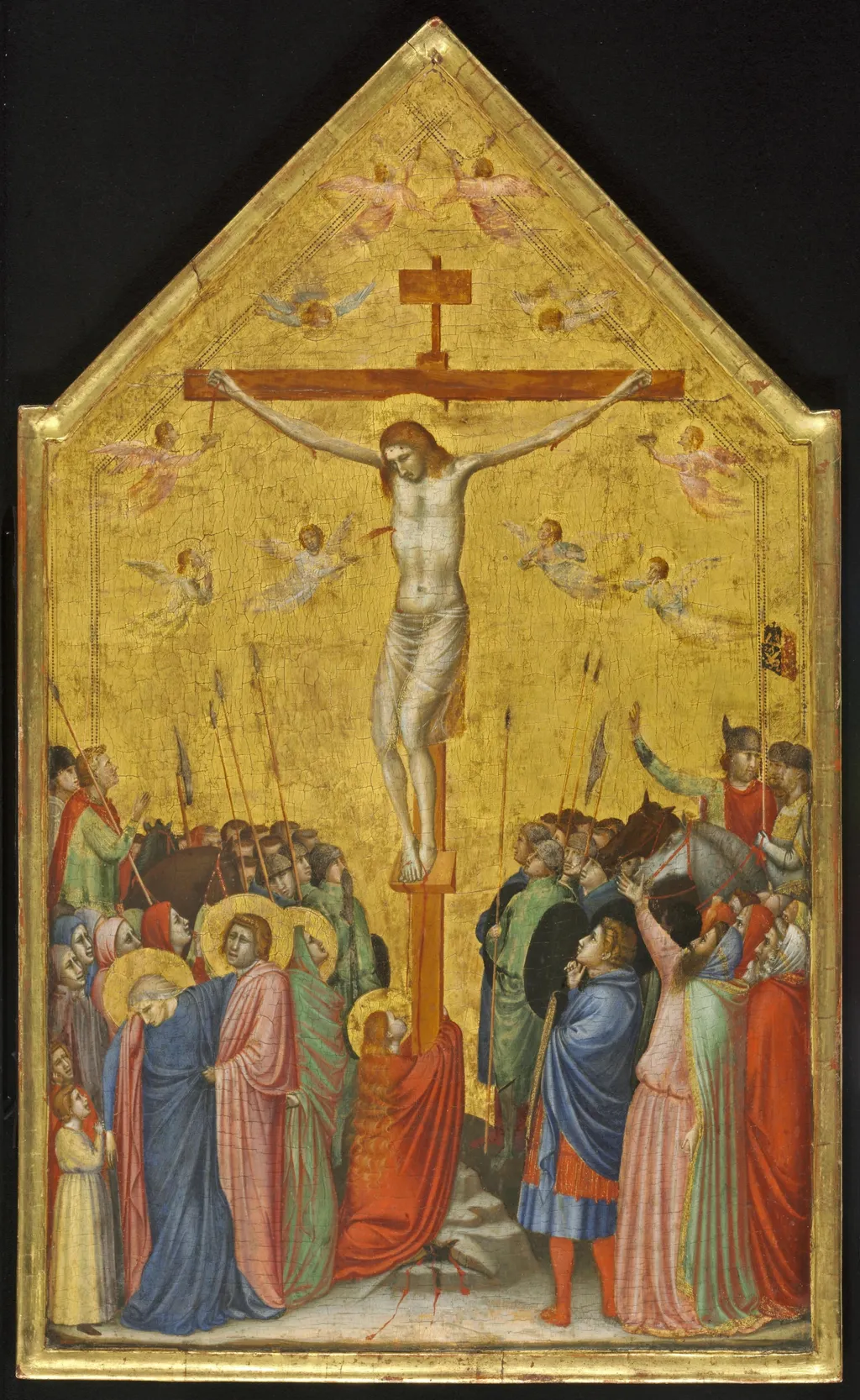
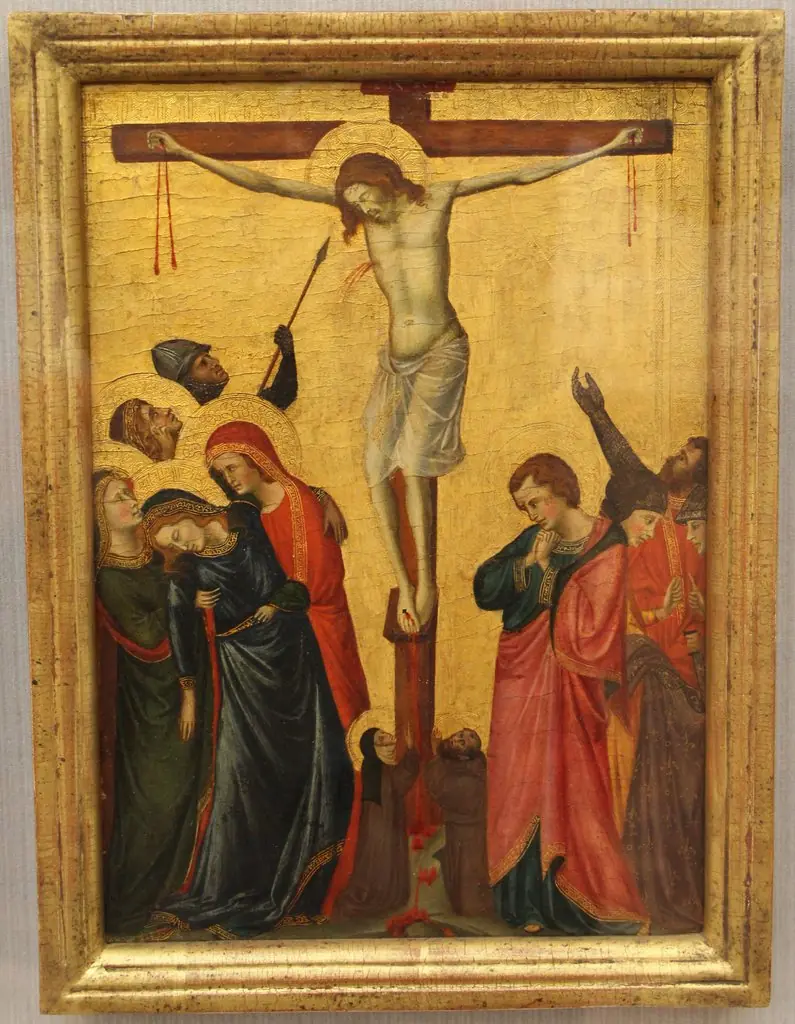
The Crucifixion of Christ is a tempera painting by the Byzantine icon painting artist Giotto. It is held in the collection of the Gemäldegalerie Berlin.
About this work
Subject & Meaning
This composition marks a turning point in traditional iconography, building upon experimental innovations seen in Giotto's earlier Scrovegni Chapel frescoes.
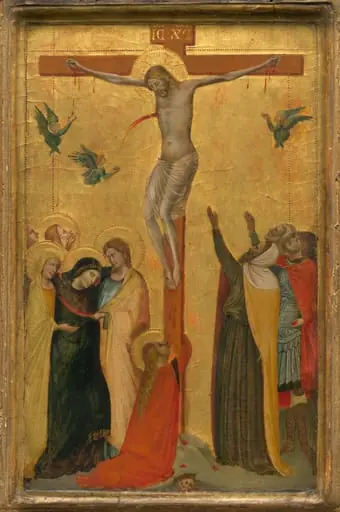
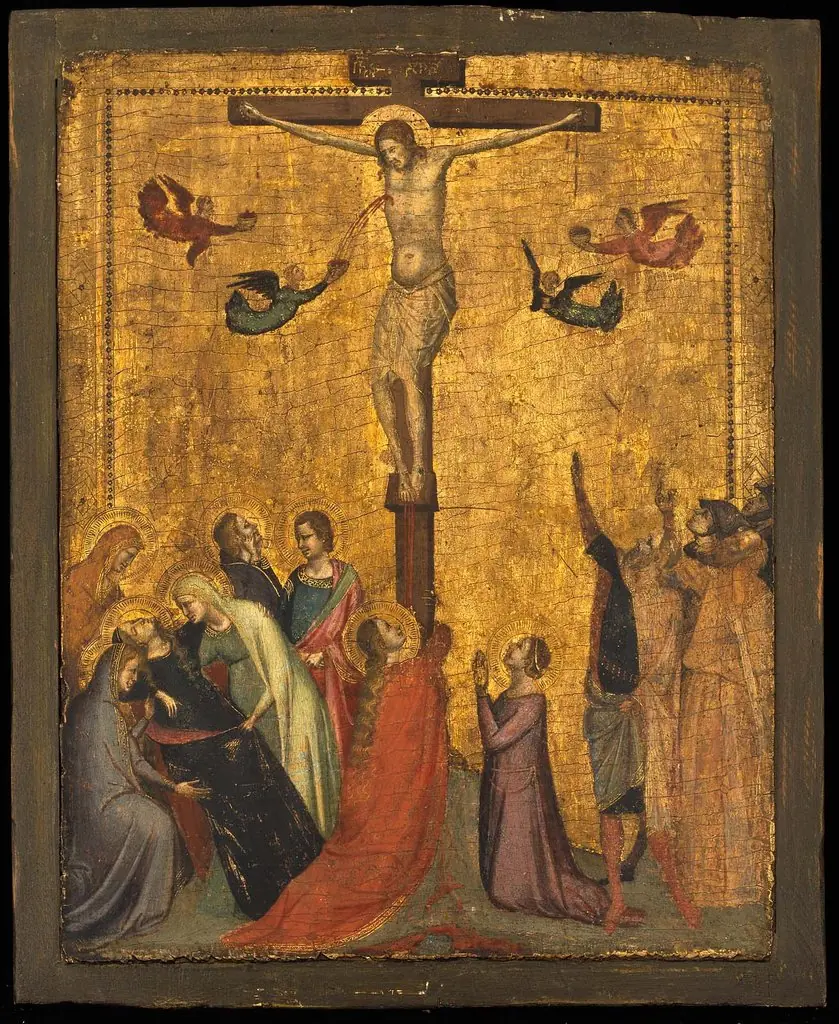
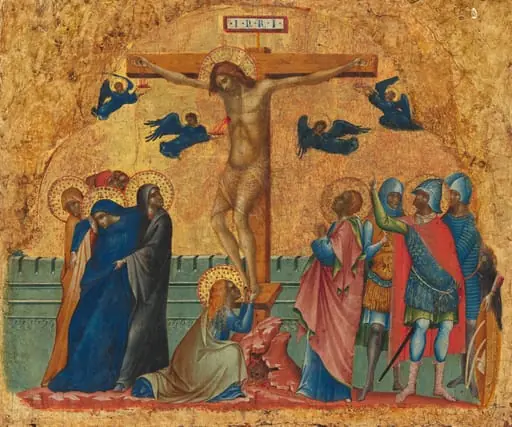
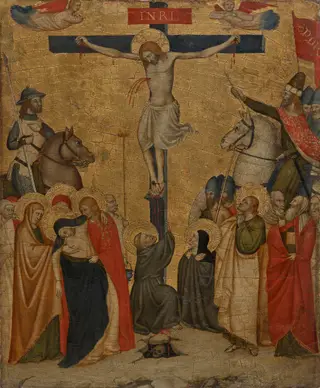
The painting depicts the crucifixion of Jesus Christ, presenting the central figure on a cross that rises hieratically against a uniform gold ground. This composition marks a turning point in traditional iconography, building upon experimental innovations seen in Giotto's earlier Scrovegni Chapel frescoes. The scene is populated by sorrowful angels surrounding Christ, while Mary Magdalene, dressed in red, embraces the base of the cross.
Flanking the central event are two distinct groups: on the left, a gathering of women supports a fainting Mary, accompanied by a worried young girl; on the right, Saint John the Baptist stands near a man on horseback raising his arm. This gesture by the horseman is a traditional symbol representing the recognition of Jesus as the Son of God amidst the natural turmoil of the event. Christ himself is rendered with an unusually thin, almost filament-like physique, departing from the heavy gravity found in earlier depictions like the Santa Maria Novella crucifix.
Technique & Style
Executed circa 1320, this small-format work is a tempera and gold painting on a poplar panel. The composition features a uniform gold ground that isolates the central figure of Christ, whose body is rendered with an unusually thin, almost filament-like quality. This depiction contrasts sharply with the heavier sense of gravity found in Giotto's earlier Santa Maria Novella Crucifix.
The artist employs voluminous drapery, a stylistic marker associated with the master's late period, similar to frescoes in the Bardi and Peruzzi Chapels. Surrounding the cross are sorrowful angels and distinct groups of mourners, including Mary Magdalene embracing the cross base. A distinctive formal device involves cropping the figures at the lateral edges, creating an illusion of a crowd extending beyond the physical boundaries of the panel.
History & Provenance
Attributed to Giotto di Bondone, this tempera and gold panel painting was created circa 1320, though some records specify the year 1317. Wilhelm von Bode conducted the initial studies attributing the work to Giotto, a view later challenged by critics such as Roberto Longhi in 1948 before he eventually reaffirmed the master's authorship. Alternative theories proposed by William Suida, Pietro Toesca, and Richard Offner suggested the hand of a "Master of the Strasbourg Crucifixion," while Roberto Salvini classified it as the work of a follower.
Despite these debates, scholars generally agree the piece originates from the artist's late period, evidenced by the voluminous drapery similar to that found in the Bardi and Peruzzi Chapels. The work is currently held in the collection of the Gemäldegalerie in Berlin.
The Crucifixion of Christ, a tempera painting on poplar panel measuring 59.7 cm by 36.2 cm, is housed in the Gemäldegalerie in Berlin, specifically in Room 41.
The work entered the Gemäldegalerie's collection through a purchase in the early 19th century, with its accession recorded as 1831. It was first studied and attributed to Giotto by Wilhelm von Bode, though later scholarship, including critiques by Roberto Longhi in 1948 and subsequent attributions to a 'Master of the Strasbourg Crucifixion' or a follower of Giotto, sparked debate over its authorship.
Exhibition history includes its display in the Gemäldegalerie's permanent collection since its acquisition, with no major traveling exhibitions documented in the provided sources. The painting has been part of scholarly discussions on Proto-Renaissance art and Giotto's late period, particularly regarding its stylistic elements such as voluminous drapery and innovative iconography.
Context
The Berlin Crucifixion occupies an unsettled position within Giotto scholarship, with attribution debated since the earliest modern studies. Wilhelm von Bode first assigned the panel to Giotto, but subsequent critics have been more skeptical. Roberto Longhi returned the work to the master in 1948, and Gnudi likewise read it as an example of Giotto's late style, while Roberto Salvini attributed it to a follower.
William Suida, Pietro Toesca, and Richard Offner instead proposed a "Master of the Strasbourg Crucifixion," linking the Berlin panel to other small-format works.
Despite these disagreements, scholars consistently place the painting in Giotto's late period, citing the voluminous drapery that also appears in the Bardi and Peruzzi Chapels at Santa Croce. The composition continues the iconographic innovations of Giotto's Scrovegni Chapel Crucifixion, situating the work within the trajectory of the Proto-Renaissance movement.
Overview
Created around 1320, this tempera and gold panel depicts the crucifixion of Christ. The composition centers on the cross‑bearing figure, surrounded by a densely populated crowd rendered in vivid garments. Angelic forms hover above against a luminous gold field, suggesting an interior church space. The work is presently housed in Berlin’s Gemäldegalerie.
Artist & collection