Artwork
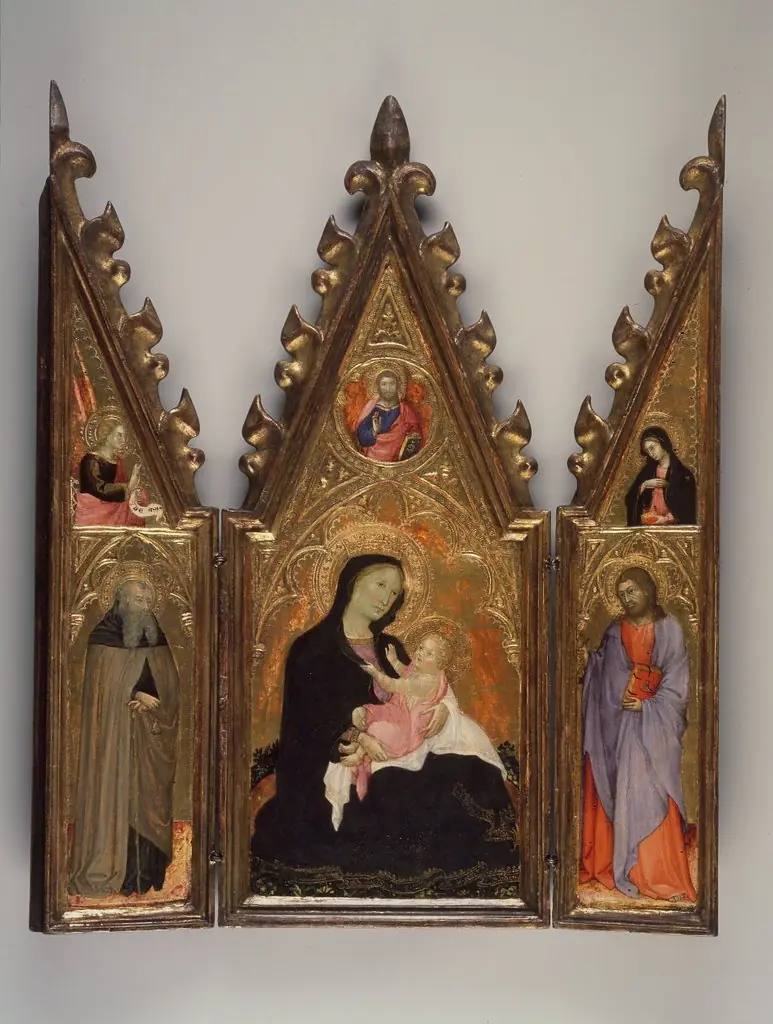
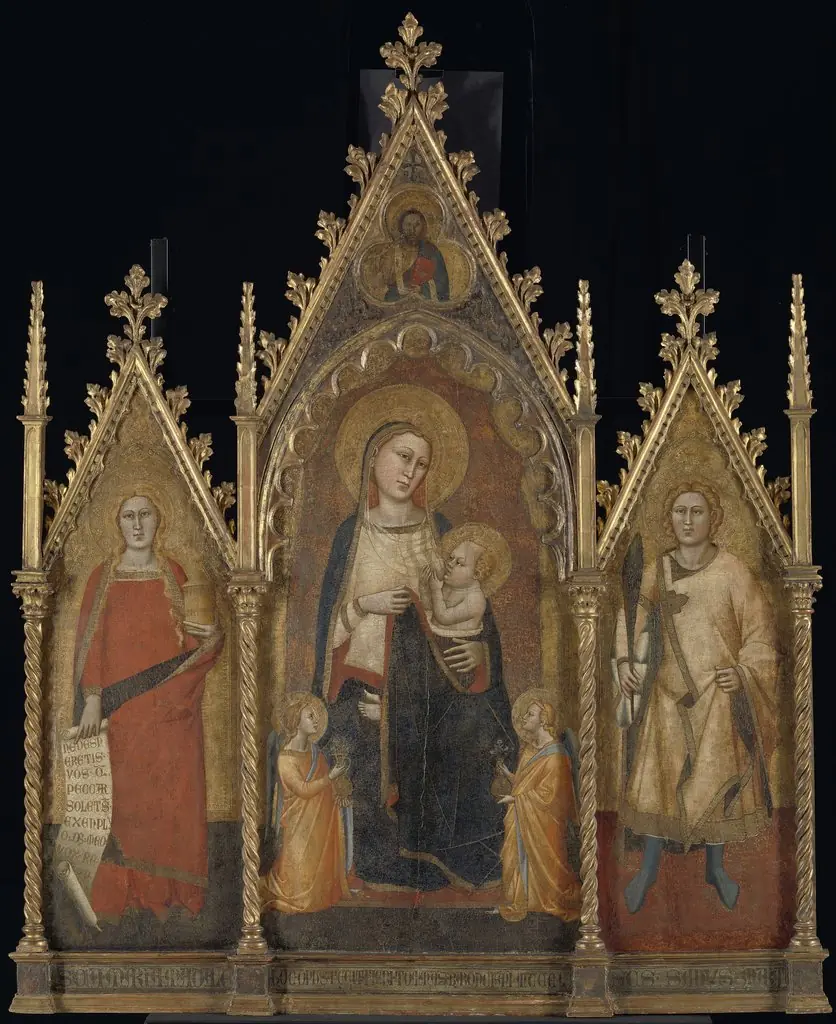
Madonna and Child, with Saints Peter and John the Evangelist, and Man of Sorrows [entire triptych]
![Madonna and Child, with Saints Peter and John the Evangelist, and Man of Sorrows [entire triptych], by Nardo di Cione, tempera, 1360](https://artifactworldgallery.com/img/nardo-di-cione--madonna-and-child-with-saints-peter-and-john-the-evangelist--a57f261be4c5dd48-w1024.webp)
Madonna and Child, with Saints Peter and John the Evangelist, and Man of Sorrows [entire triptych] is a tempera painting by the Byzantine icon painting artist Nardo di Cione. It dates from 1360 and is held in the collection of the National Gallery of Art.
- Inscription
- Inscribed:middle panel, on base of the frame: AVE.GRATIA.PLENA.DO[MINUS TECUM] (Hail, full of grace, the Lord is with thee; from Luke 1:28)
About this work
Technique & Style
The handling of the medium and the formal qualities align with the artistic practices of Nardo di Cione during this period.
The triptych is executed in tempera on panel, a standard medium for Florentine painting of the mid-fourteenth century. Created in 1360 by Nardo di Cione, the work measures 76 cm in height and 66.4 cm in width. The physical support consists of wooden panels, which served as the foundation for the tempera application.
Stylistically, the piece is classified within the religious genre, reflecting the devotional conventions of its time. The handling of the medium and the formal qualities align with the artistic practices of Nardo di Cione during this period.
History & Provenance
Nardo di Cione executed this triptych in 1360 using tempera on panel. The work entered the collection of Gustav Adolf Wilhelm von Ingenheim during the first half of the nineteenth century, likely acquired in Italy between 1820 and 1840. Following its residence with the Ingenheim family at Schloss Reisewitz in Silesia, the painting was sold in 1922 to the Munich dealer A.S. Drey.
Henry Goldman of New York purchased the triptych in 1923. After Goldman's death, the Duveen Brothers acquired the work in January 1937 and subsequently sold it later that year to the Samuel H. Kress Foundation. The foundation donated the painting to the National Gallery of Art in Washington, D.C., in 1939.
The triptych is housed in the National Gallery of Art in Washington, D.C., where it is part of the Samuel H. Kress Collection. It entered the museum’s holdings through a series of transactions: after being owned by the Ingenheim family and sold to Henry Goldman in 1923, it was acquired by Duveen Brothers in January 1937 and subsequently purchased by the Samuel H. Kress Foundation in 1937; the foundation gifted the work to the National Gallery of Art in 1939. The piece is catalogued under the collection designation of the Samuel H. Kress Collection, though a specific inventory number is not provided in the source documentation.
Legacy
The triptych entered the Samuel H. Kress Collection and has been part of the National Gallery of Art since 1939, becoming a reference work for studies of Nardo di Cione and 14th‑century Florentine panel painting.
Art historians such as Offner have used the work to trace the development of the Madonna‑Child motif and to contextualize Nardo’s stylistic evolution, cementing its reputation as a key example in the historiography of early Italian art.
Its documented provenance from 19th‑century collectors to the Kress Foundation illustrates the trajectory of European artworks in the American market, further enhancing its scholarly stature.
Overview
Nardo di Cione's Madonna and Child, with Saints Peter and John the Evangelist, and Man of Sorrows is a religious triptych executed in tempera on panel around 1360. This three-part altarpiece presents a central devotional image flanked by two saints, characteristic of sacred art from the late medieval period. It reflects the artistic conventions and spiritual focus prevalent in Italian painting during the mid-14th century.
Subject & Meaning
The central panel depicts the Madonna, clad in a blue robe, cradling the Christ Child, framed by a golden arch. To her left, Saint Peter is identifiable by the keys he holds, while Saint John the Evangelist gestures from the right panel. The triptych also includes the "Man of Sorrows," a representation of Christ's suffering. These figures collectively convey core Christian narratives and devotional themes.
Context
Created in the mid-14th century, this triptych exemplifies the religious art produced for churches or private devotion during the period. The Latin inscription at the bottom of the panels further underscores its sacred purpose, as Latin was the liturgical language of the Western Church. Nardo di Cione, a Florentine painter, contributed to a tradition of devotional imagery that emphasized spiritual contemplation.
![Madonna and Child, with the Man of Sorrows [middle panel]](https://artifactworldgallery.com/img/nardo-di-cione--madonna-and-child-with-the-man-of-sorrows-middle-panel--5ab4de48523071e4-w320.webp)
Own this work as a print
Artist & collection


![Saint John the Evangelist [right panel], by Nardo di Cione](https://artifactworldgallery.com/img/nardo-di-cione--saint-john-the-evangelist-right-panel--fdd92c8ff7afceaf-w320.webp) Saint John the Evangelist [right panel]
Saint John the Evangelist [right panel]![Saint Peter [left panel], by Nardo di Cione](https://artifactworldgallery.com/img/nardo-di-cione--saint-peter-left-panel--df6a39da35a16159-w320.webp) Saint Peter [left panel]
Saint Peter [left panel]- Madonna and Child, with the Man of Sorrows [middle panel]
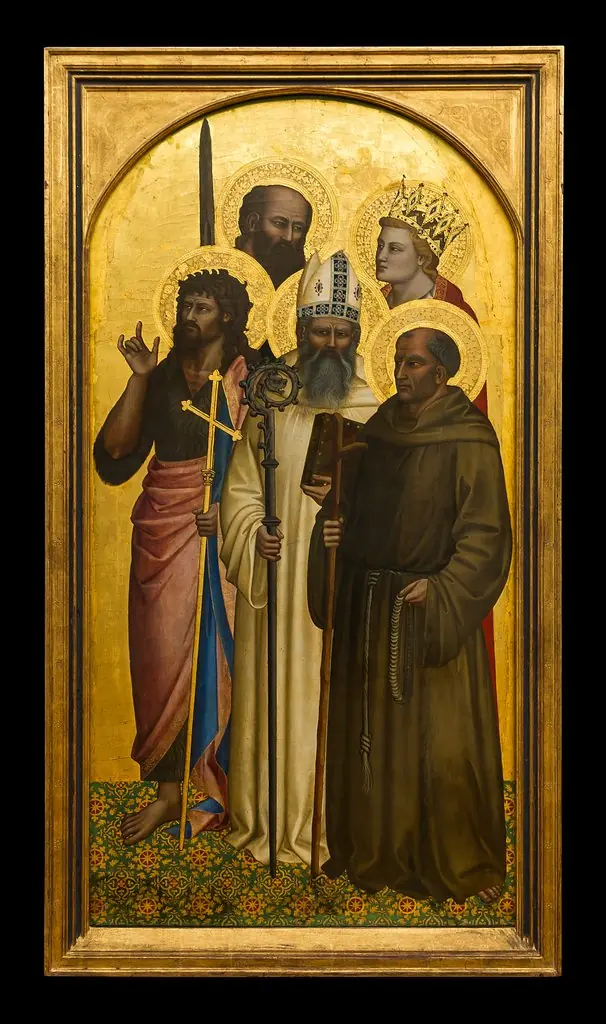 the Saints John the Baptist, Egidius, Gerard of Villamagna, Paul and Catherine (or Miniato)
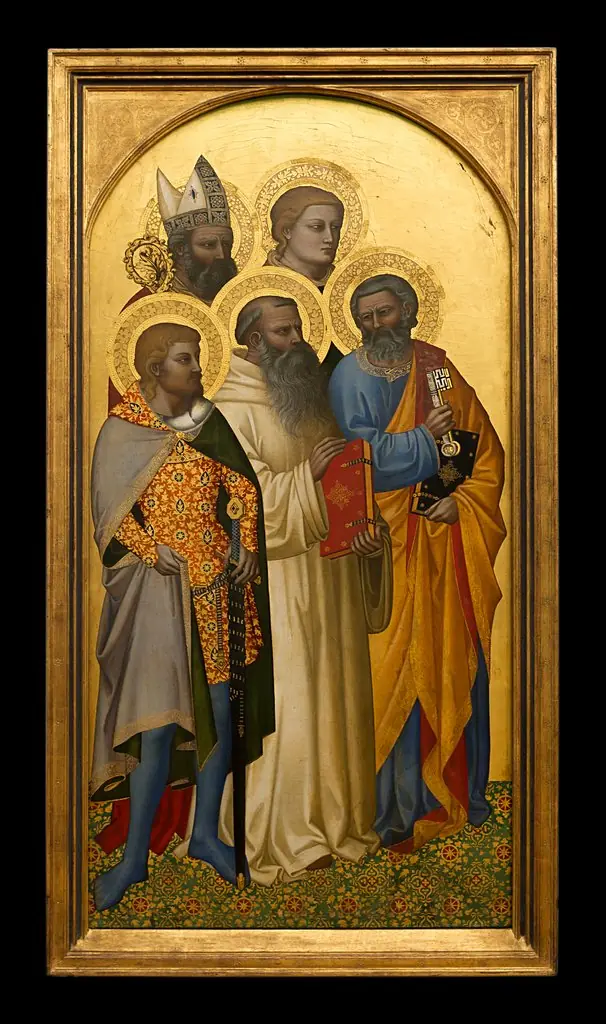 the Saints Peter, Benedict, Julian (?), Stephan (?), and a holy bishop (Nicholas of Bari?)