Artwork
Portrait of a Lady
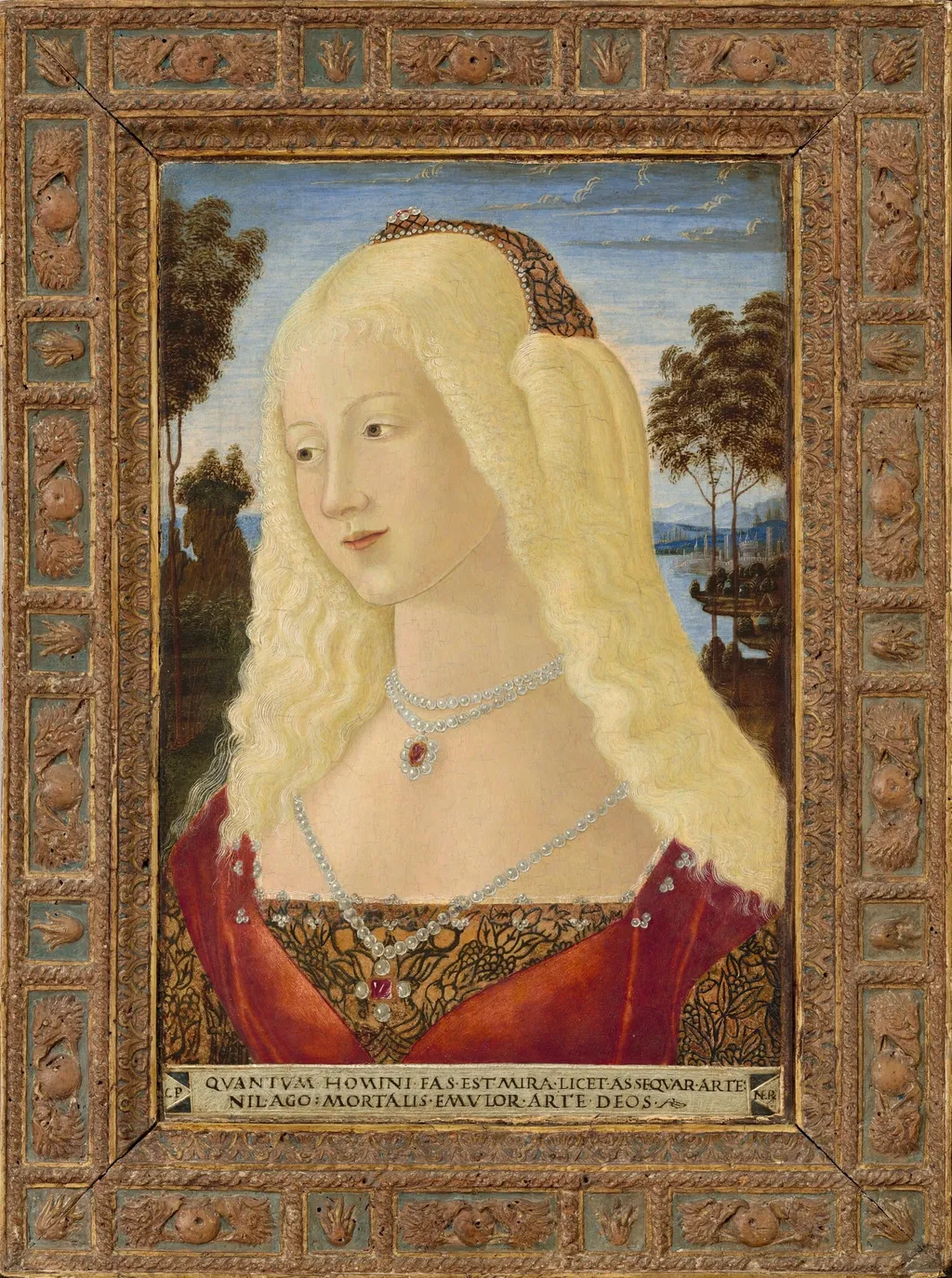
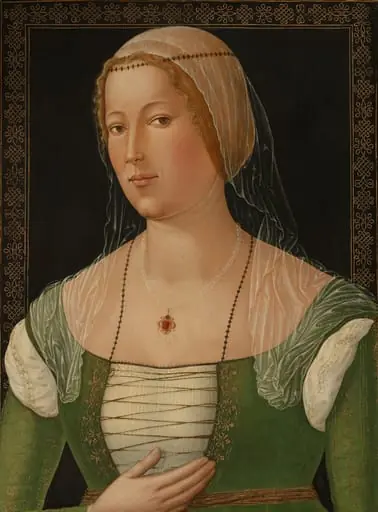
Portrait of a Lady is a tempera painting by the Early Renaissance artist Neroccio de' Landi. It dates from 1485 and is held in the collection of the National Gallery of Art.
- Inscription
- Inscribed:across bottom: QVANTVM.HOMINI.FAS.EST.MIRA.LICET.ASSEQVAR.ARTE. / NIL.AGO:MORTALIS.EMVLOR.ARTE.DEOS. (Whatever a human being is permitted to, I attain through my prodigious art; yet, a mortal competing with gods, my effort is useless); lower left in triangle: O.P.[?]; lower right in triangle: NER
About this work
Subject & Meaning
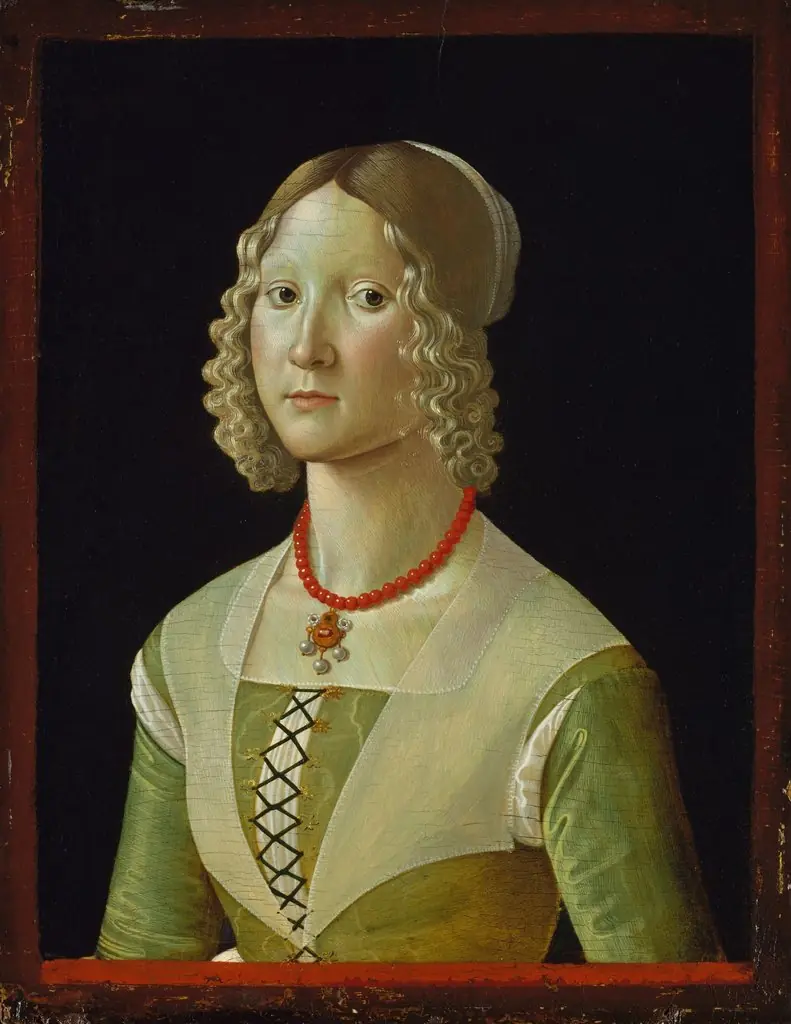
Visual iconography emphasizes her status and allure through detailed rendering of pale skin, abundant golden hair, pearl necklaces, and embroidered garments.
The work depicts an unidentified young woman, presented in a three-quarter view with head and shoulders, a composition derived from Flemish portraiture conventions. Her identity remains unknown, though scholar Max Seidel has suggested she may be a daughter of Bandino Bandini, a hypothesis supported by the family coat of arms embedded in the painting's original frame. The subject's meaning is explicitly articulated through Latin inscriptions on the panel, which praise her beauty while simultaneously asserting the limits of human artistry compared to the divine.
Visual iconography emphasizes her status and allure through detailed rendering of pale skin, abundant golden hair, pearl necklaces, and embroidered garments. The composition invites close inspection of these physical traits, reinforced by a distant background of water and slender trees that isolates the figure and intensifies the viewer's engagement with her presence.
Technique & Style
The work is executed in tempera on a pine panel, measuring approximately 47 × 31 cm, and is supported by a contemporary wooden frame that likely remains original. The surface bears an inscription of OP and NER, interpreted as OPUS NEROCCIO, underscoring the artist's authorship. Formal analysis notes a close‑up head‑and‑shoulders presentation, a shallow landscape background of water and trees, and a focus on the sitter's golden hair, pale skin, embroidered dress, and pearl necklaces, reflecting a blend of Sienese portrait conventions and Flemish influence. The handling of color and fine detail reveals the delicate texture typical of 15th‑century Italian portraiture.
History & Provenance
Created by Neroccio de' Landi, this tempera-on-panel portrait is dated to about 1485. The work bears an inscription interpreted as "OPUS NEROCCIO," confirming the artist's hand. Its documented provenance begins with Professor Luigi Grassi of Florence and Rome, who held the painting by June 1911.
It was subsequently acquired by Arthur J. Sulley & Co. in London by September 1911 and sold to Peter A.B. Widener in January 1912 for his Lynnewood Hall collection. Following Widener's death, the painting passed to his son Joseph E. Widener via inheritance. In 1942, Joseph E. Widener gifted the work to the National Gallery of Art in Washington, D.C., where it remains part of the permanent collection.
The painting was featured in the 1979 exhibition "Berenson and the Connoisseurship of Italian Painting" held at the National Gallery of Art.
Context
The Portrait of a Lady (c.1485, tempera on pine, 47 × 31 cm) is one of the few surviving Sienese portraits of the late 15th century and exemplifies Neroccio's adaptation of Flemish conventions to a distinctly Sienese idiom. Scholars note the work's dual inscription, OPUS NEROCCIO in the lower corners and a Latin laudatory verse, highlighting contemporary appreciation of the sitter's beauty and the artist's craft. The unidentified woman, possibly a member of the Bandini family, is rendered with delicate attention to hair, clothing, and jewelry, reflecting the period's emphasis on status display.
Its rare preservation of an original frame and its placement in the National Gallery of Art underscore its significance within Neroccio's oeuvre and the broader narrative of Italian Renaissance portraiture.
Overview
Neroccio de' Landi's Portrait of a Lady, executed in 1485, is a tempera on pine panel depicting a young woman in profile against a dark, neutral background. The sitter faces left, her gaze directed outward with a serene and composed expression. She wears a high-necked, dark garment with a simple white chemise visible at the neckline, reflecting the modest fashion of late 15th-century Siena.
Her hair is parted in the center and pulled back tightly, adorned with a delicate, translucent veil that frames her face. The artist employs the refined, linear elegance characteristic of his Sienese school, emphasizing graceful contours and soft modeling over dramatic chiaroscuro. The composition focuses entirely on the subject's head and shoulders, isolating her from any specific setting to highlight her individual presence and psychological stillness.
Created during the height of Neroccio's career, this work exemplifies his ability to blend the decorative grace of the International Gothic tradition with the emerging naturalism of the Italian Renaissance. It stands as a significant example of female portraiture from the period, capturing a quiet dignity through restrained color and precise draftsmanship.
Own this work as a print
Artist & collection