Artwork
Claudia Quinta
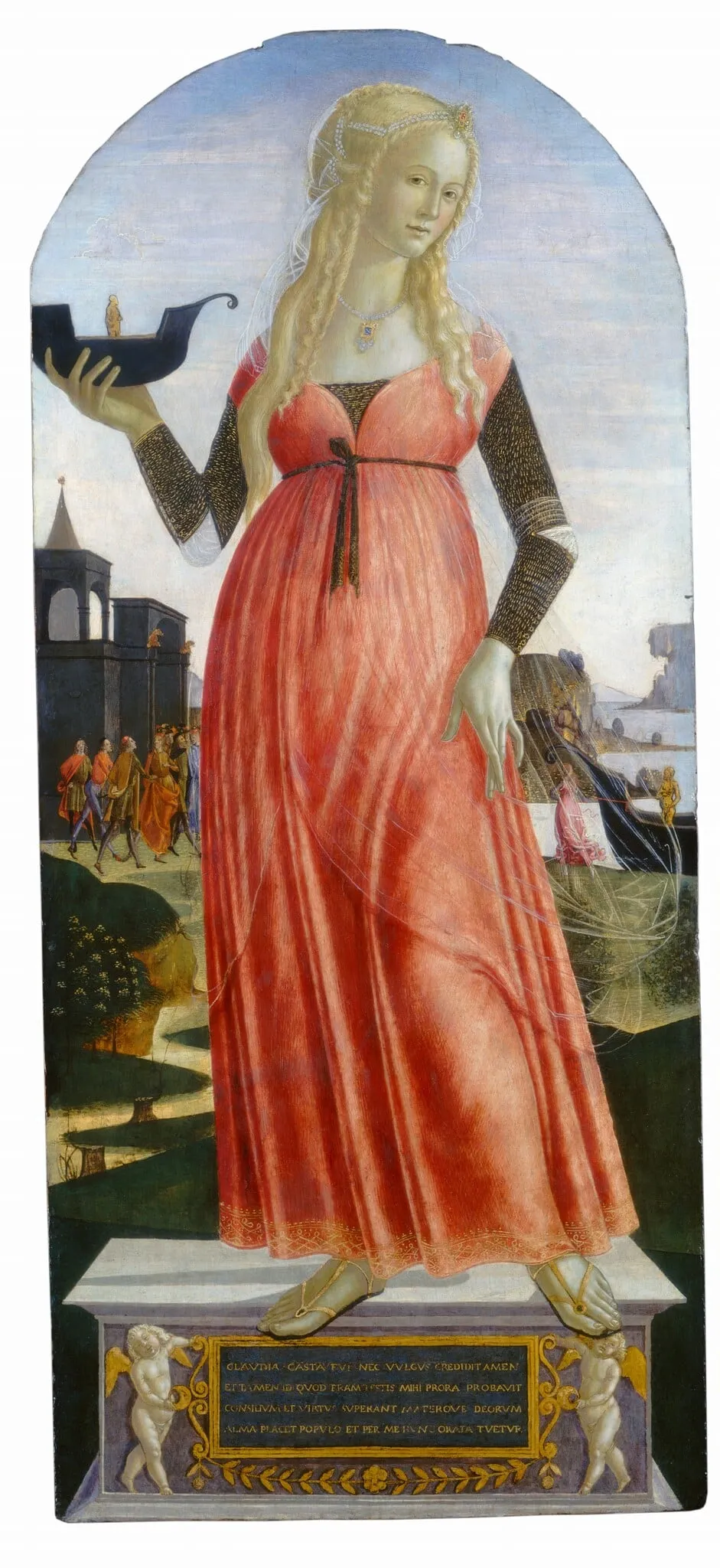
Claudia Quinta is a tempera painting by the Early Renaissance artist Neroccio de' Landi. It dates from 1492 and is held in the collection of the National Gallery of Art.
- Inscription
- Inscribed:lower center on the tablet of the pedestal: CLAVDIA CASTA FVI NEC VVLGVS CREDIDIT AMEN / ET TAMEN ID QVOD ERAM TESTIS MIHI PRORA PROBAVIT / CONSILIVM ET VIRTVS SVPERANT MATERQVE DEORVM / ALMA PLACET POPVLO ET PER ME HVNC ORATA TVETVR (I was Claudia the chaste, but men trusted not in my troth. And yet that which I was, the prow proved as my witness. Prudence and virtue triumph, and the Mother of the Gods [Cybele], she, the gracious one, is pleasing to the people and protects them when invoked through me)
About this work
Subject & Meaning
The background shows skeptics observing her act, tied to the legend of the voyage bringing the image of Cybele to Rome, in which she demonstrated divine favor.
The painting portrays Claudia Quinta, a Roman matron renowned for her chastity, embodying moral virtue. She is depicted standing on a pedestal with an inscription highlighting her purity, holding a boat containing a sacred stone, and pulling a ship ashore, referencing her miraculous proof of virtue against false accusations of unchastity. The background shows skeptics observing her act, tied to the legend of the voyage bringing the image of Cybele to Rome, in which she demonstrated divine favor.
This iconography underscores themes of faith vindicated and female resilience, aligning with the Piccolomini family's commission to celebrate virtues such as fidelity and constancy for their 1492–93 marriage.
The work functioned as a moral exemplum in the Renaissance tradition. Its symbolism draws from classical antiquity and Christian virtue, emphasizing divine intervention in earthly affairs.
Technique & Style
The painting is executed in egg tempera on a poplar panel measuring 105 × 46 cm. Neroccio de' Landi renders the standing figure of Claudia Quinta with a sculptural presence, richly dressed in a red gown and a translucent veil. Her right hand holds a small boat containing a sacred stone, while her left rests on a pedestal inscribed with Latin verses celebrating her chastity. Behind her, a two-part landscape unfolds with narrative scenes: to the left, doubting onlookers recoil as Claudia performs her miracle, and to the right, the miraculous towage of the ship is shown.
The handling is precise, with smooth modeling of the figure and delicate detailing of costume and accessories, while the background's architectural and landscape elements are rendered with refined linearity.
Recent studies have revisited attributions for the narrative passages, suggesting Neroccio's authorship may extend beyond the main figure.
History & Provenance
Probably commissioned by the Piccolomini family in Siena, this panel was likely created around 1490 to 1494 as part of a series celebrating virtues for the marriage of Silvio dei Piccolomini di Sticciano. While the central figure is attributed to Neroccio de' Landi, the background narrative scenes have historically been assigned to the Master of Griselda, though recent scholarship suggests Neroccio may have executed the entire work.
The painting entered the art market in Florence circa 1850 or 1860 before being acquired by Louis Charles Timbal in Paris. Timbal sold his collection to Gustave Dreyfus in 1872. Following Dreyfus's death, his heirs retained the work until 1930, when the Duveen Brothers purchased the entire collection.
The A.W. Mellon Educational and Charitable Trust acquired the panel in December 1936, donating it to the National Gallery of Art in 1937.
The painting is held by the National Gallery of Art in Washington, D.C., where it resides within the Andrew W. Mellon collection. While the artwork is part of a systematic catalogue of the gallery's holdings, the provided sources do not list specific exhibition histories or unique inventory accession numbers beyond its collection attribution.
Context
The painting's critical reception has long emphasized its division of labor between Neroccio de' Landi's figure of Claudia Quinta and the background narrative scenes traditionally assigned to the Master of Griselda. Recent reassessment, however, challenges this attribution split. Laurence B. Kanter argues that there are no sufficient grounds to exclude Neroccio from painting the narrative elements, thereby reframing the work's authorship and stylistic unity.
Technical studies by Jill Dunkerton, Carol Christensen, and Luke Syson further support reconsideration of the Master of Griselda's role within Sienese workshop practice of the 1490s.
Within its original Piccolomini context, the painting functioned as a moral exemplar in a series celebrating conjugal virtue, produced around the marriage of Silvio dei Piccolomini di Sticciano in 1492–93. Its iconography, Claudia Quinta's miraculous towing of the sacred ship, was read as an emblem of chastity vindicated, aligning with contemporary Sienese elite values. The work's later market history, from the Dreyfus collection to the Mellon Gift, has situated it within nineteenth- and twentieth-century transatlantic collecting narratives.
Overview
Painted in 1492, Neroccio de' Landi's 'Claudia Quinta' depicts the Roman matron who famously proved her chastity by miraculously pulling a ship grounded on the Tiber. The composition centers on the figure standing in three-quarter view, dressed in a vibrant red gown beneath a dark, sleeveless overdress, with loose blonde hair framing her face. She holds a small cup, likely referencing the libations offered to the goddess Cybele.
The background features a detailed landscape with a distant city, tiny figures, and the ship on the water, visually narrating the miracle. A Latin inscription on the lower frame identifies the subject and the event. Executed in tempera on poplar panel, the work exemplifies the refined Sienese style of the late 15th century, characterized by elegant linearity, soft modeling, and a harmonious color palette.
Created during the height of Neroccio's career in Siena, the painting reflects the period's interest in classical antiquity and moral exemplars, blending religious devotion with humanist themes. The delicate rendering of the figure and the atmospheric depth of the landscape demonstrate the artist's mastery in bridging Gothic traditions with emerging Renaissance naturalism.
Artist & collection


![The Archangel Gabriel [middle left panel], by Cosimo Tura](https://artifactworldgallery.com/img/cosimo-tura--the-archangel-gabriel-middle-left-panel--c900f72d54477be2-w320.webp)