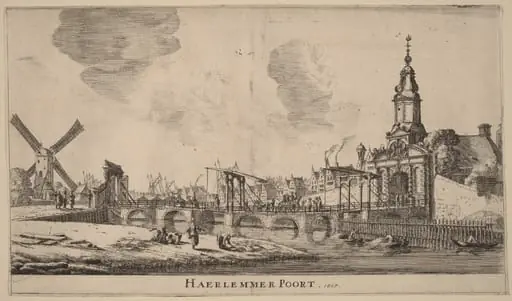
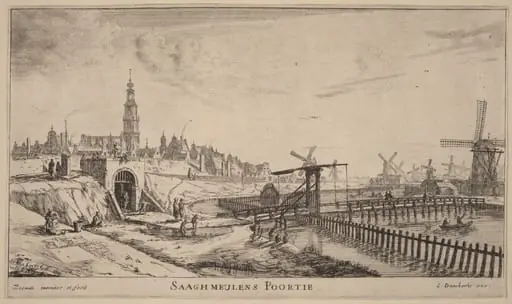
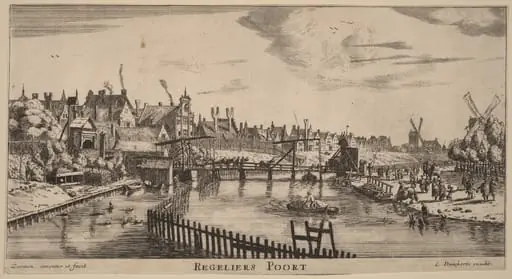
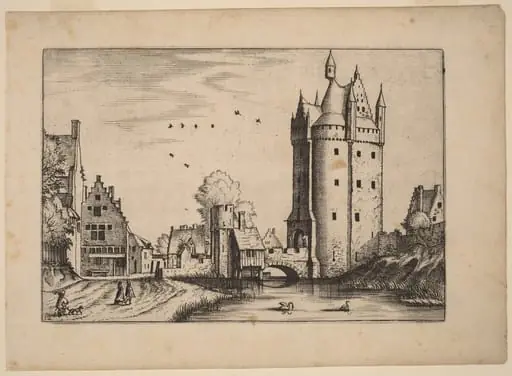
Artwork
Heyligeweg Gate (Heyligewechs Poort)
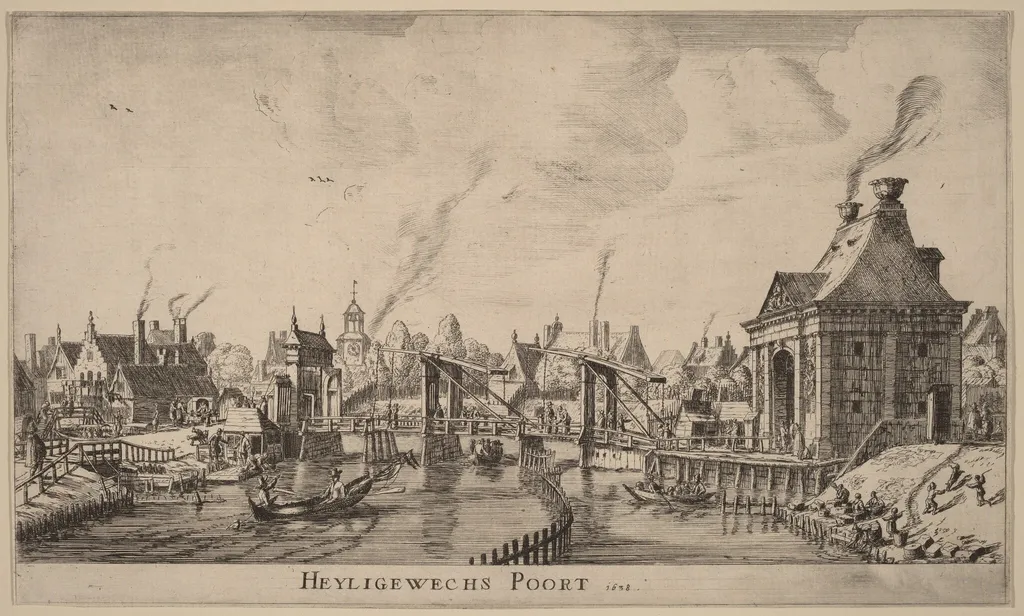
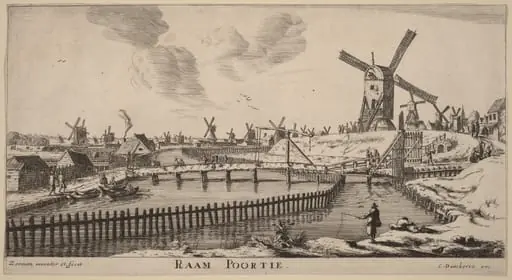
Heyligeweg Gate (Heyligewechs Poort) is an ink print by the Baroque artist Nooms, called Zeeman, Reinier. It dates from 1638 and is held in the collection of the National Gallery of Art. Reinier Nooms, known as Zeeman, created the etching Heyligeweg Gate in 1638.
About this work
Overview
Reinier Nooms, known as Zeeman, created the etching Heyligeweg Gate in 1638. It captures a specific Amsterdam waterway with architectural and nautical detail. Though he later focused on maritime subjects from the 1650s, this early work already demonstrates his precision in rendering urban waterways and the movement of daily life along them.
Subject & Meaning
The scene centers on a canal gate, a functional structure regulating water levels and traffic. Boats are moored, figures move along the banks, and distant buildings suggest a working urban environment. The composition reflects Amsterdam’s reliance on its waterways for transport and commerce, presenting the gate not as a monument but as a vital node in the city’s infrastructure.
Technique & Style
Nooms employed fine, controlled lines typical of etching to define textures: the roughness of stone, the sheen of wet wood, the softness of clouds. Light and shadow are carefully modulated to give depth to the architecture and water, guiding attention toward the gate. The inclusion of small, active figures enhances realism without overwhelming the spatial structure.
History & Provenance
Created in 1638, this print belongs to Nooms’s early period, before his later focus on ships at sea. It likely circulated among collectors and fellow artists interested in topographical accuracy. While its exact early ownership is undocumented, its survival reflects the value placed on detailed urban views in 17th-century Dutch print culture.
Context
Amsterdam in the 1630s was expanding rapidly, with canals and gates integral to its growth. Nooms’s etching aligns with a broader trend of documenting the city’s infrastructure, serving both practical and aesthetic purposes. Such images helped define civic identity and provided reference for architects and mapmakers of the time.
Legacy
Though less known than his later seascapes, this etching exemplifies Nooms’s early skill in capturing urban environments with clarity. It contributed to a tradition of Dutch topographical printmaking, influencing how later artists recorded the relationship between water, architecture, and daily life in the Netherlands.
Own this work as a print
Artist & collection

Artist
Reinier Nooms (c. 1623 – 1664), also known as Zeeman or Seeman (Dutch for "sailor"), was a Dutch maritime painter known for his highly detailed paintings and etchings of ships. From the 1650s, Nooms started producing…