Artwork
The Crucifixion
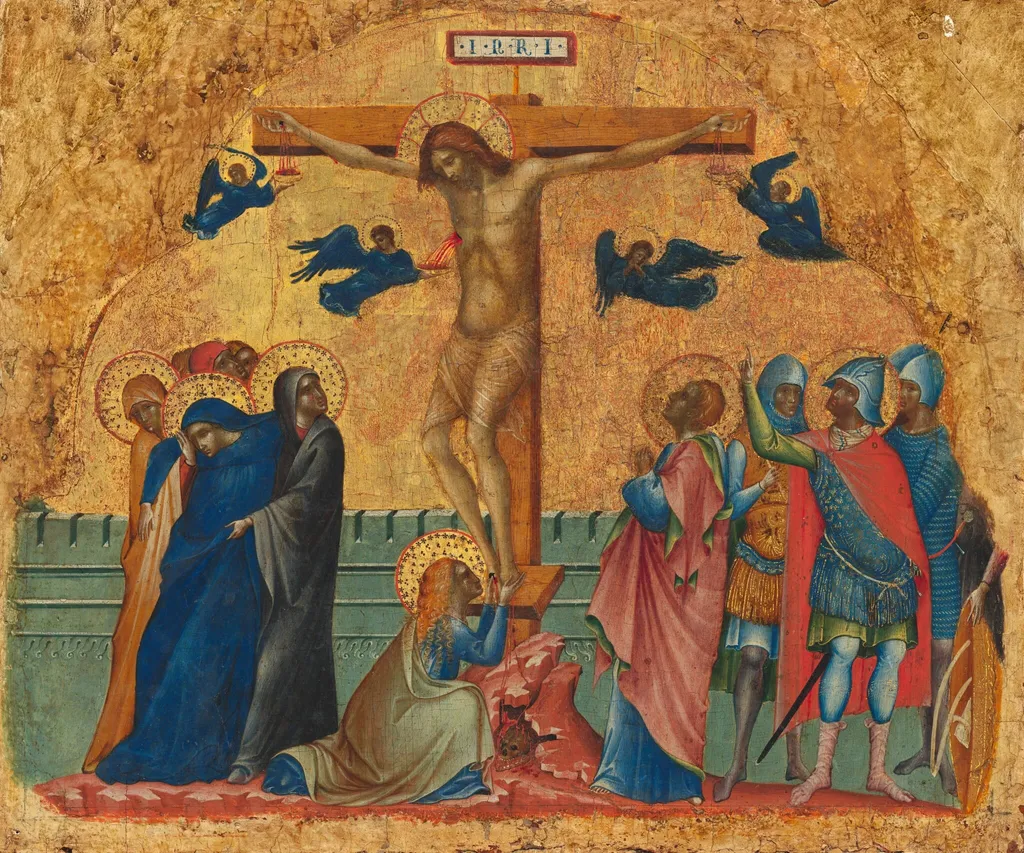
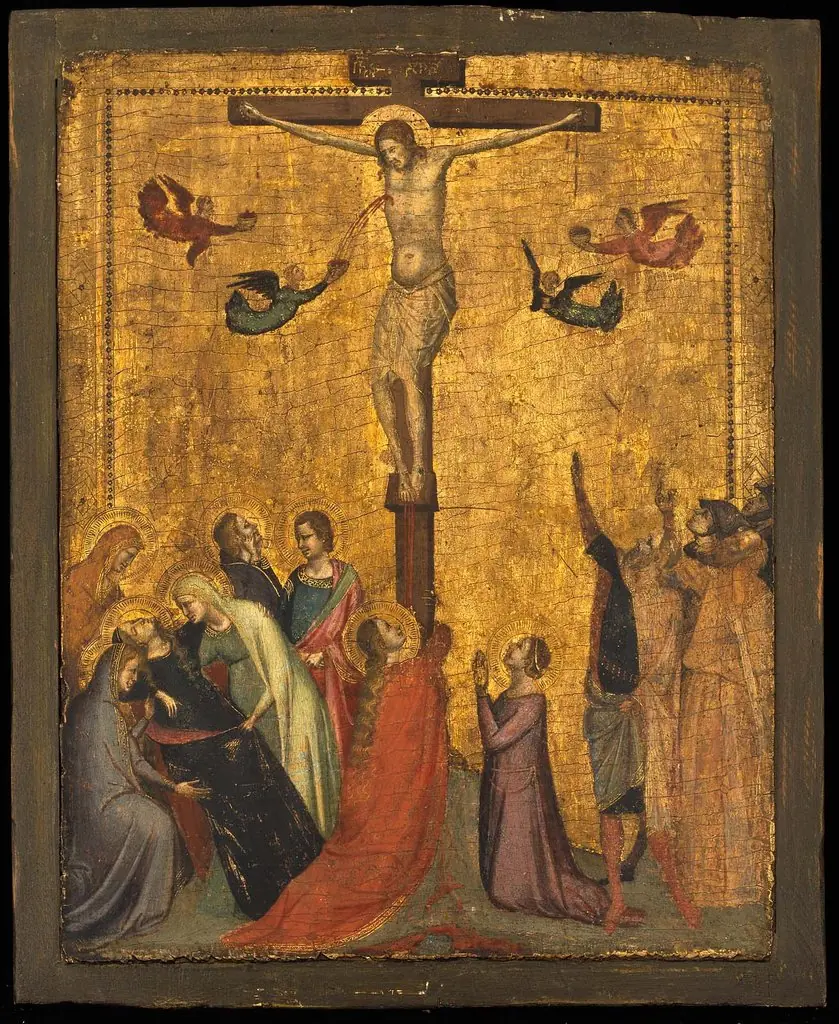
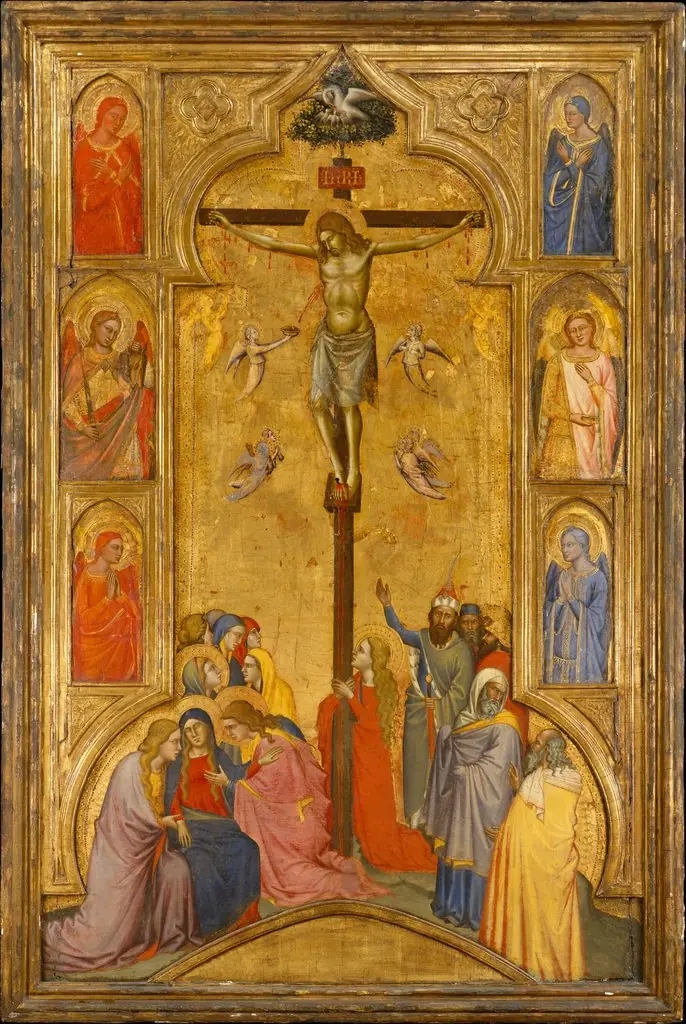
The Crucifixion is a tempera painting by the Byzantine icon painting artist Paolo Veneziano. It dates from 1342 and is held in the collection of the National Gallery of Art.
- Inscription
- Inscribed:upper center: I.N.R.I. (Jesus of Nazareth, King of the Jews)
About this work
Subject & Meaning
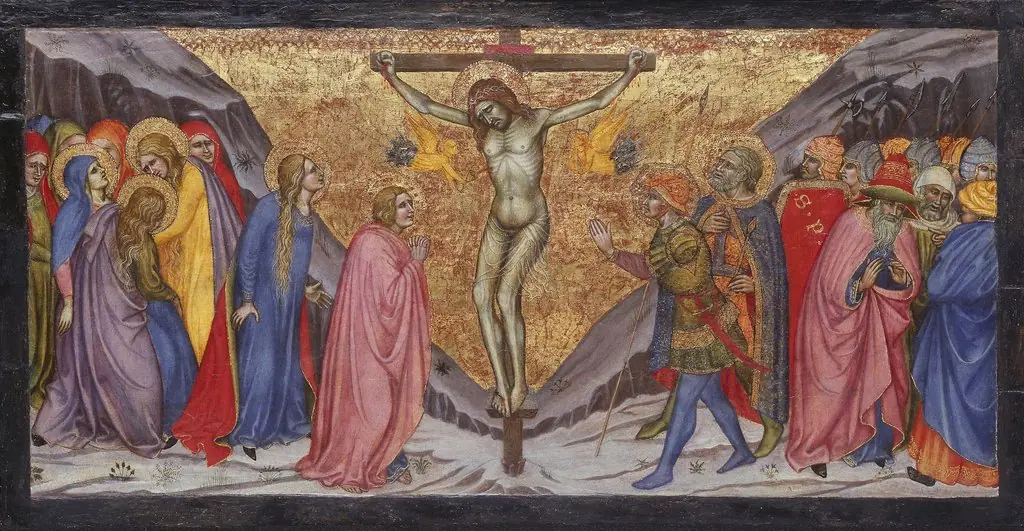
The painting depicts the Crucifixion of Jesus Christ, the central event of Christian salvation history in which Christ is shown nailed to the cross.
The painting depicts the Crucifixion of Jesus Christ, the central event of Christian salvation history in which Christ is shown nailed to the cross. As a work of religious art by Paolo Veneziano, the subject is treated within the devotional tradition of fourteenth-century Venetian painting, where the Crucifixion served as a focal image for meditation on Christ's sacrifice and the redemption of humanity. The work's classification as religious art and its identification of Jesus Christ as the depicted figure confirm that the panel's meaning is rooted in Christian iconography, presenting the Passion as an object of veneration and contemplation rather than narrative description.
The compact horizontal format concentrates attention on this single sacred episode, aligning the image with the function of devotional panels intended to focus the viewer's mind on the theological significance of Christ's death on the cross.
Technique & Style
The Crucifixion is executed in tempera on panel, a standard medium for mid-fourteenth-century Italian devotional painting. The work is modest in scale, measuring 31.8 cm in height by 37.5 cm in width, consistent with a small portable object rather than a large altarpiece. Its religious subject and panel support reflect the conventions of Venetian painting of the period, while the format suggests it may have functioned as an intimate devotional image.
The provenance record does not document specific handling notes, conservation interventions, or current condition assessments, and no stylistic analysis of the painter's technique is provided in the available sources.
History & Provenance
Created in 1340 by Paolo Veneziano, this tempera on panel depicting the Crucifixion likely originated within the Italian art market, possibly in Venice, by 1902. Roger Fry documented seeing the work in Italy around October 1902, noting its presence in the market several years prior. By the early twentieth century, the painting entered the collection of Achillito Chiesa in Milan, a holding later dispersed due to the collector's financial struggles between 1925 and 1931.
The work subsequently came into the possession of Count Alessandro Contini Bonacossi in Florence. In July 1934, Contini Bonacossi sold the panel to the Samuel H. Kress Foundation in New York. The foundation ultimately gifted the artwork to the National Gallery of Art in Washington, D.C., in 1939, where it remains part of the Samuel H. Kress Collection.
Paolo Veneziano's The Crucifixion (1340) is held in the collection of the National Gallery of Art in Washington, D.C., specifically within the Samuel H. Kress Collection. The panel painting entered the museum's holdings in 1939 as a gift from the Samuel H. Kress Foundation. Prior to this acquisition, the work was sold to the foundation in July 1934 by Count Alessandro Contini Bonacossi of Florence.
Earlier provenance records indicate the painting belonged to Achillito Chiesa in Milan during the early twentieth century and was likely present in the Italian art market, possibly in Venice, by 1902. While the work was noted by Roger Fry in 1912 as having been seen in Italy years prior, specific public exhibition history beyond its presence in private collections and the art market is not detailed in the available records.
Context
Paolo Veneziano’s The Crucifixion (c.1340), a tempera panel housed in the National Gallery of Art, exemplifies early Venetian devotional painting and marks a transitional phase between Byzantine formalism and Renaissance naturalism. Contemporary scholarship, notably Roger Fry’s 1912 discussion of the work within the Semitecolo circle, highlighted its compositional innovation and devotional intensity, situating it within the broader context of 14th‑century Venetian ateliers. The painting’s provenance, documented in Achilleto Chiesa’s collection, sold to the Samuel H. Kress Foundation in 1934, and gifted to the NGA in 1939, reflects early 20th‑century patterns of art market circulation.
Its enduring scholarly interest underscores its significance as a representative example of Italian religious art of the period.
Legacy
The 1912 publication of Roger Fry brought the work to scholarly attention, emphasizing its importance within the early Venetian school and highlighting its role in shaping connoisseurship of 14th‑century Italian art. Its acquisition by Samuel H. Kress and subsequent gift to the National Gallery of Art in 1939 placed the painting in a leading public collection, increasing its visibility and cementing its place in the narrative of the Kress collection’s impact on American museum holdings. As part of the National Gallery’s holdings, the work has been featured in exhibitions and studies that trace the development of devotional painting, reinforcing the legacy of Paolo Veneziano and contributing to ongoing research on early Italian primitives.
Overview
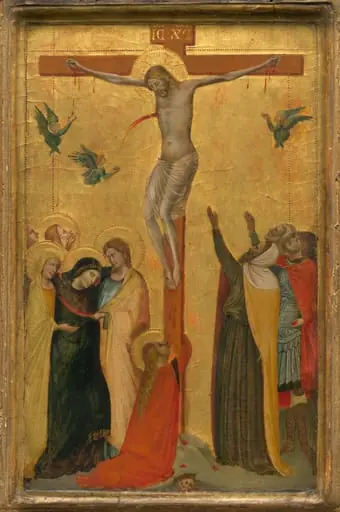
Paolo Veneziano's 'The Crucifixion,' executed in 1342 in tempera on panel, is a definitive example of the Venetian Gothic style bridging Byzantine tradition and emerging naturalism. The composition centers on the figure of Christ on the cross, set against a flat gold background that signifies the divine realm, with a green architectural element below grounding the scene. Flanking the central event are distinct groups of mourners: on the left, female figures in long robes, some identified as saints by their halos, express grief; on the right, male figures clad in armor represent the Roman soldiers or witnesses.
A notable iconographic detail involves angels positioned near the cross, collecting the blood flowing from Christ's wounds, a motif emphasizing the Eucharistic significance of the sacrifice. Created during the height of the artist's career, this work reflects the influence of his training under the Byzantine tradition while demonstrating the refined elegance and decorative richness characteristic of 14th-century Venetian painting. The piece serves as a testament to the period's devotional practices, utilizing the gold ground not merely as decoration but as a theological statement of eternal light.
Own this work as a print
Artist & collection

Artist
Paolo Veneziano, also Veneziano Paolo or Paolo da Venezia was a 14th-century painter from Venice, the "founder of the Venetian School" of painting, probably active between about 1321 and 1362.