Artwork
Henry IV at the Battle of Ivry, 14 March 1590
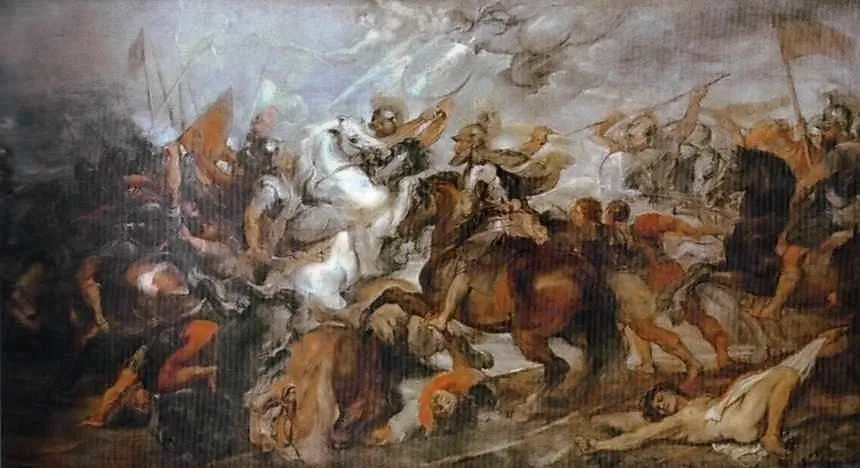
Henry IV at the Battle of Ivry, 14 March 1590 is an oil painting by the Flemish Baroque painting artist Peter Paul Rubens. It dates from 1627 and is held in the collection of the Uffizi Gallery.
About this work
It was created as a companion piece to Rubens’s The Triumphal Entry of Henry IV into Paris, and both were bought together by Cosimo III de’ Medici in 1686.
Henry IV at the Battle of Ivry, 1627, is a huge oil on canvas by the Flemish painter Peter Paul Rubens. The work measures 367 by 693 cm, so it really dominates a wall. It was created as a companion piece to Rubens’s The Triumphal Entry of Henry IV into Paris, and both were bought together by Cosimo III de’ Medici in 1686.
The pair has lived in the Uffizi Gallery in Florence since 1773. If you’re curious about where to see it, check out the Uffizi Gallery.
Overview
Henry IV at the Battle of Ivry, 14 March 1590 is a 1627 oil on canvas by Peter Paul Rubens, measuring 367 by 693 cm. The painting depicts the French king at his decisive victory during the Wars of Religion and is housed in the Uffizi Gallery in Florence. It was conceived as part of an unrealized cycle on the life of Henry IV intended to complement Rubens's celebrated Marie de' Medici cycle, and it remains one of the most significant unfinished works from the Flemish master's mature period.
Subject & Meaning
The painting portrays Henry IV of France at the Battle of Ivry, fought on 14 March 1590, a pivotal moment in the French Wars of Religion that secured Henry's claim to the throne. At the center of the composition, the king appears on a rearing white horse, his arm raised in command amid swirling mounted and fallen combatants. The iconography draws upon traditions of Roman triumph, with flags and standards piercing the upper space to create vertical accents within the tumult. The scene carries dynastic and political resonance: it was commissioned by Marie de' Medici, Henry's widow, as part of a commemorative program to glorify her husband's reign and legitimize the Bourbon dynasty. The nearly nude corpse in the lower right foreground serves as a memento mori, grounding the heroic narrative in the brutal reality of warfare.
Technique & Style
Rubens executed the work in oil on canvas with a palette dominated by browns, grays, muted oranges, and creamy whites, punctuated by touches of red on sashes and banners. The paint application is notably loose and sketch-like, with visible brushstrokes and thin, atmospheric layers that contribute to an intentionally unfinished surface. The composition is organized along a diagonal thrust from lower left to upper right, with the left side sinking into deep shadow while the right and upper portions open to a turbulent, cloudy sky with pale light breaking through. Bodies, horses, and weapons intermingle in a swirling mass that deliberately sacrifices clear spatial depth for dynamic movement. Light falls unevenly across the surface, highlighting the central white horse and rider against darker surrounding forms in a manner characteristic of Rubens's late, painterly manner.
History & Provenance
The painting was commissioned by Marie de' Medici, queen of France, as part of a cycle on the life of Henry IV meant to accompany Rubens's famous cycle on her own life. Unlike the Marie de' Medici cycle, which was completed and is now at the Louvre, the Henry IV project was never brought to completion. Beyond preparatory drawings and sketches, only this large canvas and its pendant, The Triumphal Entry of Henry IV into Paris, were substantially advanced. In 1686 or 1687, both paintings were acquired by Cosimo III de' Medici, Grand Duke of Tuscany, bringing them to Florence. They have been in the Uffizi Gallery since 1773, and from the late eighteenth century they have hung in the Sala della Niobe.
Context
The unfinished Henry IV cycle represents one of the most tantalizing what-ifs of Rubens's career. At the time of commission in 1627, Rubens was at the height of his international reputation, having completed the Marie de' Medici cycle for the Luxembourg Palace in Paris between 1622 and 1625. The proposed companion cycle would have created an unprecedented dual royal monument, celebrating both the queen mother's piety and political acumen and the military prowess of her assassinated husband. Scholars have debated why the project stalled: the painter's advancing age, his increasing diplomatic commitments, and shifting political circumstances in France following the death of Henry IV in 1610 and Marie's subsequent regency all likely played roles. The surviving canvas demonstrates Rubens's late working method, where compositional energy and chromatic harmony took precedence over finished detail, anticipating developments in Baroque painting across Europe.
Legacy
The painting's influence extends through its afterlife as a document of Rubens's creative process and as a model for battle painting in the Baroque tradition. Its residence in the Uffizi since 1773 has ensured continuous public and scholarly attention, placing it among the most studied unfinished works in Western art. The canvas, together with its pendant, offers rare insight into how Rubens developed large-scale historical compositions, with the sketch-like surface revealing the artist's thinking in a way that fully realized works cannot. The work has also served as a touchstone for discussions of Rubens's relationship with his Medici patrons and the international circulation of Baroque imagery between Flanders, France, and Italy. Its placement in the Sala della Niobe, alongside classical sculpture, has created a lasting dialogue between Rubens's dynamic modernity and antique models of heroic narrative.
Artist & collection
Artist
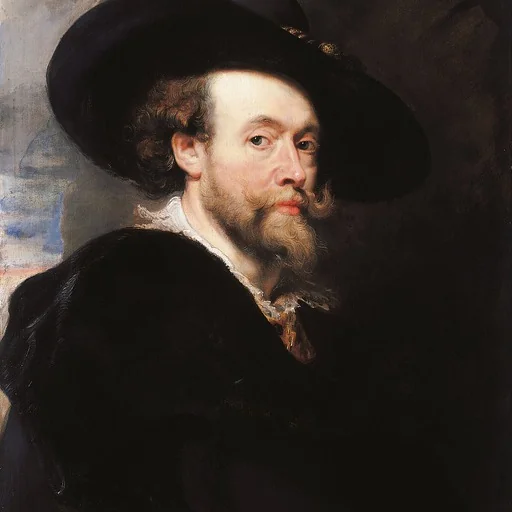
Sir Peter Paul Rubens ( ROO-bənz; Dutch:; 28 June 1577 – 30 May 1640) was a Flemish artist and diplomat.

 Batalla de San Quintín
 Gefecht zwischen österreichischen und schwedischen Truppen
 Legendary Battle of the Torriani and Visconti - the Capture
 The Road to Calvary
 Batalla de San Quintín
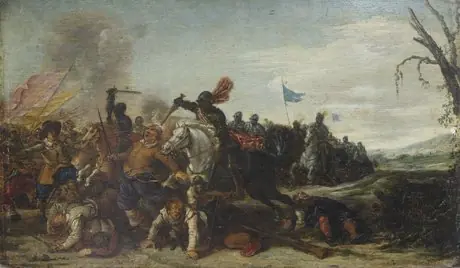 Battle
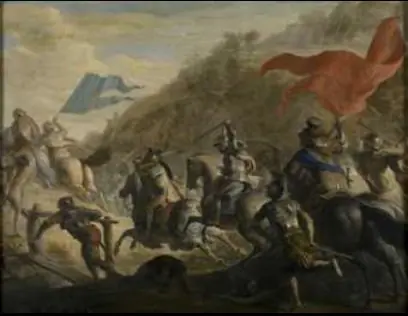 Legendary Battle of the Torriani and Visconti - the Chase
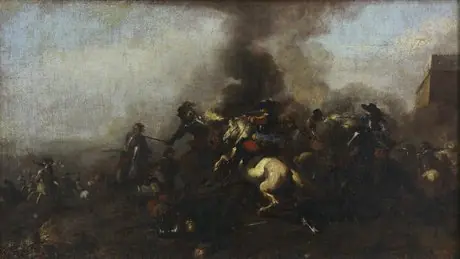 The battle
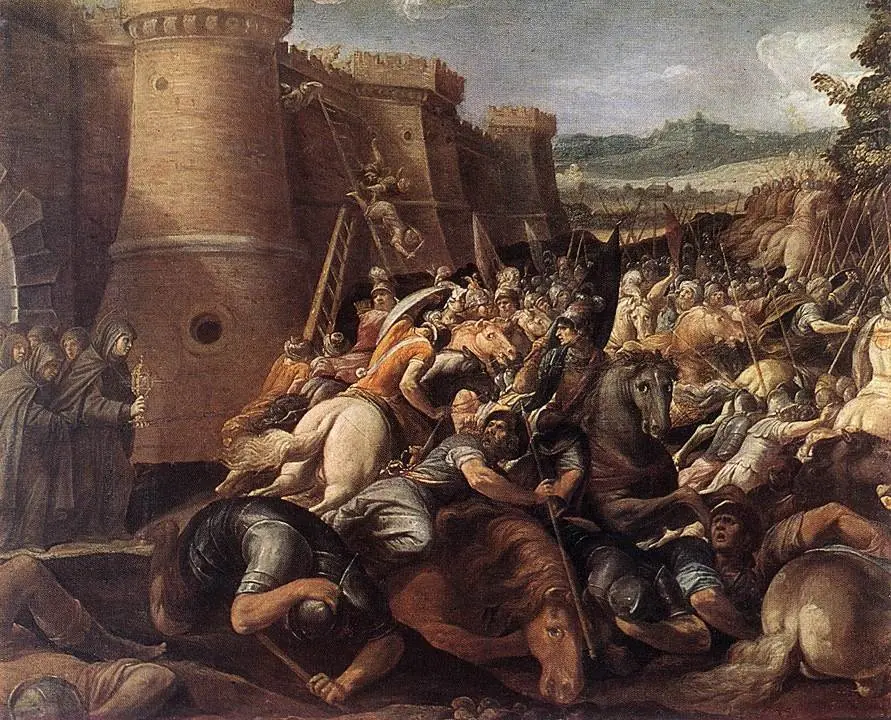 St Clare with the Scene of the Siege of Assisi
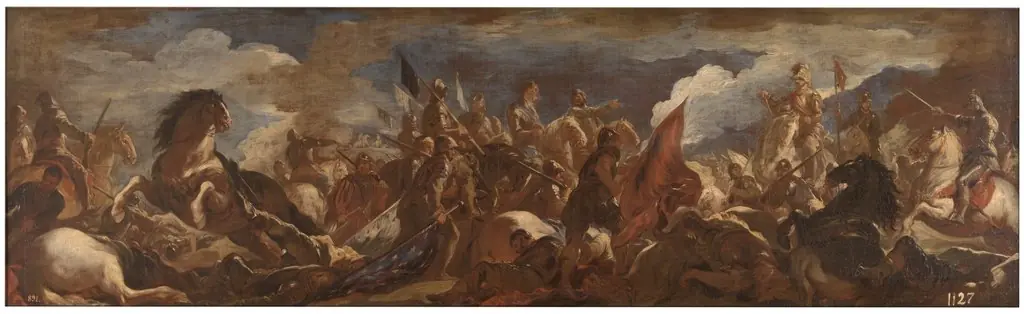 Prisión del condestable de Montmorency, en la Batalla de San Quintín
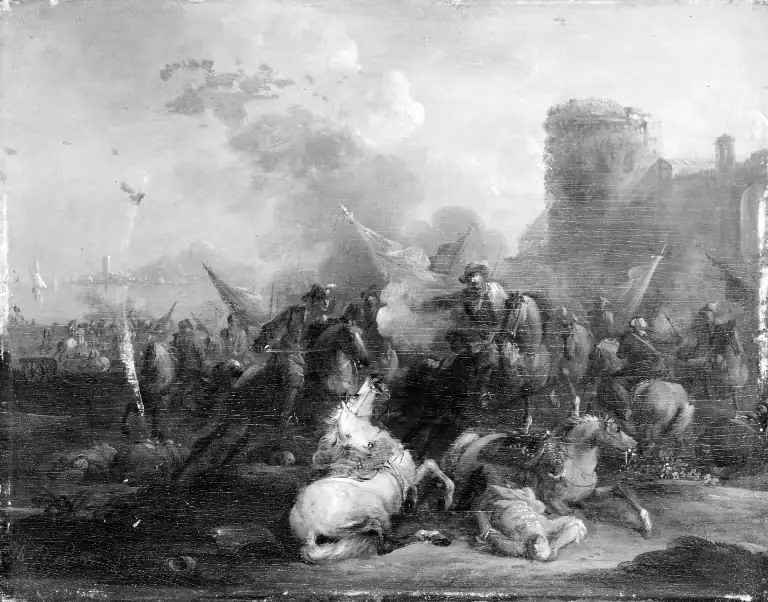 Cavalry Skirmish
- Henri IV at the battle of Arques