Artwork
Miracle of Saint Ignatius of Loyola
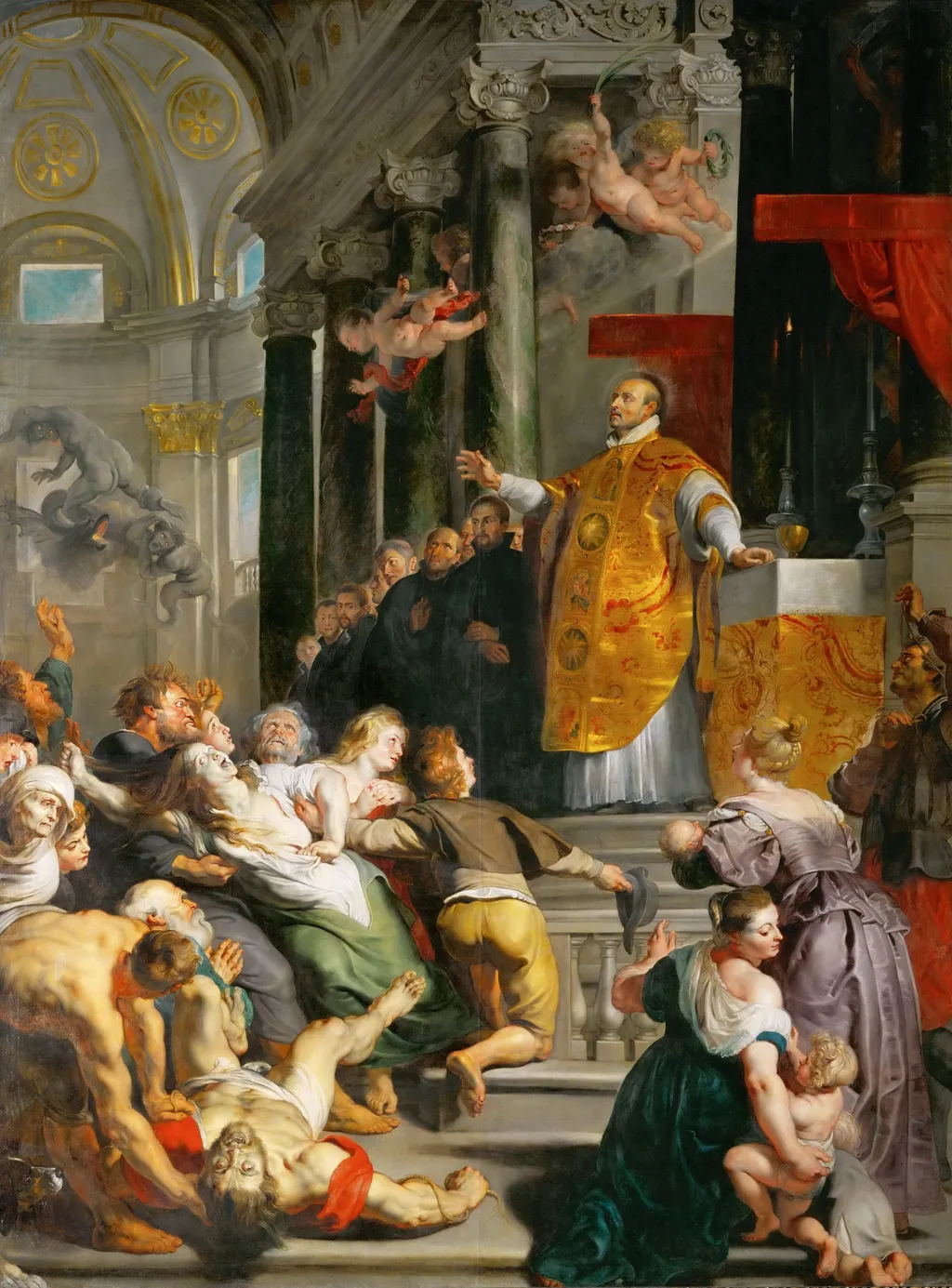
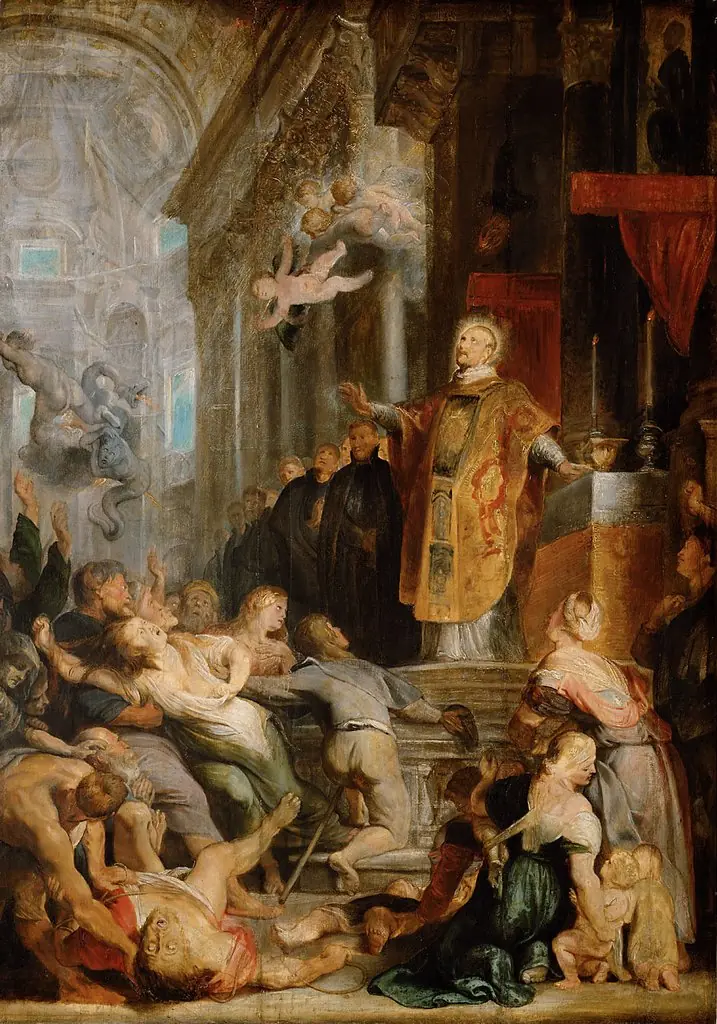
Miracle of Saint Ignatius of Loyola is an oil painting by the Flemish Baroque painting artist Peter Paul Rubens. It dates from 1618 and is held in the collection of the Kunsthistorisches Museum.
About this work
Subject & Meaning
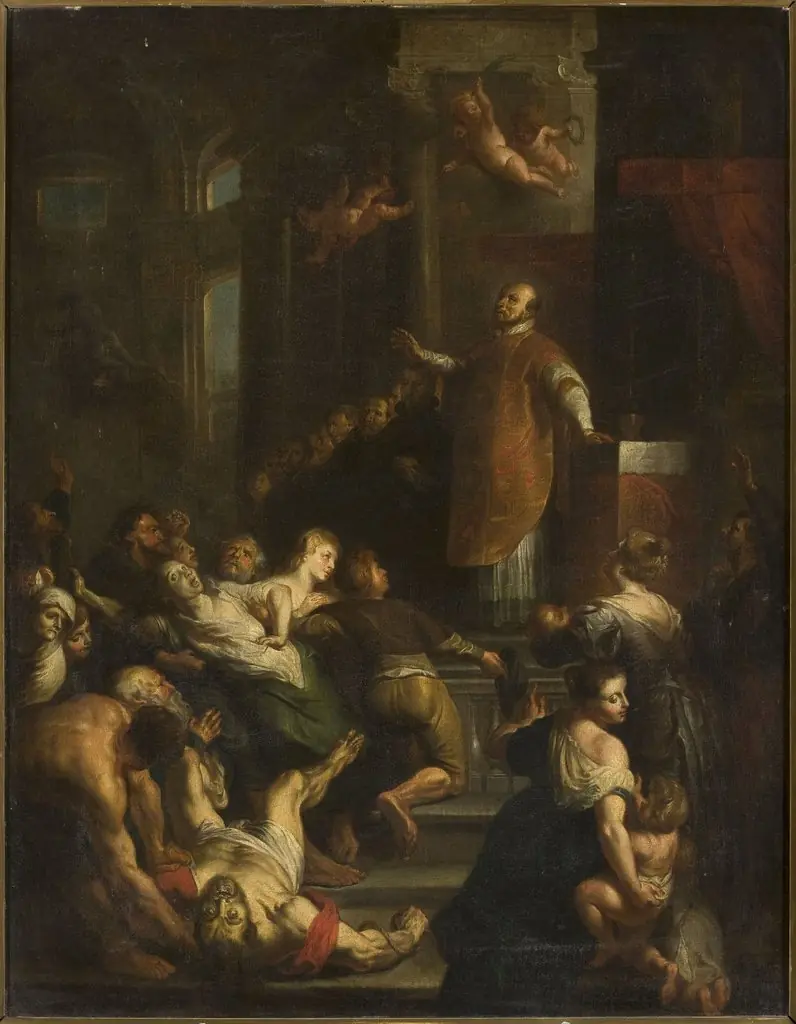
Dressed in gold-woven liturgical vestments with a halo, the saint stands at an altar with his left hand resting upon it, having just celebrated Mass.
The painting depicts Saint Ignatius of Loyola, founder of the Society of Jesus, performing an exorcism. Dressed in gold-woven liturgical vestments with a halo, the saint stands at an altar with his left hand resting upon it, having just celebrated Mass. His right hand, placed at the exact center of the composition, gestures toward a man and woman being thrown to the ground in convulsions as demons are expelled from their bodies. Above Ignatius, cherubs carry palms and crowns, alluding to his future canonization in 1622. The iconography presents a classic Rubensian opposition between physical turmoil and spiritual triumph. The lower left shows tormented, convulsing figures, while the upper right conveys serene divine power. A communion rail sharply divides the sacred from the profane. Behind the saint, six Jesuits in black soutanes stand aligned with four columns, symbolizing the disciplined, serene "troops" of Ignatius. In the background, expelled demons, including a dragon and a horned figure, disappear into grisaille, reinforcing Counter-Reformation themes of the Church's power over evil.
Technique & Style
Executed in oil paint on canvas, this monumental altarpiece measures 535 by 395 cm. The composition exhibits a characteristic Rubensian contrast between the tormented physical vigor of the possessed figures in the lower left and the serene, victorious power of the spiritual realm in the upper right. A eucharistic balustrade visually separates these profane and sacred zones. Saint Ignatius is depicted in gold-threaded vestments with red-rimmed eyes turned heavenward, while demons flee into a grisaille background. The formal arrangement aligns Jesuit witnesses with architectural columns to suggest order, while angels bearing palms hover above in anticipation of canonization.
History & Provenance
The painting was commissioned by the Jesuits for the interior decoration of their newly completed Baroque church in Antwerp, finished in 1621. Rubens, at the height of his fame, was tasked with creating two large altar pieces depicting the miracles of Saint Ignatius of Loyola and Saint Francis Xavier, intended for alternating display via a pulley system common in Jesuit churches. After the suppression of the Jesuit order in 1773, the church was stripped of its treasures, and the artwork, along with other Rubens pieces, was acquired by the imperial museum in 1776, now known as the Kunsthistorisches Museum in Vienna, where it remains on display. The work was originally created between 1618 and 1619 for the church of the Society of Jesus in Antwerp, later renamed San Carlo Borromeo.
The painting was originally commissioned for the Jesuit church of Saint Ignatius in Antwerp (later rededicated to Saint Charles Borromeo), where it served as an altarpiece alongside its pendant depicting the Miracles of Saint Francis Xavier, the two canvases being displayed alternately by means of a pulley mechanism. Following the suppression of the Society of Jesus in 1773, the church was stripped of its masterworks. In 1776, the canvas was acquired by Empress Maria Theresa of Austria, sovereign of the Austrian Netherlands, and entered the imperial collection that became the Kunsthistorisches Museum in Vienna, where it remains today. The work is catalogued under the inventory designation KHM GG_517 and is held at the Kunsthistorisches Museum.
A fire in 1718, caused by lightning striking the Antwerp church, had already destroyed the surrounding ceiling fresco cycle by Rubens, leaving the altarpiece canvases as the principal survivors of the decorative program.
Context
Created between 1618 and 1619, *The Miracles of Saint Ignatius of Loyola* stands as a monumental example of Peter Paul Rubens's engagement with the Counter-Reformation. Commissioned by the Jesuits for their church in Antwerp, the work was designed to reaffirm faith in the Roman Church through the depiction of miraculous interventions by the order's founder. The painting functions as a pendant to *The Miracles of Saint Francis Xavier*, with both canvases originally intended to be displayed alternately via a pulley system within the church. This pairing highlights the Jesuit emphasis on the sanctity of their founders during a period when Rubens was at the height of his fame in the region. The composition exemplifies Rubens's characteristic contrast between the turbulent physicality of the possessed figures and the serene, victorious power of the spiritual realm, a visual strategy used to separate the profane from the sacred. Although the church's ceiling frescoes were destroyed by fire in 1718, these altarpieces survived to enter the Kunsthistorisches Museum in Vienna in 1776 following the suppression of the Jesuit order.
Own this work as a print
Artist & collection
Artist
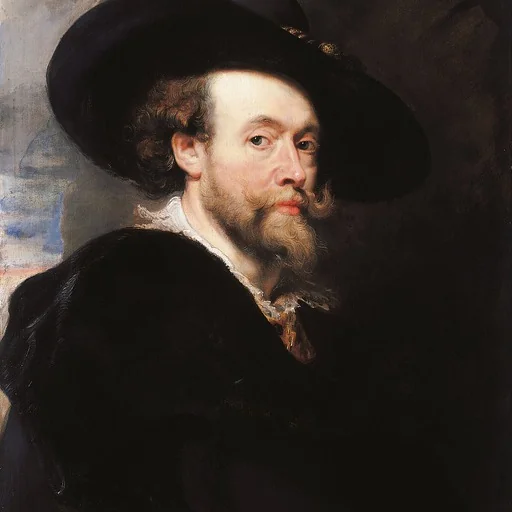
Sir Peter Paul Rubens ( ROO-bənz; Dutch:; 28 June 1577 – 30 May 1640) was a Flemish artist and diplomat.