Artwork
The Return of the Herd
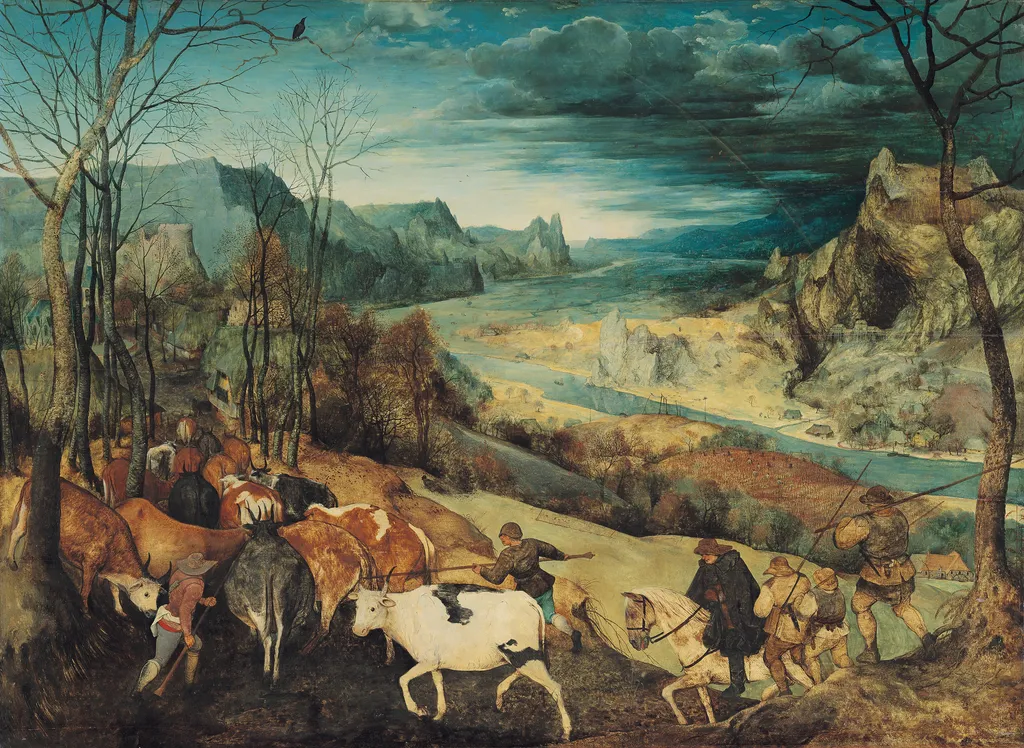
The Return of the Herd is an oil painting by the Northern Renaissance artist Pieter Brueghel I. It dates from 1565 and is held in the collection of the Kunsthistorisches Museum. Pieter Bruegel the Elder’s oil on panel, dated 1565, forms part of a six‑painting cycle illustrating the months of the year.
About this work
Technique & Style
A white cow in the foreground functions as a repoussoir, deepening spatial recession, and a bird trap and gallows further structure the narrative space.
The Return of the Herd is an oil painting on wood panel measuring 117 × 159 cm, executed in 1565 by Pieter Brueghel the Elder. The composition employs a loose yet assured handling, with areas of rapid execution, such as the cattle rendered through thin, translucent layers that reveal the ground, juxtaposed with meticulous detailing in distant villages, vineyards, and the gallows mound.
The scene unfolds from an elevated viewpoint, with foreground figures driving the herd along a wooded path, while the valley below is bathed in sunlight and the background rises to craggy mountains. The autumnal palette emphasizes bare or nearly bare trees, storm clouds gathering, and the reflective river valley, creating a seasonal atmosphere aligned with October–November. A white cow in the foreground functions as a repoussoir, deepening spatial recession, and a bird trap and gallows further structure the narrative space.
History & Provenance
The Return of the Herd was painted by Pieter Brueghel the Elder in 1565 as part of a series of six seasonal works commissioned by the Antwerp merchant Niclaes Jonghelinck. The painting entered the Habsburg collection through Archduke Ernest of Austria and later passed to Emperor Rudolf II before being acquired by the Kunsthistorisches Museum in Vienna, where it remains today. The work measures 117 cm by 159 cm and is executed in oil on panel.
It is the autumnal counterpart in Bruegel's 'Months of the Year' cycle, depicting cattle being driven into a village under stormy skies and bare trees, with a prominent white cow serving as a compositional focal point. The series was originally conceived as a set of seasonal allegories, with The Return of the Herd representing the transition from autumn to winter. The painting's provenance is well documented, tracing ownership from Jonghelinck to Archduke Leopold Wilhelm and finally to the Kunsthistorisches Museum.
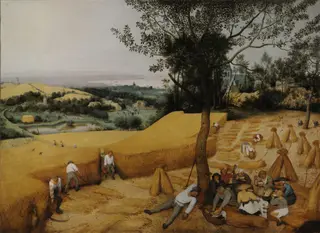
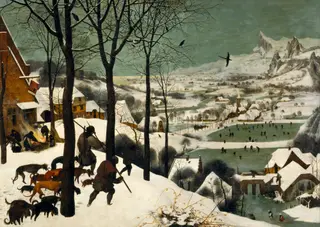
It is part of a larger cycle that includes The Hunters in the Snow and The Corn Harvest, while the spring counterpart has not survived.
The work reflects Bruegel's interest in alpine pastoral traditions rather than direct Flemish calendar imagery, incorporating motifs such as a gallows hill and vineyard workers. Its dating is securely anchored to 1565 based on stylistic analysis and contemporary records of the commission. The painting's composition emphasizes atmospheric depth through contrasts of light and shadow, with the river valley illuminated against darker forested hills.
The depiction of seasonal migration and landscape elements demonstrates Bruegel's innovative approach to genre painting, blending naturalistic detail with symbolic undertones. The artwork has been part of the Kunsthistorisches Museum's collection since the 17th century, maintaining its status as a key example of Northern Renaissance art.
The Return of the Herd is held in the Kunsthistorisches Museum in Vienna, Austria, with inventory number KStZ 1018. It was owned by Nicolaes Jonghelinck, Archduke Ernest of Austria, Emperor Rudolf II, Archduke Leopold Wilhelm of Austria, and entered the Kunsthistorisches Museum collection through Archduke Leopold Wilhelm. The work was part of a series of six seasonal paintings commissioned in 1565 by Nicolaes Jonghelinck, and it has been exhibited in the museum's permanent display, including Saal 10, GG 1018.
The painting was also featured in exhibitions such as the 2018 Bruegel retrospective at the Kunsthistorisches Museum and referenced in scholarly literature including Bertram Kaschek's 'Weltzeit und Endzeit' (2012).
Context
Created in 1565 as part of a six-panel cycle depicting the seasons, this work represents October and November within the Netherlandish Renaissance tradition. Unlike contemporary Flemish calendar illustrations that typically emphasize the grape harvest, the composition prioritizes the descent of cattle from alpine pastures, a motif likely inspired by the artist's travels through mountainous regions. Scholars note that the painting displays a remarkably free and rapid execution, particularly in the rendering of the herd and atmospheric storm clouds, suggesting it may be the most confidently handled piece in the series.
The work deviates from local customs by integrating vineyard activities into a rugged, composite landscape rather than a specific geographic location. Originally commissioned for the collector Nicolaes Jonghelinck, the painting entered the Habsburg imperial collection by 1594 and remains a defining example of Bruegel's synthesis of observed nature and constructed scenery.
Overview
Pieter Bruegel the Elder’s oil on panel, dated 1565, forms part of a six‑painting cycle illustrating the months of the year. The work, titled The Return of the Herd, is currently housed in Vienna’s Kunsthistorisches Museum and is associated with the autumnal period, specifically October and November, through its muted palette and leaf‑less trees.
Subject & Meaning
The composition depicts villagers guiding cattle along a winding country road. The figures move methodically amid a landscape of rolling hills, a meandering river, and barren trees, suggesting the seasonal routine of moving herds to winter pastures. The scene captures ordinary rural labor rather than a singular narrative event.
Own this work as a print
Artist & collection

Artist
Pieter Bruegel (also Brueghel or Breughel) the Elder ( BROY-gəl, US also BROO-gəl; Dutch: ; c.