Artwork
Two Chained Monkeys
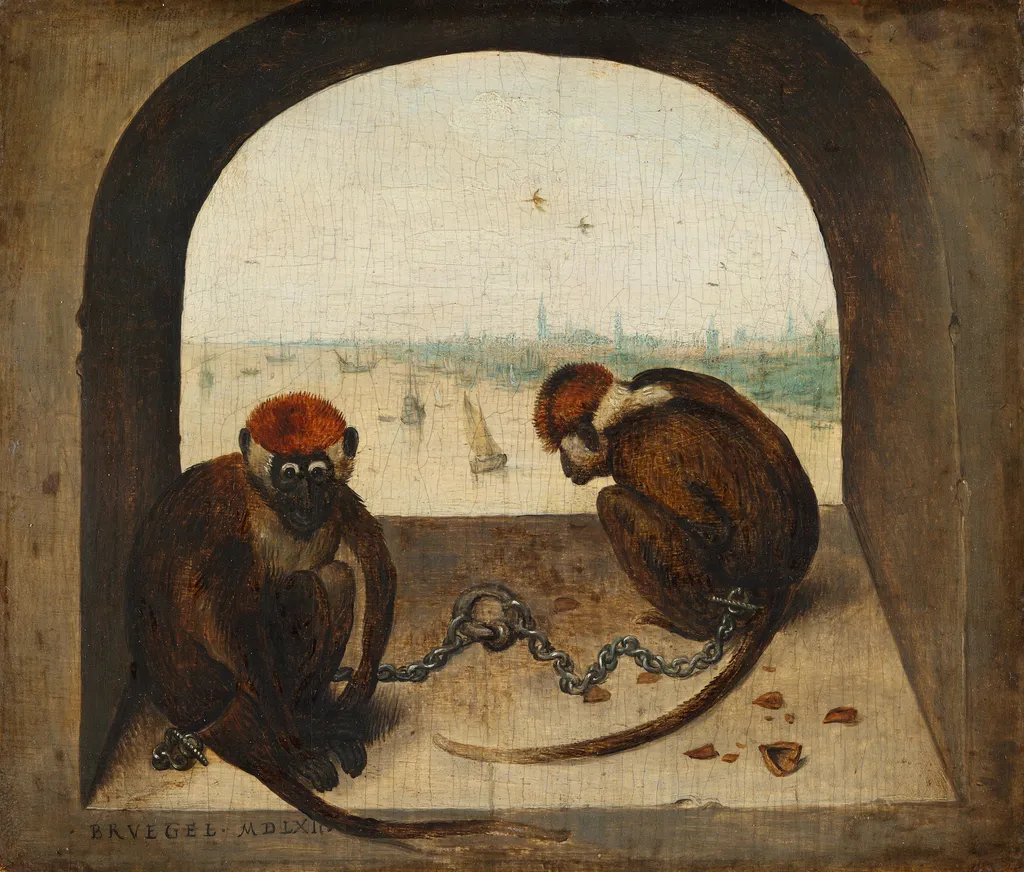
Two Chained Monkeys is an oil painting by the Northern Renaissance artist Pieter Brueghel I. It dates from 1562 and is held in the collection of the Gemäldegalerie Berlin.
About this work
Subject & Meaning
Behind them lies a landscape identifying Antwerp, with ships on the Scheldt River and church spires visible, suggesting Bruegel's farewell to his hometown.
Two Chained Monkeys, painted by Pieter Bruegel the Elder in 1562, depicts two red-capped mangabeys shackled to an iron ring beneath an arched opening. Behind them lies a landscape identifying Antwerp, with ships on the Scheldt River and church spires visible, suggesting Bruegel's farewell to his hometown. The monkeys serve as allegorical symbols: one representing avarice (greed) and the other prodigality (excess), reflecting human folly tied to material desire, as interpreted by Margaret A. Sullivan.
Additional interpretations link the chained figures to Antwerp's citizens under Spanish rule during the Eighty Years' War and to themes of marital commitment following Bruegel's 1563 marriage. The work employs a traditional symbol of monkeys as emblems of foolishness, drawing on earlier uses in Gentile da Fabriano's Adoration of the Magi, while Bruegel reinvents their meaning to critique human behavior and contemporary political tensions.
Technique & Style
Executed in oil on oak panel in 1562, the painting measures 20 cm in height and 23 cm in width. Infrared reflectography and X-ray fluorescence analyses conducted by the Gemäldegalerie in 2017 confirmed the use of a single oak support and identified the pigments as oil-based, consistent with Netherlandish practice of the period. The composition centers on two red-capped mangabeys chained to a central iron ring beneath a round-arched embrasure, their long tails curling toward one another in the foreground’s dim light.
Behind the aperture, a pale, luminous view of the Scheldt estuary and Antwerp unfolds, rendered with attenuated detail and subdued color that recedes under a broad sky. The figures are set within a shallow, stage-like space, their silhouettes sharply contrasted against the brighter background, reinforcing the allegorical charge of captivity and human folly.
History & Provenance
Pieter Bruegel the Elder created Two Chained Monkeys in 1562, a date inscribed as MDLXII on the masonry beneath the left monkey alongside his signature, BRVEGEL. The work is executed in oil on an oak panel. While the specific circumstances of its commission remain unknown, the painting's earliest documented appearance occurs in 1668 within the estate of the collector Pieter Stevens.
The artwork currently resides in the Gemäldegalerie of the Berlin State Museums. In preparation for the 2018 exhibition Bruegel - The Hand of the Master in Vienna, the museum conducted extensive technical analysis between January and August 2017, including tree-ring dating and various imaging techniques, which aided in the painting's reconstruction.
The painting Two Chained Monkeys is held in the collection of the Gemäldegalerie in Berlin, part of the Berlin State Museums. Its inventory number is 2077. The work has been the subject of technical analysis and restoration by the museum, particularly in preparation for major exhibitions.
In 2018, the painting was included in the exhibition Bruegel - The Hand of the Master at the Kunsthistorisches Museum in Vienna, running from October 2, 2018, to January 13, 2019. Prior to this, the Gemäldegalerie conducted an extensive examination of the work from January to August 2017, utilizing methods such as tree-ring dating, X-ray imaging, and infrared reflectography to facilitate its reconstruction.
Context
The painting Two Chained Monkeys by Pieter Brueghel the Elder, created in 1562, has attracted scholarly attention for its layered symbolism and historical context. Art critic Kelly Grovier interprets the chained monkeys as representations of human folly, linking them to moral allegories of imprudent attachment to material wealth, while Margaret A. Sullivan connects them to Bruegel’s broader use of moralizing motifs seen in works like Dull Gret. The work engages with Renaissance traditions, notably Gentile da Fabriano’s Adoration of the Magi, which also depicts chained monkeys, allowing Bruegel to reinvent earlier iconography.
Margaret A. Sullivan further notes a 'fundamental resemblance' between Two Chained Monkeys and Dull Gret, reinforcing the painting’s role in Bruegel’s exploration of human vice. Margaret A. Sullivan draws these conclusions based on observations that Two Monkeys exhibits a 'fundamental resemblance' to another of Bruegel's paintings, Dull Gret (Mad Meg).
Contemporary interpretations extend beyond moral allegory. Jozef Muls situates the painting within Antwerp’s political tensions, viewing the chained monkeys as symbols of civic subjugation under Spanish rule, while also suggesting linguistic wordplay tied to notions of authority. Silvio Blatter draws on the painting to inspire his novel Two Monkeys, and Wisława Szymborska’s poem Two Monkeys by Bruegel reflects on themes of human vulnerability and historical scrutiny.
The painting’s provenance and technical analysis, including dendrochronological dating and pigment studies conducted between January–August 2017, were part of preparations for the 2018–2019 exhibition Bruegel - The Hand of the Master at the Kunsthistorisches Museum, Vienna. During this process, restorer Bertram Lorenz reconstructed aspects of the work’s original appearance.
The painting’s depiction of Antwerp’s skyline, including the Liebfrauenkathedraal and Scheldt estuary, aligns with Bruegel’s documented ties to the city, and its composition reflects both observational detail and symbolic depth. The monkeys, identified as red-capped mangabeys, likely originated from African trade networks, underscoring Antwerp’s role as a commercial hub. While some interpretations link the chains to marital bonds, given Bruegel’s marriage in 1563, this connection remains speculative.
Scholars also note parallels with other works, such as Jan Brueghel the Elder’s Tierstudie, which shares similar animal depictions, and Attila Richard Lukacs’s contemporary art, which references Bruegel’s use of monkeys as self-portraits. These connections highlight the painting’s enduring influence across artistic disciplines and historical narratives.
Legacy
The painting Two Chained Monkeys (1562) by Pieter Bruegel the Elder has influenced later artists and thinkers, particularly through its symbolic use of chained monkeys to represent human folly. Art critic Kelly Grovier interprets the chained monkeys as symbols of how humans chain themselves through excessive attachment to material wealth, with the left monkey embodying avarice and the right prodigality. Margaret A. Sullivan further links this to Bruegel's broader themes, noting a resemblance to Dull Gret in its allegorical critique of human behavior.
The work has inspired literary responses, including Wisława Szymborska's poem 'Two Monkeys by Bruegel', which reflects on human experience through the painting's imagery. Its legacy is also shaped by technical studies, such as those conducted for the 2018–2019 exhibition Bruegel - The Hand of the Master in Vienna, which used advanced imaging to analyze its creation and history.
Overview
Created in 1562, Two Chained Monkeys is an oil painting by the Dutch‑Flemish Renaissance painter Pieter Bruegel the Elder. The work measures a modest size and is presently displayed in the Gemäldegalerie of the Berlin State Museums. Its composition centers on two brown monkeys with striking red fur, confined within a dark, arched frame that isolates them from a muted landscape beyond.
Own this work as a print
Artist & collection

Artist
Pieter Bruegel (also Brueghel or Breughel) the Elder ( BROY-gəl, US also BROO-gəl; Dutch: ; c.