Artwork
Ramon Casas and Pere Romeu on a Tandem
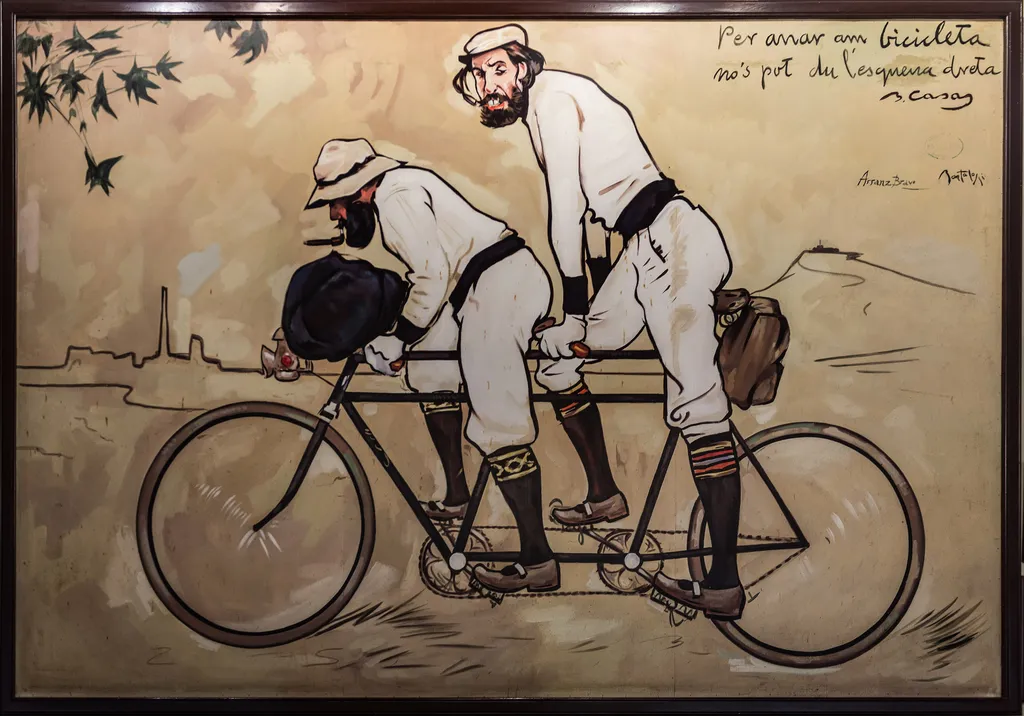
Ramon Casas and Pere Romeu on a Tandem is an oil painting by the Art Nouveau artist Ramon Casas. It dates from 1899 and is held in the collection of the Museu Nacional d'Art de Catalunya.
About this work
This painting is called Ramon Casas and Pere Romeu on a Tandem. It was created in 1897 by Ramon Casas. The artist chose oil paint as the medium for this work, which is now held at the Museu Nacional d'Art de Catalunya.
Ramon Casas was the one who made this painting, and that's a notable fact about it. To learn more about similar works, look up Ramon Casas.
Subject & Meaning
The work carries explicit symbolic meaning through its original Catalan inscription: "to ride a bicycle, you can't go with your back straight.
The painting is a double portrait depicting artist Ramon Casas and Pere Romeu, promoter of the Els Quatre Gats bar, riding a tandem bicycle against the Barcelona skyline. Casas appears in profile smoking a pipe, while Romeu faces the viewer directly. The composition possesses the bold, graphic quality of a poster, reflecting Casas's background as a poster designer.
The work carries explicit symbolic meaning through its original Catalan inscription: "to ride a bicycle, you can't go with your back straight." This message conveyed the founders' progressive attitude, that breaking with tradition was necessary to move forward, embodying the spirit of Els Quatre Gats as a hub of Catalan Modernisme. The tandem bicycle itself symbolized collaborative forward momentum and modernity.
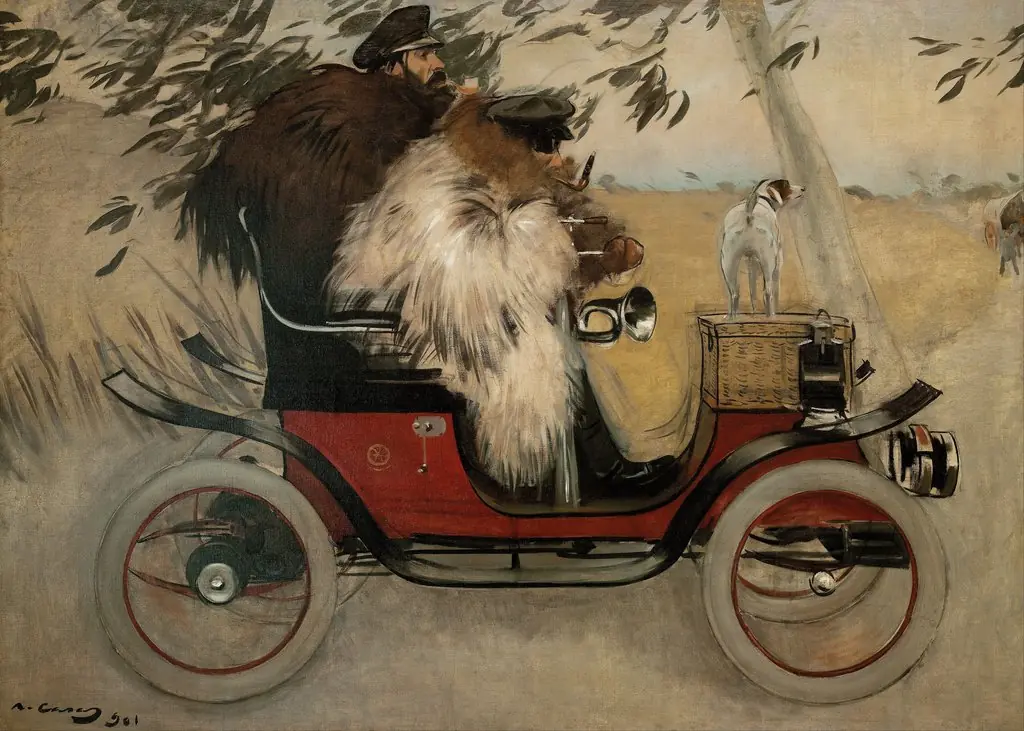
The painting's meaning was reinforced contextually when replaced in 1901 by a companion work showing the same figures in an automobile. Magazine reproductions titled the pair "The End of the 19th Century" and "The Beginning of the 20th Century," cementing the tandem image as a symbol of fin-de-siècle transformation.
Technique & Style
Ramon Casas and Pere Romeu on a Tandem is an oil painting executed on canvas in 1897. Although the work utilizes traditional painting materials, its formal execution deliberately emulates the graphic aesthetic of a large-scale poster. This stylistic choice reflects the artist's background as a skilled illustrator and poster designer, resulting in bold drawing and simplified forms rather than complex painterly textures.
The composition features a double portrait with a flattened perspective against a skyline, prioritizing graphic impact over naturalistic depth. The original version included a Catalan inscription on the right side, which was subsequently cut off from the canvas.
History & Provenance
Ramon Casas created this oil on canvas painting in 1897 in Barcelona, specifically to decorate the interior of Els Quatre Gats, a cabaret central to the Catalan modernisme movement. The artwork hung on the bar's main wall above a long table from the establishment's inauguration in 1897 until around 1900 or 1901, when Casas replaced it with a new composition depicting the same figures in an automobile to symbolize the new century.
The painting eventually entered the collection of the Museu Nacional d'Art de Catalunya in 1964, where it is currently held.
Ramon Casas and Pere Romeu on a Tandem is held by the Museu Nacional d'Art de Catalunya in Barcelona. It was accessioned as part of the museum's collection and has been on display within the institution's modernisme galleries. The work was originally painted for the interior of Els Quatre Gats in 1897 and remained there until 1901, when it was replaced by Casas's Automobile version. It entered the museum's permanent holdings following the 1964 transfer of the building's artworks.
Exhibition history includes its presentation in the museum's dedicated Modernisme wing and inclusion in retrospectives of Casas's output at the Museu Nacional d'Art de Catalunya. The painting has also featured in thematic exhibitions on Catalan modernism and early 20th-century avant-garde movements at the institution.
The work is catalogued under the museum's inventory system, though the specific accession number is not published in the available sources.
Context
Painted in 1897 for the interior of Els Quatre Gats, Ramon Casas and Pere Romeu on a Tandem serves as a seminal document of Catalan Modernism and the Art Nouveau movement. The work functioned as a visual manifesto for the bar's founders, who championed a break from tradition to foster progress, a sentiment encapsulated by the painting's now-lost inscription. Its graphic, poster-like composition reflects Casas's dual expertise in painting and illustration, bridging fine art and commercial design.
The piece held a central place in the cultural life of Barcelona until 1901, when it was replaced by a companion work depicting the same figures in an automobile. This substitution, described in contemporary reproductions as marking the transition from the end of the 19th century to the beginning of the 20th, symbolized the shift toward modernity. The painting remains a key reference for understanding the artistic milieu that included emerging figures such as Picasso.
Legacy
Ramon Casas and Pere Romeu on a Tandem became a visual emblem of the Catalan modernist spirit, embodying the innovative, forward‑looking attitude of the Els Quatre Gats circle. Its bold graphic style and the inscription about breaking with tradition influenced later Catalan artists who cited the work as a model for merging contemporary subject matter with decorative art. The painting’s symbolic shift to a motor car in 1901 was widely interpreted as marking the transition from the 19th to the 20th century, a narrative that persisted in scholarship and popular accounts of Catalan art history.
The work’s legacy is reinforced by its continual display at the Museu Nacional d'Art de Catalunya and its frequent reproduction in publications, reinforcing its status as a cornerstone of Barcelona’s artistic heritage.
Overview
Ramon Casas’ 1897 canvas portrays the artist alongside his business partner Pere Romeu perched on a tandem bicycle. Executed in oil, the work measures a modest size and now belongs to the collection of the Museu Nacional d’Art de Catalunya in Barcelona, where it is displayed among other late‑19th‑century Catalan pieces.
Own this work as a print
Artist & collection
Artist
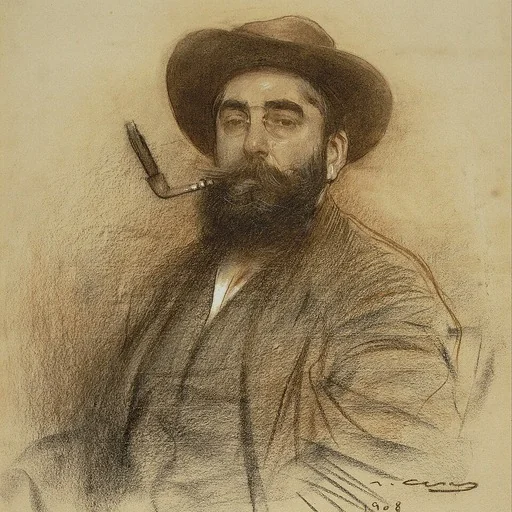
Ramon Casas i Carbó (Catalan pronunciation:; 4 January 1866 – 29 February 1932) was a Catalan artist from Spain.

 Le Devoir
 Untitled
 A qui penses-tu donc, coquenard? ...
 Environs of Antwerp, Sunday Afternoon
 Réglement du Jockey Club de Paris: Chaque membre du Jockey Club doit avoir un Jockey, et un cheval...
 Chermeză în Bretania
 Tavern Interior
 Voltz, Tamara - Malerei, Spandauer Bock, Berlin 1903-06
 Le Devoir
 Chez Durand