Artwork
Man in plumed beret
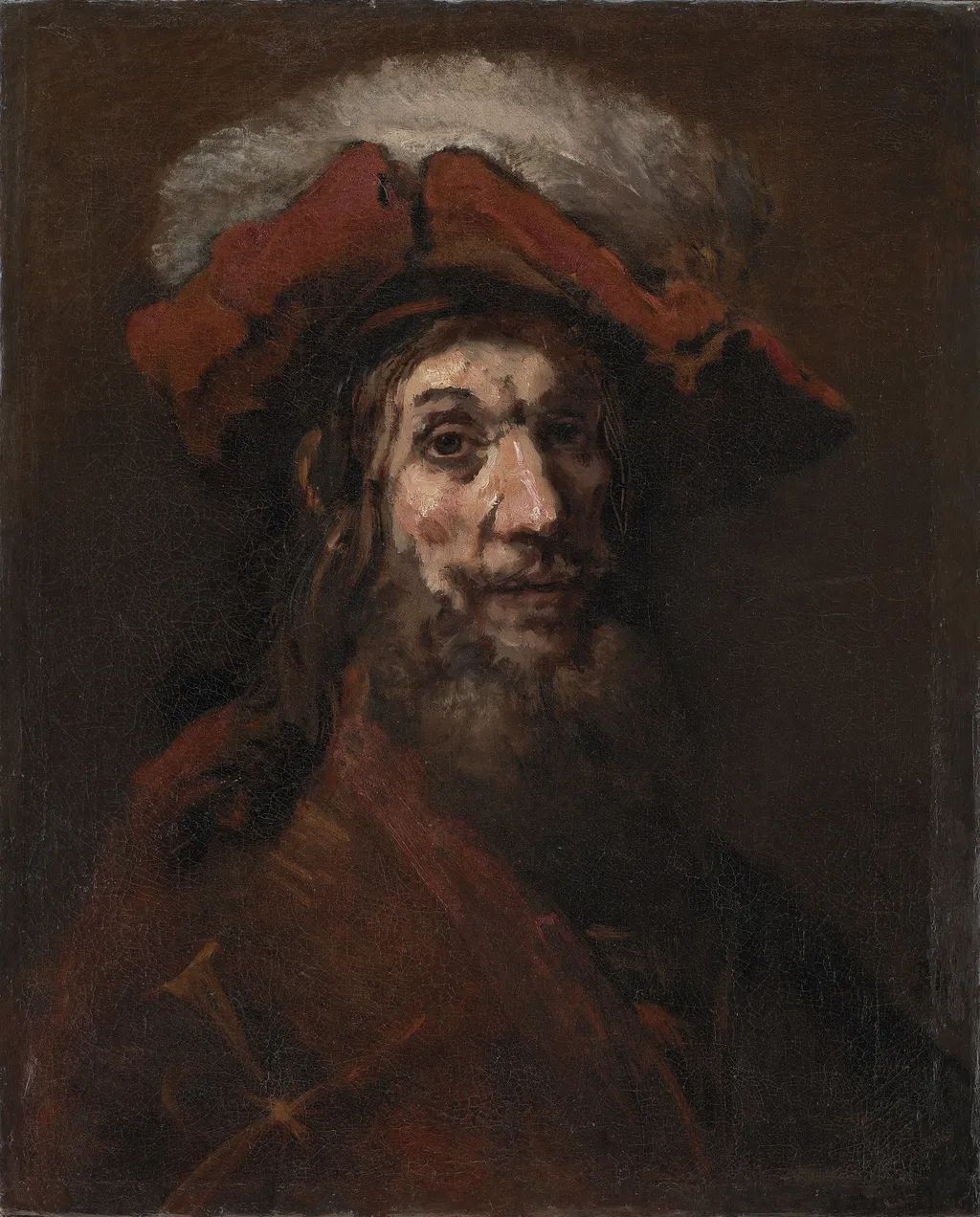
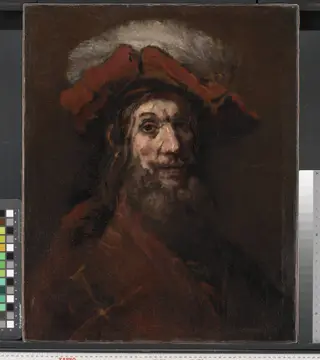
Man in plumed beret is an oil painting by the Dutch Golden Age artist Rembrandt van Rijn. It dates from 1659 and is held in the collection of the Statens Museum for Kunst.
About this work
Subject & Meaning
He wears a large slashed red head-dress adorned with a white plume, a plain costume, and a Maltese cross on the right shoulder.
The painting depicts a bearded man with long hair, shown half-length and turned slightly while looking toward the viewer. He wears a large slashed red head-dress adorned with a white plume, a plain costume, and a Maltese cross on the right shoulder. These attributes led the early Rembrandt scholar Hofstede de Groot to identify the sitter as a crusader, a reading reflected in the work's traditional title "The Crusader."
The Maltese cross functions as the central iconographic marker, lending the otherwise unidealized figure an air of martial or chivalric identity rather than naming a specific historical person.
More recent scholarship recasts the image as a character study rather than a portrait of an identifiable individual. The same model and similar plumed headgear reappear in Rembrandt's related compositions of the 1650s and 1660s, and the canvas was found to come from the same bolt of cloth used for the Gothenburg painting The Knight with the Falcon, supporting the view that the Copenhagen panel is an oil sketch or study linked to that larger work.
Technique & Style
Executed in oil paint on canvas, this work presents a half-length figure of a bearded man wearing a large, slashed red head-dress adorned with a white plume. The subject is turned to the right while gazing directly at the spectator, dressed in plain costume featuring a Maltese cross on the right shoulder. Technical analysis of the support revealed that the canvas originates from the same bolt of linen used for a related painting held in Gothenburg, suggesting a close material link between the two works.
Some scholars have characterized the handling as that of an oil sketch rather than a finished portrait, noting its potential role as a study for another composition.
History & Provenance
Man in plumed beret entered the Danish royal collection, was recorded at Frederiksborg Castle by 1814, and was transferred to the Statens Museum for Kunst in December 1890. The work was documented in the museum's catalogue since 1775, examined by Hofstede de Groot (1914) and Karl Madsen (1911), who dated it to the mid-1650s. Its attribution has fluctuated: included in Kurt Bauch's 1966 catalogue as a Rembrandt, rejected by Horst Gerson in 1969, then re-accepted in the 2006 exhibition catalogue Rembrandt?
The Master and his Workshop after technical analysis by Jørgen Wadum linked the canvas to a Swedish work, though Christopher Brown later disputed the claim.
Context
The attribution history of Man in a Plumed Beret has been contested for over a century. The painting was first documented by Karl Madsen, then director of the Statens Museum for Kunst, who discovered it in 1911 in temporary storage at Fredensborg Castle and dated it to about 1655. Cornelis Hofstede de Groot catalogued it in 1914, identifying the sitter as a "Crusader" wearing a Maltese cross.
Kurt Bauch included it in his 1966 Rembrandt oeuvre catalogue, but attribution was subsequently rejected by Horst Gerson in 1969, with some scholars even suggesting it was a nineteenth-century copy.
The work's status was reassessed in the 2006 exhibition catalogue Rembrandt? The Master and his Workshop, where Jørgen Wadum argued that the canvas came from the same bolt of cloth used for The Knight with the Falcon in Gothenburg, supporting a reattribution to Rembrandt. Christopher Brown, however, rejected this conclusion.
The Swedish gallery has linked the painting as an oil sketch for The Knight with the Falcon, observing that the same model appears in other Rembrandt works from the 1650s and 1660s.
Legacy
Man in a Plumed Beret, dated around 1659, entered the Statens Museum for Kunst in 1890 after being documented in the Fredensborg Castle collection. Originally classified as a tronie, its attribution to Rembrandt has fluctuated: 19th-century scholars such as Hofstede de Groot praised it, while 20th-century experts like Horst Gerson later rejected the authorship. Recent research, including the 2006 catalogue Rembrandt?
The Master and his Workshop, re-affirmed the Rembrandt attribution after technical analysis linked the canvas to a Swedish work. The piece is now viewed as a preparatory study for later portraits, influencing scholarship on Rembrandt's use of recurring models and workshop practices.
Overview
This oil painting, titled Man in Plumed Beret, was created by Rembrandt around 1661. The work is a portrait rendered in oil on canvas and is currently housed in the collection of the Statens Museum for Kunst. It depicts an elderly man, his features illuminated against a dark setting, characteristic of the artist's late period.
Own this work as a print
Artist & collection

Artist
Rembrandt Harmenszoon van Rijn, known mononymously as Rembrandt, was a Dutch Golden Age painter, printmaker, and draughtsman.