Artwork
Portrait of Maria Trip
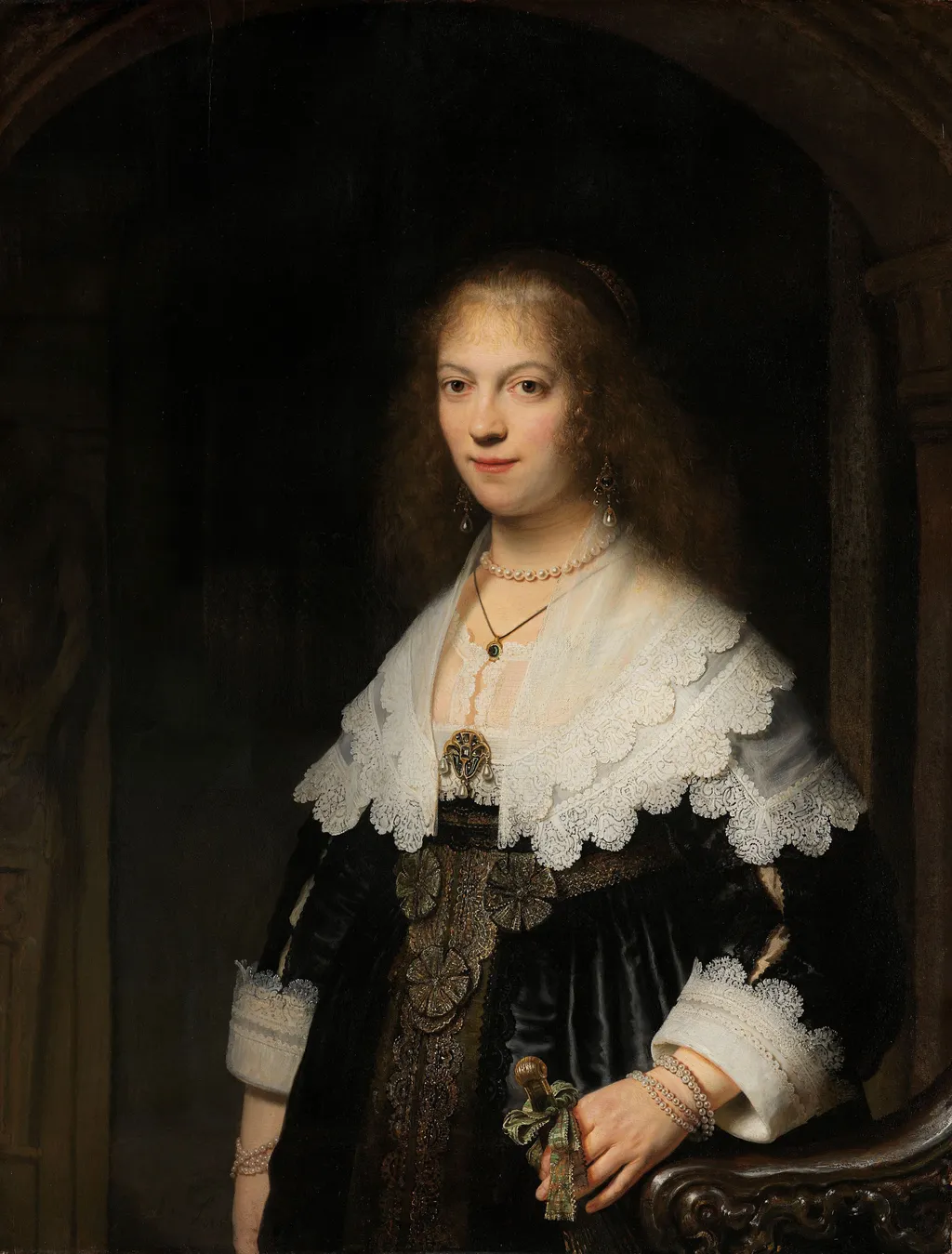
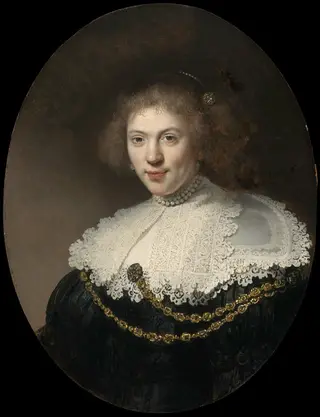
Portrait of Maria Trip is an oil painting by the Dutch Golden Age artist Rembrandt van Rijn. It dates from 1639 and is held in the collection of the Rijksmuseum.
About this work
This painting is a portrait of Maria Trip. It was made by Rembrandt in 1639.
The portrait is an example of Dutch Golden Age painting. It is now in the collection of the Rijksmuseum, which suggests it is a significant work from that time.
To learn more about the style and techniques used in this portrait, look up the artist: Rembrandt.
Subject & Meaning
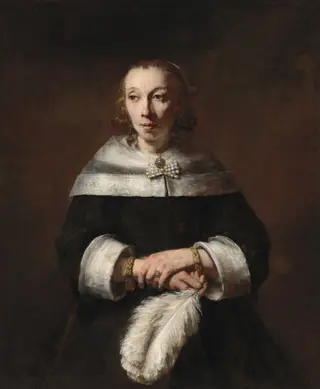
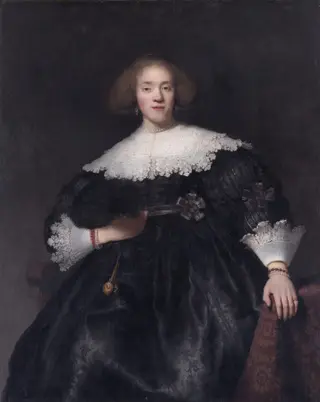
The painting depicts Maria Trip, a young woman from an influential Amsterdam merchant family, likely her sister's brother Jacobus Trip and later married to Balthasar Coymans. She is identified through provenance research conducted by Isabella Henriette van Eeghen, who linked the portrait to her family lineage as the daughter of Elias Trip and Aletta Adriaensdr. The work shows her in formal black silk with lace trim, holding a fan on a balustrade, adorned with pearls and a jewelled medallion, set against a dark curtain with daylight illumination.
Rembrandt's signature 'Rembrandt f. 1639' appears in the lower left corner, though the Rembrandt Research Project notes this signature is a later imitation rather than authentic, while confirming the painting's overall authenticity.
Technique & Style
Visible underdrawing corrections on the lower edge indicate that a table was originally painted there and that large buttons once adorned the left sleeve.
The Portrait of Maria Trip is an oil painting executed on a poplar panel support. Measuring 107 cm in height by 82 cm in width, the work depicts a half-length figure illuminated by full daylight falling from the front. The composition features the subject standing before a dark curtain with a caryatid to the left, holding a fan in her left hand which rests on a stone balustrade.
Her attire includes a black silk gown trimmed with rosettes, a triple lace collar, and extensive pearl jewelry. Visible underdrawing corrections on the lower edge indicate that a table was originally painted there and that large buttons once adorned the left sleeve. A preparatory pen sketch held in the British Museum reveals a larger original design, suggesting the panel was cut down on all sides, though the timing of this reduction remains unknown.
History & Provenance
The painting is held by the Rijksmuseum, Amsterdam, inventoried as SK-C-1887.
It was exhibited on loan in the Rijksmuseum from at least 1896 and formally entered the museum’s holdings after the Van Weede family transferred it to the Rijksmuseum in May 1897.
Exhibitions include Amsterdam in 1872 and 1898, Brussels in 1882, The Hague in 1890, Utrecht in 1894, and Amsterdam again in 1911.
Context
The identification of the sitter as Maria Trip was established through provenance research by Isa van Eeghen in the 20th century, confirming her as the daughter of Elias Trip and later wife of Balthasar Coymans, linking the work to Amsterdam’s merchant elite during the Dutch Golden Age.
The painting’s critical reception has centered on its formal qualities and status within Rembrandt’s oeuvre. Early catalogues describe the half-length portrait as life-size, with the sitter holding a fan and dressed in a black silk gown with lace and pearl adornments, set against a darkened interior with a caryatid and curtain. The Rembrandt Research Project questioned the authenticity of the 1639 signature but affirmed the painting’s attribution, situating it within Rembrandt’s mid-career portrait practice.
Exhibited repeatedly from 1872 onward, the work has been treated as a canonical example of Dutch portraiture, reflecting both the artist’s renown and the sitter’s social standing.
Legacy
The painting's identity as a portrait of Maria Trip was established in the 20th century through research by Isabella van Eeghen, who utilized provenance records to link the sitter to the wealthy Trip and Coymans families. Although the Rembrandt Research Project later questioned the authenticity of the 1639 signature, suggesting it was copied from another work, the attribution of the painting itself to Rembrandt remains unchallenged. The work's historical significance is further underscored by the existence of a larger preparatory drawing in the British Museum, which indicates the final canvas was likely trimmed on all sides after its initial execution.
The portrait has been a featured subject in major exhibitions since the late 19th century, including significant Rembrandt retrospectives in Amsterdam and London, and remains a permanent highlight of the Rijksmuseum's collection.
Overview
Rembrandt’s oil on panel portrait of Maria Trip, dated around 1639, measures roughly 42 by 32 inches. The work is held in the Rijksmuseum’s collection and exemplifies the Dutch Golden Age’s portraiture tradition.
Own this work as a print
Artist & collection

Artist
Rembrandt Harmenszoon van Rijn, known mononymously as Rembrandt, was a Dutch Golden Age painter, printmaker, and draughtsman.