Open full image Pin
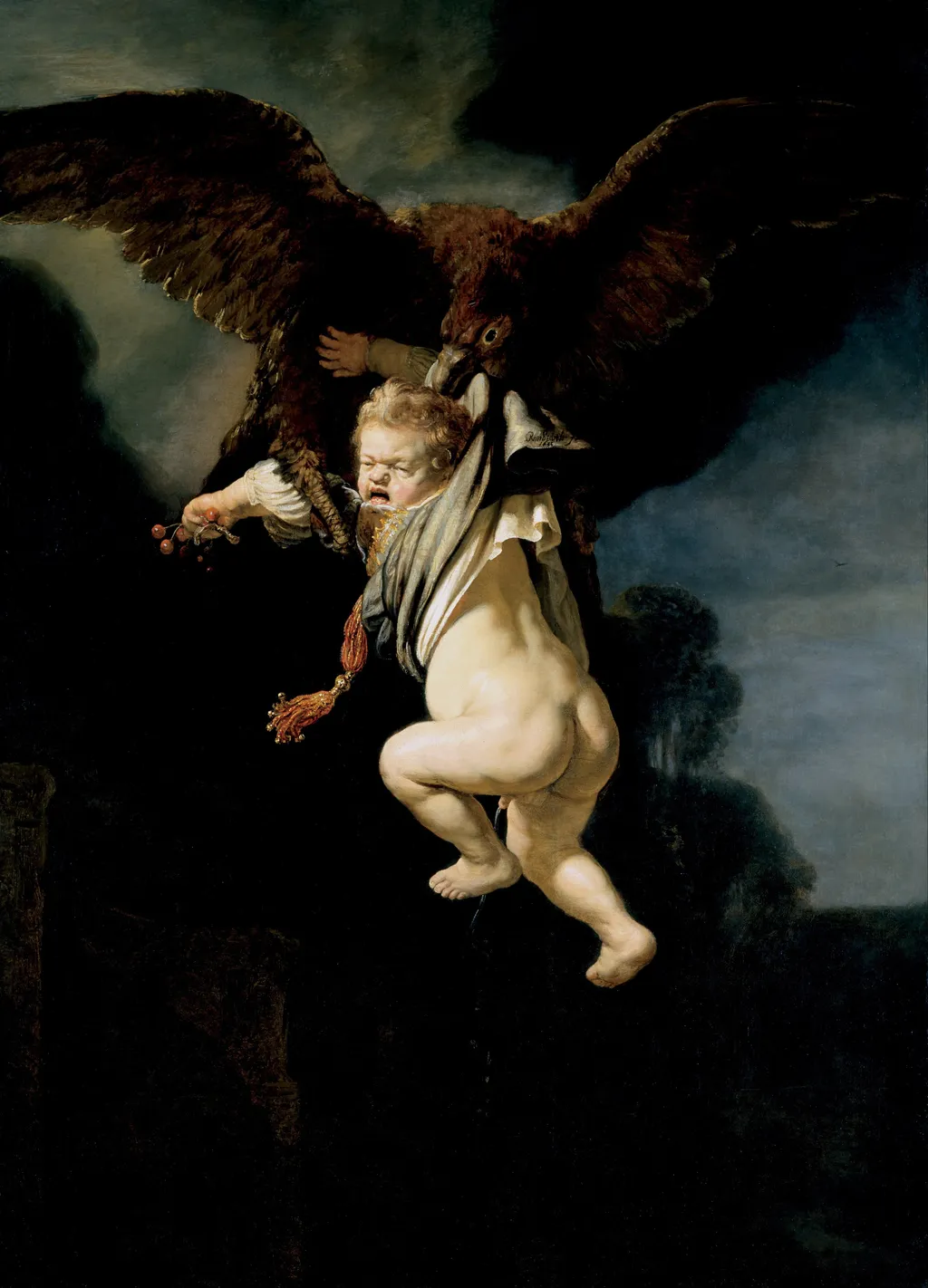
The Rape of Ganymede, by Rembrandt, oil, 1635

The Rape of Ganymede

Rembrandt

1635

oil

canvas

From the collection of Staatliche Kunstsammlungen Dresden

Dominant colour

Overview

The Rape of Ganymede is a 1635 oil by Rembrandt, a Dutch Golden Age work, depicting Putto, held at Staatliche Kunstsammlungen Dresden.

Who painted this?
Rembrandt
When & what style?
1635 · Dutch Golden Age
Where can I see it?
Staatliche Kunstsammlungen Dresden

About this work

This painting depicts a putto being carried away by a large bird, possibly an eagle. The putto is shown from behind, with his arms outstretched and his legs bent at the knees. He is nude, except for a cloth draped over his shoulder. The bird's wings are spread wide, and its talons are grasping the putto's arms and legs. The background of the painting is dark and shadowy, with hints of blue and gray. The overall mood of the painting is one of drama and tension, as if the putto is being swept away against his will. This painting is reminiscent of the work of Rembrandt.

The story of this work

Overview

The Rape of Ganymede (also called The Abduction of Ganymede) is an oil painting of 1635 by the Dutch Golden Age painter Rembrandt, depicting the myth of Ganymede. It is in the collection of the Gemäldegalerie Alte Meister in Dresden.

Source: wikipedia, available under CC BY-SA 4.0.

Painting

This painting was documented by Hofstede de Groot in 1915, who wrote:207. THE RAPE OF GANYMEDE. Sm. 197; Bode 79; Dut. 106; Wb. 70; B-HdG. 197. The eagle of Zeus, seen in front with out-stretched wings, rises towards the heavens. He holds with his beak the clothing, and with his talons the left arm, of the fair curly-haired boy, who, turned sharply to the left and almost seen from the back, faces round to the spectator as if crying loudly, and with his right hand tries to repulse the bird. His light blue dress and shirt are pulled up by the eagle's claws so as to expose the whole of the boy's…

Source: wikipedia, available under CC BY-SA 4.0.

Interpretation

Rembrandt's depiction of the reluctant Ganymede should be seen not in the Renaissance context of the homo-erotic catamite theme, but in a relatively new Protestant Baroque interpretation of Ganymede as a beloved child "abducted from life too soon". In the 1670s the painter Nicolaes Maes even made a whole series of paintings of Ganymedes that are considered deathbed portraits of children. An inventory, made on 17 February 1671, of the estate of Catharina van der Pluym, widow of Willem Schilperoort and aunt of Rembrandt's great-nephew and pupil Karel van der Pluym, mentions "een stuck van…

Read the full account in the museum source.

Source: wikipedia, available under CC BY-SA 4.0.

About the artist

Portrait of Rembrandt
Artist

Rembrandt

Rembrandt Harmenszoon van Rijn (15 July 1606 – 4 October 1669), known mononymously as Rembrandt, was a Dutch Golden Age painter, printmaker, and draughtsman.

See the richer artist page

More by Rembrandt

Artifact World Gallery — 100,000 artworks Get the app