Artwork
Tityus
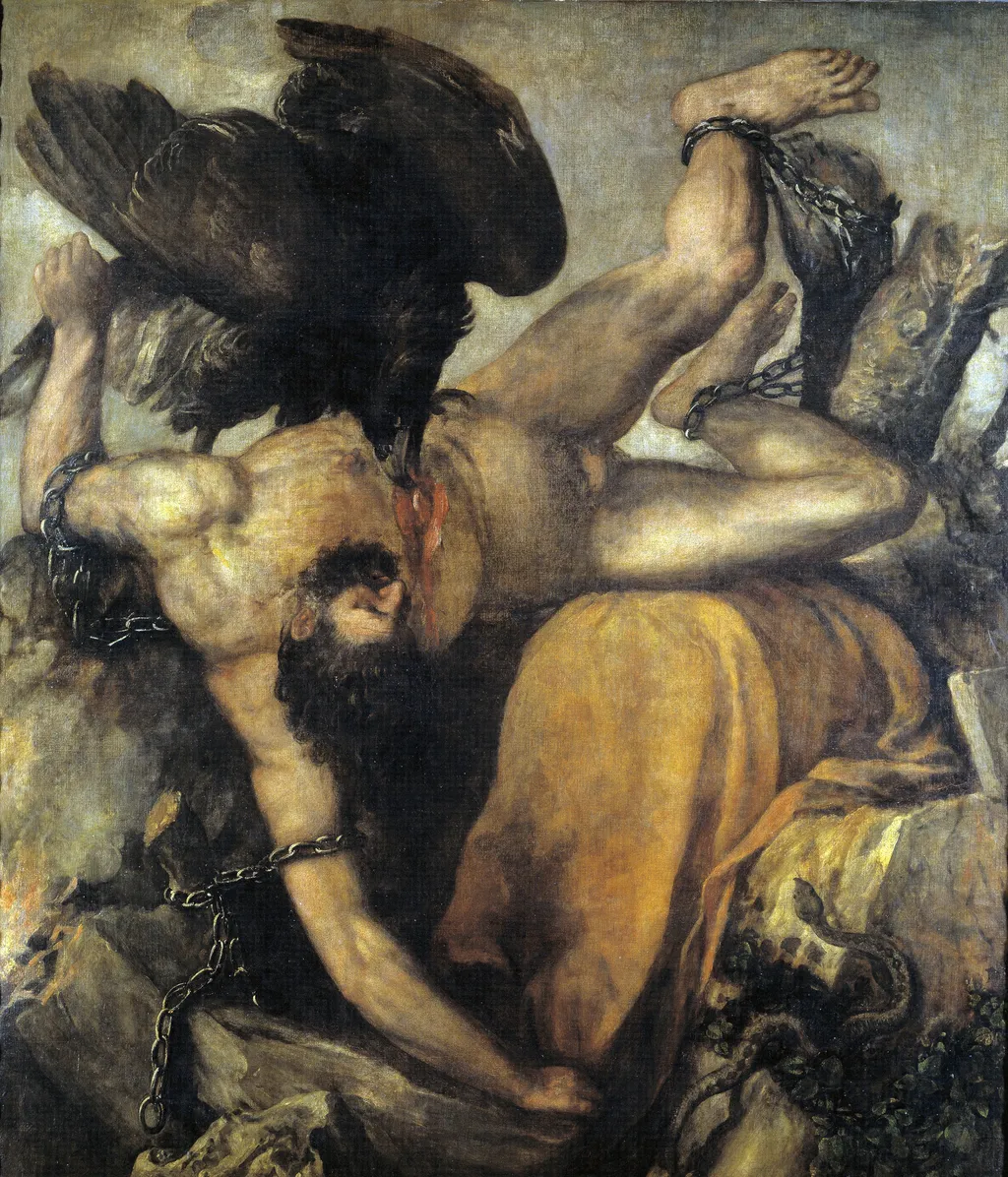
Tityus is an oil painting by the Mannerist artist Titian. It dates from 1565 and is held in the collection of the Museo del Prado.
About this work
Subject & Meaning
Beyond its mythological narrative, the work functions as a political allegory warning against rebellion.
The painting depicts the eternal punishment of Tityus, a giant from Greek mythology and son of Zeus. After attempting to violate the goddess Leto at Hera's instigation, Tityus was slain by Leto's children, Apollo and Artemis, and condemned by Zeus to the underworld. The composition shows the immortal giant chained to tree trunks, writhing in agony as a vulture devours his regenerating liver or intestines, ensuring his suffering never ends. A snake appears in the lower section, symbolizing evil and reflecting the sin committed by the giant.
Beyond its mythological narrative, the work functions as a political allegory warning against rebellion. By drawing a veiled comparison between Zeus and Emperor Charles V, the image highlights the dire consequences of defying established imperial authority, specifically addressing the religious and political tensions of the sixteenth century.
Technique & Style
Tityus is an oil painting on canvas created around 1565 by Titian, depicting the mythological punishment of the giant Tityos. The work shows the immortal Titan chained to a tree while a vulture devours his regenerating liver, symbolizing eternal torment. Titian employs Mannerist techniques, notably dramatic foreshortening, to heighten violence and emotional intensity, a stylistic choice atypical of his usual approach.
The composition includes symbolic elements such as a snake representing sin and evil, reinforcing moral and allegorical themes. The painting reflects political subtext, drawing parallels between mythological punishment and Habsburg warnings against rebellion. It belongs to the Museo del Prado's collection, acquired in 1828, and is part of a series of mythological 'damned' figures commissioned by Marie of Hungary.
Earlier versions and related works, such as Michelangelo's lost drawing and Nicolas Béatrizet's print after Raphael, inform its artistic context.
History & Provenance
Titian designed the composition of Tityus around 1549 as part of a series of four mythological paintings commissioned by Mary of Austria, sister of Emperor Charles V, to decorate her palace at Binche. The series, known as the Damned or the Furies, depicted the punishments of Sisyphus, Tityus, Tantalus, and Ixion. The original Tityus painted for Binche is now considered lost; the surviving canvas in the Museo del Prado is a later version datable to the 1560s, painted in a freer palette and handling.
Documentary evidence indicates that Philip IV exchanged the poorly preserved Binche original for this later version, which had belonged to the Duke of Infantado. The painting has belonged to the Museo del Prado's collections since 1828, and Wikidata records Ferdinand VII of Spain among its former owners.
Tityus is held by the Museo del Prado in Madrid. It entered the museum's collection in 1828 after being exchanged from the ducal collection of the Infantado, having previously been part of a series commissioned by Marie of Hungary for the Palace of Binche. The work was originally intended for Binche but the version now in the Prado is a later copy; the earlier version from Binche is considered lost.
The painting is catalogued under the museum's inventory as P00968, reflecting its acquisition history and transfer from the Royal Palace of Madrid to its current location.
Context
Titian's Tityus belongs to a series of mythological punishments commissioned by Mary of Austria, sister of Charles V, to decorate her palace at Binche during the 1547 Diet of Augsburg. The series, known as the "Damned" or "Furies," also included Sisyphus, Tantalus, and Ixion; the latter two were lost in the 1734 fire at the Alcázar of Madrid. While the Sisyphus at the Prado is the original Binche commission, the Prado Tityus is a later version from the 1560s, originally belonging to the Duke of Infantado. The original Binche canvas is considered lost.
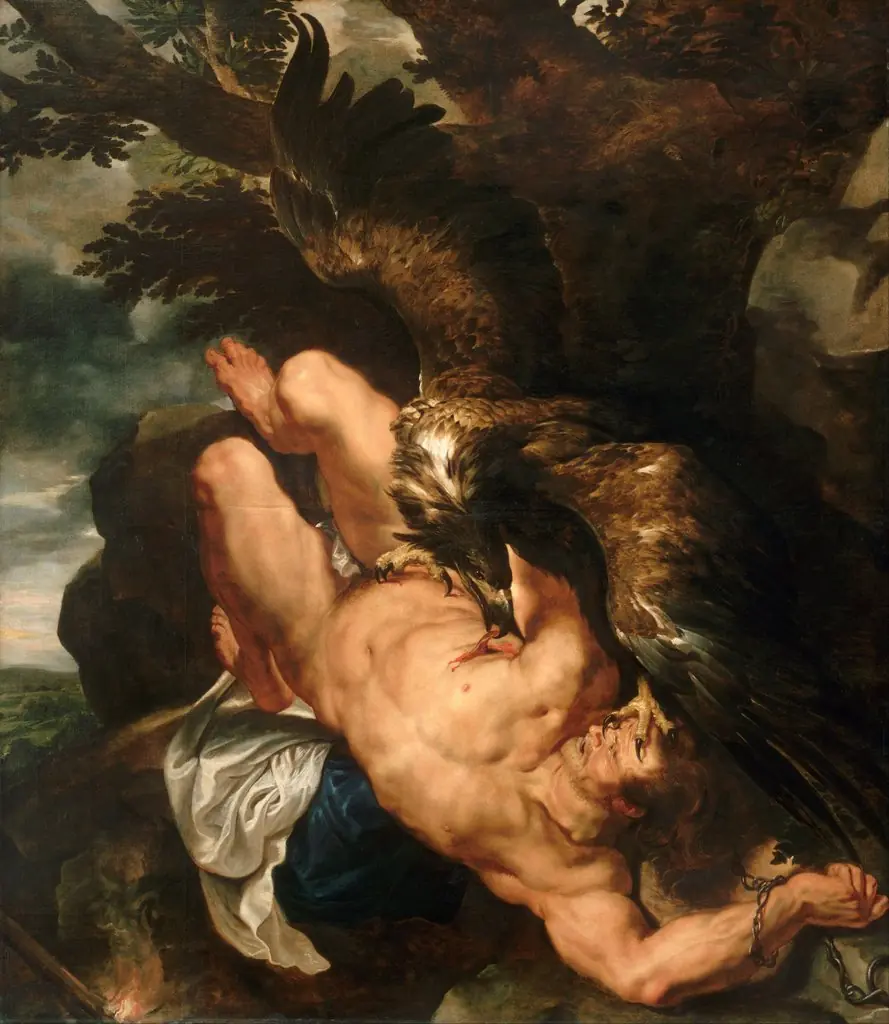
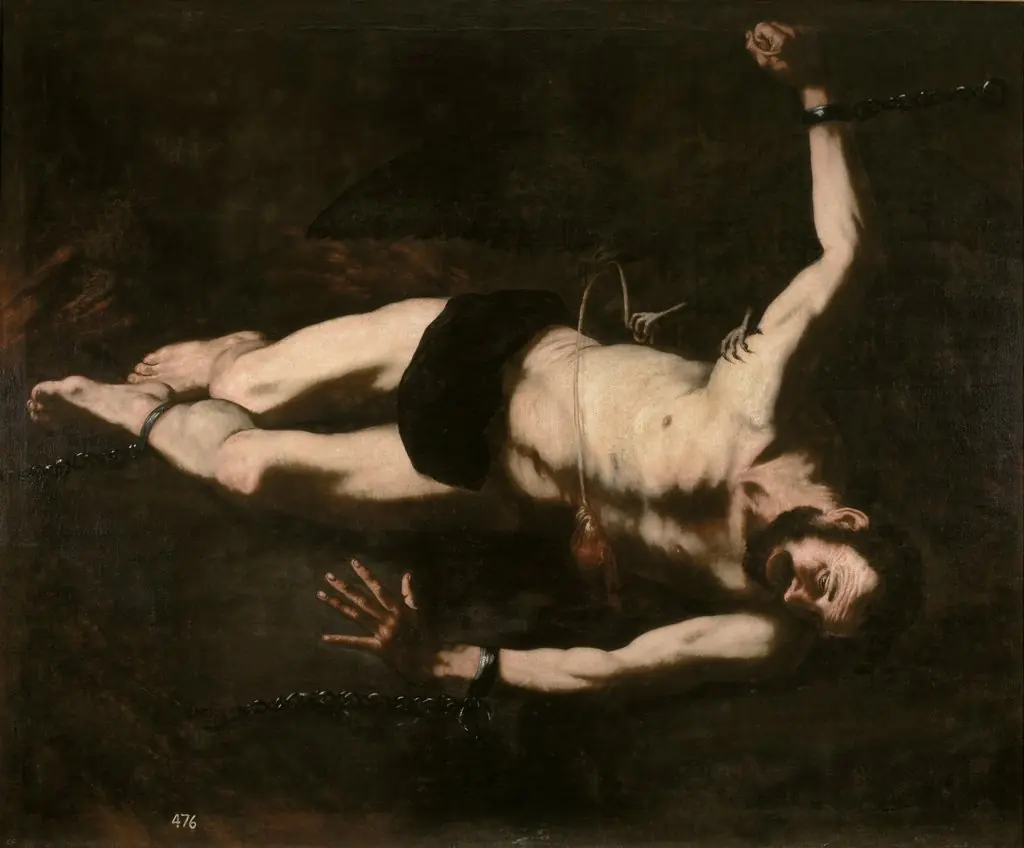
The subject had earlier been treated by Michelangelo, whose drawing of Tityus being devoured by an eagle, given to Tommaso dei Cavalieri in 1532 and now in the Royal Collection at Windsor Castle, influenced subsequent representations. Nicolas Béatrizet's engraving circulated Michelangelo's composition widely, and Cornelis Cort produced an engraving after Titian's design in 1566. Titian also drew on antique sculpture, notably the Laocoon, and on literary sources including Ovid's Metamorphoses and Achilles Tatius.
The painting exemplifies Titian's late Mannerist style, with pronounced foreshortening heightening the scene's violence. Scholars have read the work as a veiled political allegory, comparing Zeus to Charles V and warning against rebellion against imperial authority.
Overview
Titian’s oil painting Tityus, executed in 1549, is part of the Prado Museum’s collection in Madrid. The work depicts the mythic giant Tityos, condemned to perpetual torment by the gods. The composition centers on the bound figure under attack by a carrion bird, set against a dark, foreboding landscape that emphasizes his agony.
Own this work as a print
Artist & collection
Artist
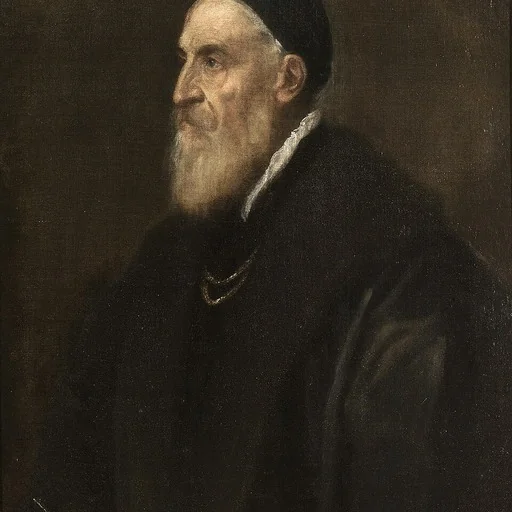
Tiziano Vecellio (Italian:; c. 1488/1490 – 27 August 1576), Latinized as Titianus, hence known in English as Titian ( TISH-ən), was an Italian Renaissance painter. The most important artist of Renaissance Venetian…