Artwork
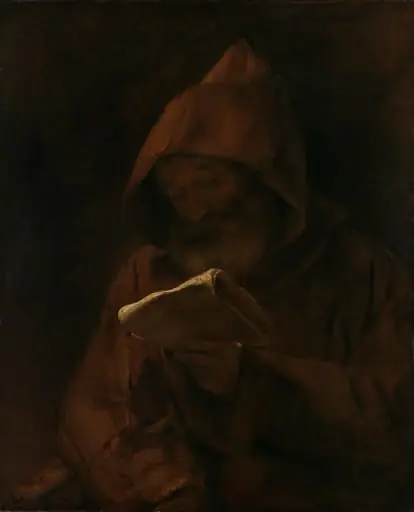
Titus as a Monk
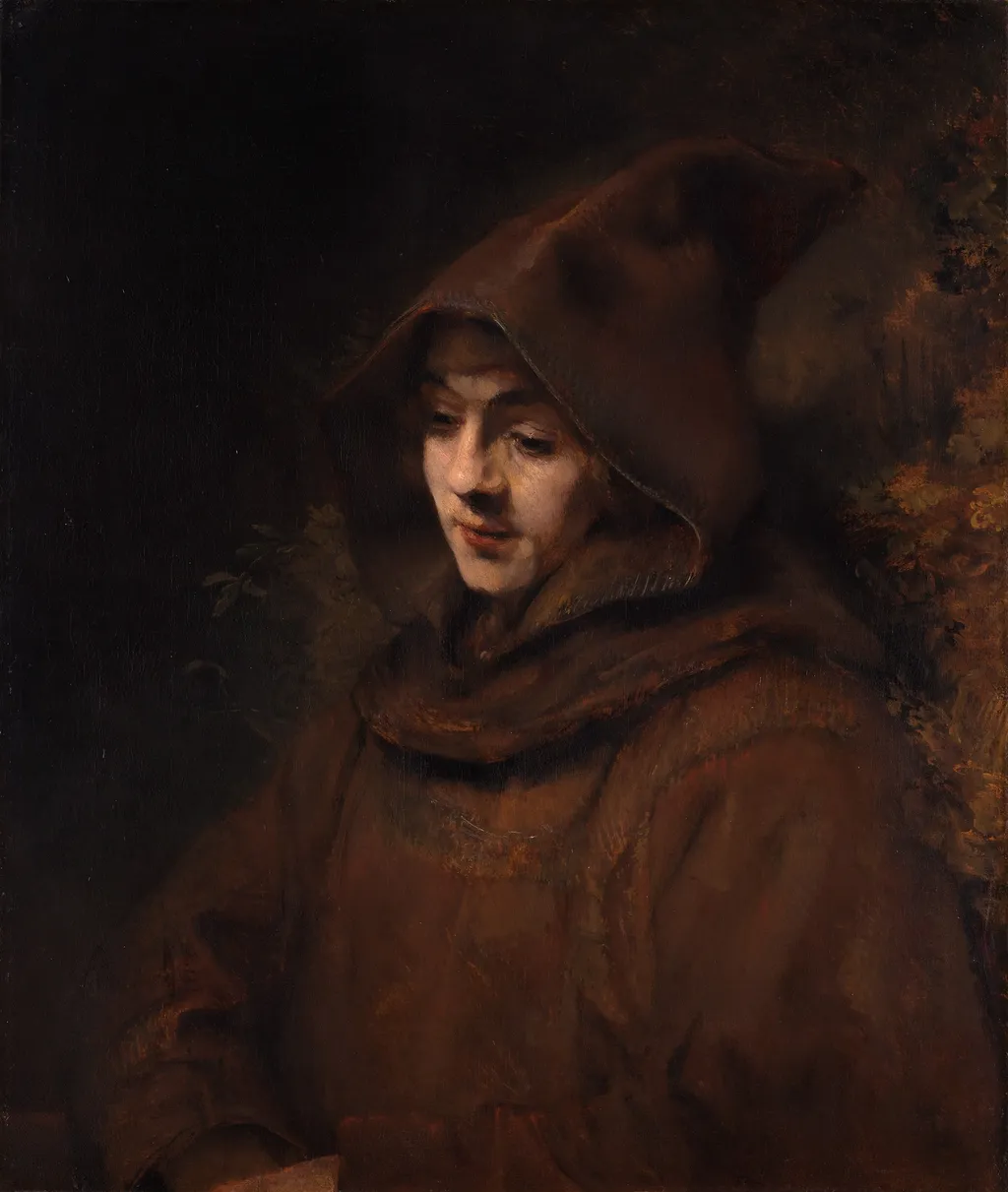
Titus as a Monk is an oil painting by the Dutch Golden Age artist Rembrandt van Rijn. It dates from 1660 and is held in the collection of the Pushkin Museum of Fine Arts.
About this work
Subject & Meaning
The painting depicts Rembrandt's son, Titus van Rijn, portrayed in the habit of a Franciscan monk, making the work a historiated portrait rather than a straightforward likeness. Shown half-length in three-quarter view from his left profile, Titus wears a coarse hooded robe and casts his gaze downward in the humility expected of a Franciscan friar, set against a background of foliage that darkens toward the upper left corner.
The subject is conventionally identified as Saint Francis of Assisi, a reading supported by some sources, though no definitive documentation confirms this attribution. Like other late works by Rembrandt, the painting uses his son as a model for a historical or religious figure, lending the portrait a contemplative, devotional character through the monk's meditative pose and downcast eyes.
Technique & Style
The support is a vertically oriented linen canvas, prepared with a warm-toned ground typical of the artist's late period.
Rembrandt's Titus as a Monk is an oil-on-canvas painting measuring 79.5 × 67.7 cm. The support is a vertically oriented linen canvas, prepared with a warm-toned ground typical of the artist's late period. Paint is applied in thin, translucent glazes for the habit's folds and impasto highlights on the face and hands, creating a tactile contrast between the matte robe and luminous skin.
Stylistically, the work exemplifies Rembrandt's mature handling: broad, sketch-like strokes define the background foliage and robe, while finer, almost calligraphic lines articulate facial details. The palette is restrained, dominated by earthy browns and blacks, with subtle tonal shifts achieving volumetric modeling. The composition's darkened upper-left corner directs focus toward the sitter's downcast gaze, reinforcing the introspective mood characteristic of the artist's late portraits.
History & Provenance
Executed in 1660, this oil-on-canvas portrait bears the signature "Rembrandt f. 1660" in the lower left corner. While the work may have appeared in Parisian auctions during the late 18th century under descriptions of a Capuchin monk, its documented ownership chain begins definitively in 1800 within the collection of Alexander Sergejevitsj Stroganov in Saint Petersburg.
The painting remained with the Stroganov family until the Russian Revolution of 1917, when it was transferred to state custody and eventually held in Moscow.
In July 1933, the Soviet government sold the work through the London dealer Colnaghi & Co. to the Rijksmuseum in Amsterdam, with financial support from the Rembrandt Society. The painting has been in the Rijksmuseum collection since that acquisition.
Context
The painting has been understood as a rare example of Rembrandt portraying his son Titus in a religious guise, reflecting the artist's late focus on intimate, introspective subjects and his engagement with Dutch Golden Age portraiture and monastic themes. Scholarly attention emphasizes its significance within Rembrandt's broader oeuvre as a historical portrait and its role in the evolution of religious portraiture in 17th-century Dutch art. The work's provenance, including its acquisition by the Rijksmuseum in 1933 through a sale from the former Stroganov collection, underscores its complex journey from Russian ownership to Western museum custody.
Legacy
Titus as a Monk has shaped Rembrandt's legacy through its intimate portrayal of family and spiritual humility. The painting's late-period technique and subtle brushwork influenced later portraiture that blended personal narrative with symbolic depth. Its provenance across European collections underscores its role in transnational art exchange.
The work remains a reference point for studies of Dutch Golden Age portraiture and the evolving representation of religious identity in secular contexts.
Overview
Created in 1660, this oil-on-canvas work by Rembrandt van Rijn portrays a young man dressed in the simple brown habit of a Franciscan monk. The figure is identified as the artist’s son, Titus, who appears contemplative within the muted setting. The painting is part of the permanent collection of the Rijksmuseum in Amsterdam.
Own this work as a print
Artist & collection

Artist
Rembrandt Harmenszoon van Rijn, known mononymously as Rembrandt, was a Dutch Golden Age painter, printmaker, and draughtsman.