Artwork
Death of the Virgin
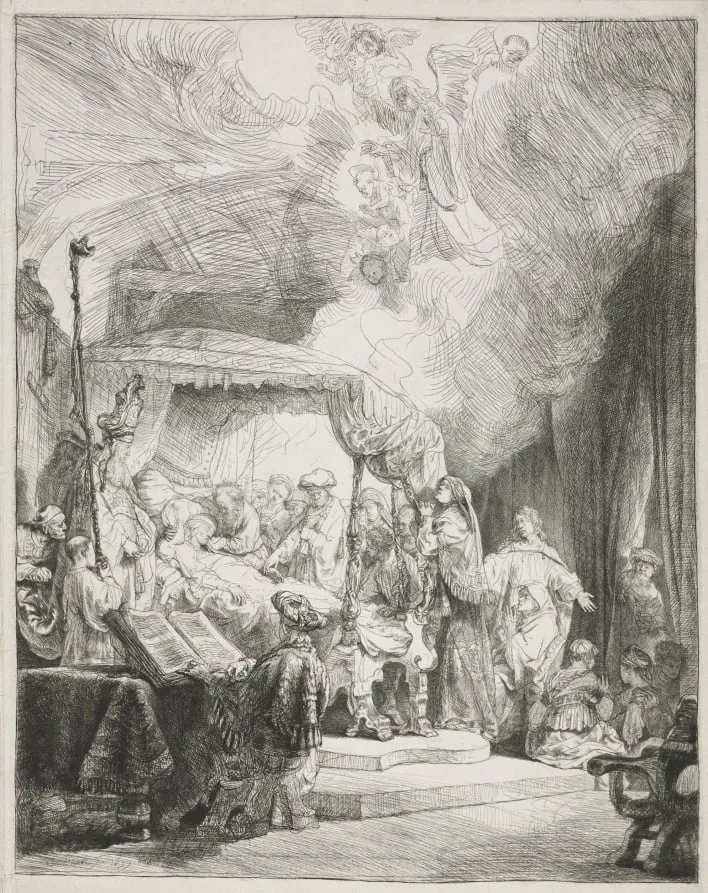
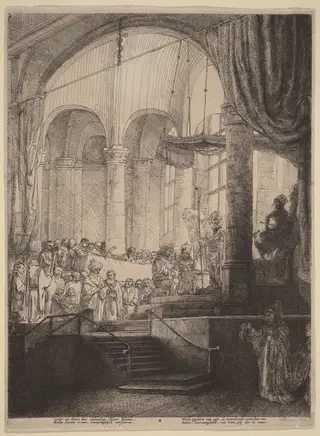
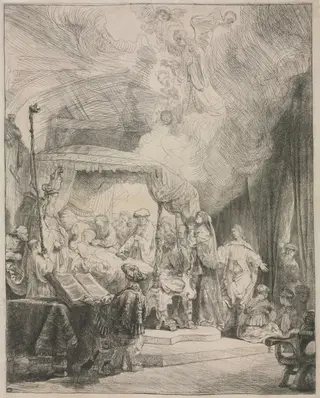
Death of the Virgin is a print by the Baroque artist Rembrandt van Rijn. It dates from 1639 and is held in the collection of the Cleveland Museum of Art.
- Accession no.
- 1926.467
- Credit line
- Bequest of Ralph King
About this work
Overview
Rembrandt employs dramatic chiaroscuro, with light streaming through an open doorway to cast deep shadows across the walls and illuminate the central group.
The Death of the Virgin is a 1639 print executed in etching and drypoint by Rembrandt van Rijn. The work illustrates the death of the Virgin Mary as recounted in The Golden Legend. Compositionally, the scene is set within a dimly lit interior where a group of apostles and mourners gather around a bed draped in heavy fabric.
The figures are depicted standing or kneeling, their attention focused downward upon the deceased. Rembrandt employs dramatic chiaroscuro, with light streaming through an open doorway to cast deep shadows across the walls and illuminate the central group. Above the mourners, ghostly, ethereal shapes float in the upper space, suggesting a spiritual presence or the soul's ascent.
Created early in Rembrandt's mature period in Amsterdam, this print demonstrates his mastery of the drypoint technique, utilizing the burr to create rich, velvety blacks and a sense of atmospheric depth. The work stands as a significant example of Rembrandt's exploration of religious narrative, combining intimate human grief with supernatural elements through his distinctive handling of light and shadow.
Subject & Meaning
The image portrays the final moments of the Virgin Mary, surrounded by a small group of mourners gathered around a richly draped bed. The figures, some kneeling and others standing, convey a solemn atmosphere as they look toward the dying figure, suggesting contemplation of mortality and devotion.
Technique & Style
Rembrandt employs a loose, sketch‑like line that animates the scene with a sense of immediacy. Strong contrasts of light and shadow, characteristic of his chiaroscuro approach, create depth, while the faint, ethereal shapes hovering above the bed hint at a spiritual presence.
History & Provenance
Created in the late 1630s, the print was likely produced as part of Rembrandt’s workshop output for the Dutch market. It entered the Cleveland Museum of Art’s holdings through a mid‑20th‑century acquisition, joining a broader collection of Dutch graphic works.
Context
During the 1630s Rembrandt frequently explored biblical narratives, integrating dramatic lighting and expressive figures to engage viewers emotionally. This work reflects the period’s Protestant interest in personal piety, focusing on the human aspects of sacred stories rather than overtly decorative iconography.
Artist & collection

Artist
Rembrandt Harmenszoon van Rijn, known mononymously as Rembrandt, was a Dutch Golden Age painter, printmaker, and draughtsman.