Artwork
Lucretia
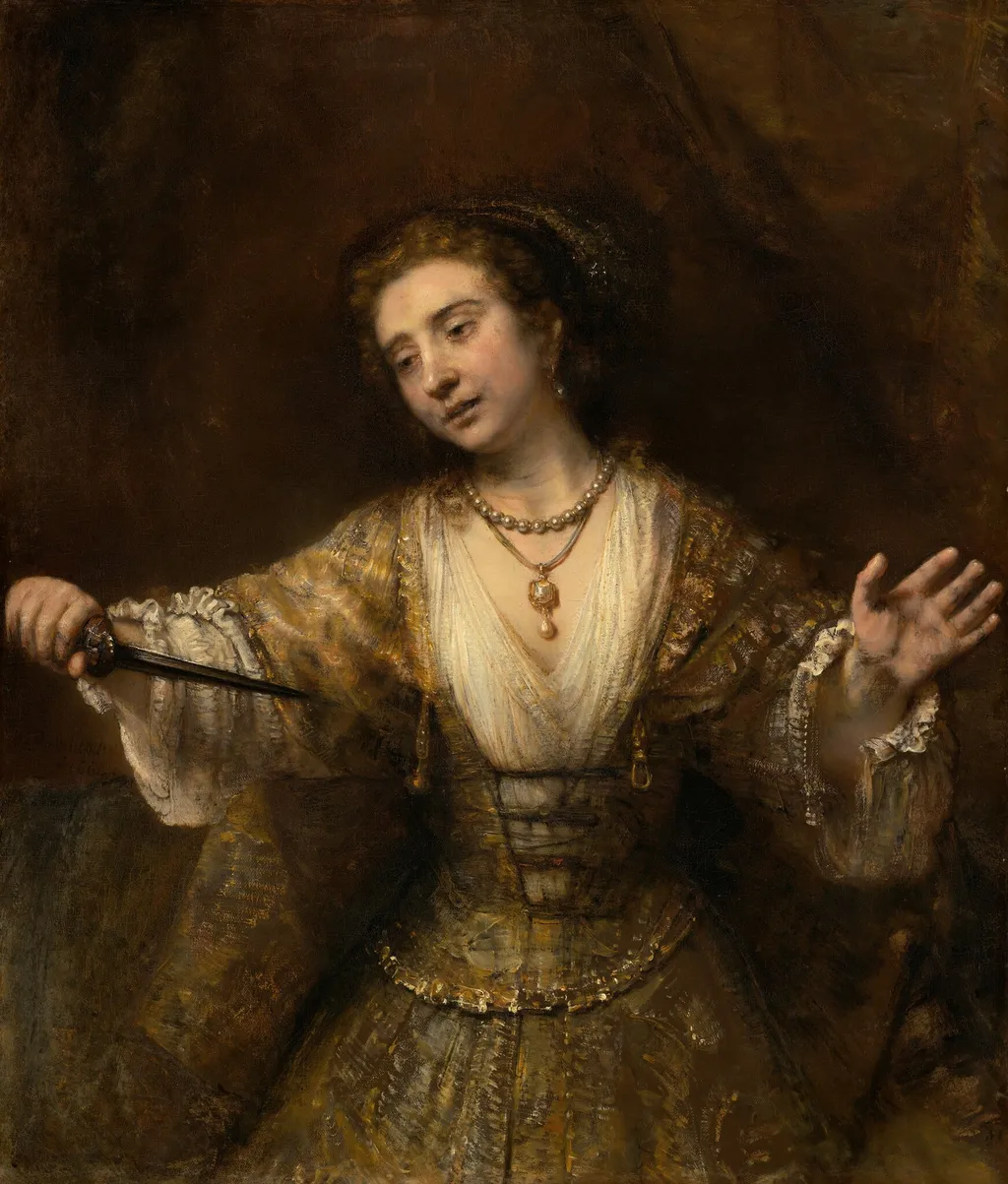
Lucretia is an oil painting by the Baroque artist Rembrandt van Rijn. It dates from 1664 and is held in the collection of the National Gallery of Art.
- Inscription
- Inscribed:center left: Rembrandt / 1664
About this work
Subject & Meaning
The work departs from earlier eroticized depictions, focusing instead on dignified tragedy and the psychological intensity of the moment.
Lucretia, a Roman noblewoman forced into adultery, chooses self-inflicted death to preserve her honor, clutching a dagger against her breast while her left hand extends outward, her head tilted toward the weapon. She wears a richly detailed greenish-gold gown with wide sleeves, a pearl necklace, earrings and a pendant, emphasizing both her aristocratic status and personal anguish. The composition underscores themes of moral sacrifice; her resolute expression and the act of suicide have been interpreted as a protest against violated chastity and an assertion of autonomy.
The work departs from earlier eroticized depictions, focusing instead on dignified tragedy and the psychological intensity of the moment.
Technique & Style
The painting Lucretia (1664) is executed in oil on canvas. The single canvas measures roughly 120 × 101 cm and bears the signature 'Rembrandt f. 1664' in the lower left corner.
The composition depicts the Roman heroine half-length, turned slightly to the left, her right hand holding a dagger to her breast, with a pearl necklace and pendant visible. Contemporary descriptions note a rich green-gold dress with wide sleeves, a loosely rendered bodice, and a solemn, resolute expression, reflecting a late style that emphasizes chiaroscuro and textural detail. Recent scholarship has questioned the autograph status of the work while connecting its handling of light and loose brushwork to the Dutch Golden Age tradition.
History & Provenance
The work, an oil on canvas painted in 1664, was created as a history painting depicting the Roman heroine Lucretia. It entered the market in 1825, when it was sold by Jean-Joseph-Pierre-Augustin Lapeyrière at Galerie Le Brun in Paris. The painting passed to Michael M. Zachary in London, then to Sir Thomas Lawrence, who acquired it for Hugh Andrew Johnstone Munro.
Subsequent owners included Paul Demidoff, Léon Gauchez, Bourgeois & Cie., Leo Nardus, Matthew Borden, M. Knoedler & Co., August Janssen, Jacques Goudstikker, Hermann Heilbuth, and finally Andrew Mellon, who donated it to the National Gallery of Art in 1937 (accession no. 1937.1.122). Its exhibition history includes the British Institution, London, in 1832; a showing in Amsterdam in 1913; and the Hudson-Fulton Celebration at the Metropolitan Museum of Art, New York, in 1909.
Context
Created in 1664, this history painting reflects Rembrandt's late style, characterized by a sumptuous handling of the heroine's rich, golden dress. The work diverges from classical iconography by portraying Lucretia fully clothed, thereby rejecting the traditional depiction of her as a seductive temptress. The painting's attribution has been a subject of scholarly debate; while traditionally accepted as an autograph work, Ernst van de Wetering of the Rembrandt Research Project concluded in 2015 that its formal properties and execution exclude Rembrandt's authorship, suggesting instead a connection to the artist Aert de Gelder.
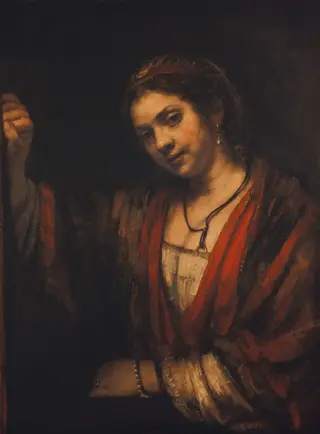
Consequently, the 1664 canvas is excluded from the project's 2015 corpus, distinguishing it from the artist's 1666 Lucretia held in Minneapolis. Some critics have also speculated that the figure represents Hendrickje Stoffels, the painter's companion.
Legacy
The painting's reputation has been complicated by modern attribution debates. While historically accepted as an autograph late work by Rembrandt on the basis of its 1664 date and signature, the 2015 corpus by the Rembrandt Research Project excluded it, with Ernst van de Wetering arguing that the execution and formal properties point to Aert de Gelder rather than the master himself. Despite this scholarly reclassification, the piece remains a prominent work in the National Gallery of Art's collection.
Its legacy is also defined by its distinctive iconography, which departs from classical depictions by portraying Lucretia fully clothed in rich attire, emphasizing her honor rather than her vulnerability. Its provenance, tracing through major nineteenth-century collectors before entering the Mellon collection, further cements its status as a significant, if contested, work of the Dutch Golden Age.
Overview
This oil on canvas, titled Lucretia, depicts the Roman noblewoman of the same name. Created in 1664, the painting has long been associated with the Dutch Golden Age master Rembrandt and resides in the collection of the National Gallery of Art. However, recent scholarship has challenged this traditional attribution, proposing that the work may originate from a different hand within Rembrandt's circle or school.
Own this work as a print
Artist & collection

Artist
Rembrandt Harmenszoon van Rijn, known mononymously as Rembrandt, was a Dutch Golden Age painter, printmaker, and draughtsman.