Artwork
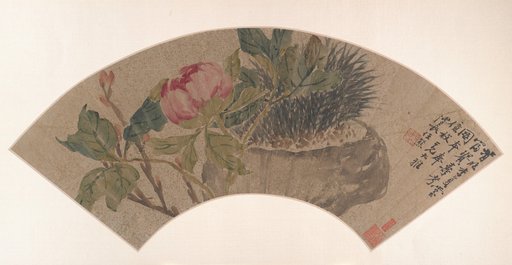
清 任熊 牡丹 扇面|Peony
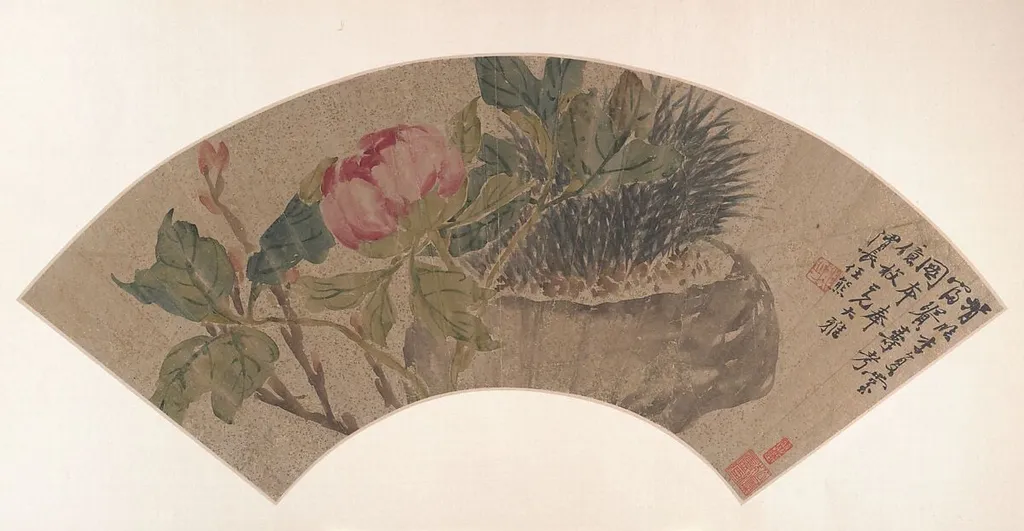
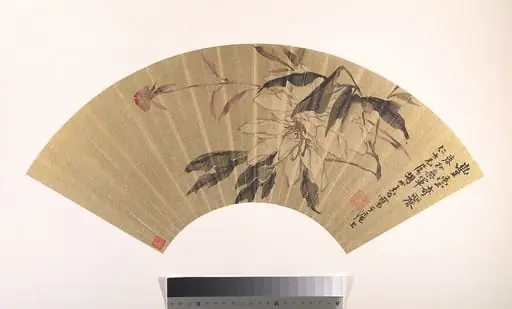
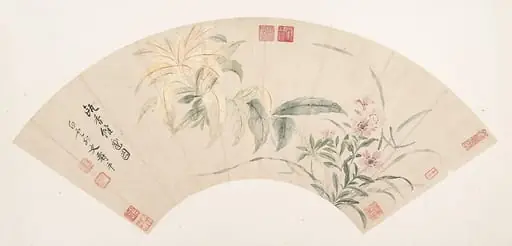
清 任熊 牡丹 扇面|Peony is an ink painting by the Qing dynasty painting artist Ren Xiong. It dates from 1840 and is held in the collection of the Metropolitan Museum of Art.
- Accession no.
- 1986.267.18
About this work
Subject & Meaning
Created in 1840 by the Qing dynasty artist Ren Xiong, the piece presents the flower as the central subject within a still-life composition.
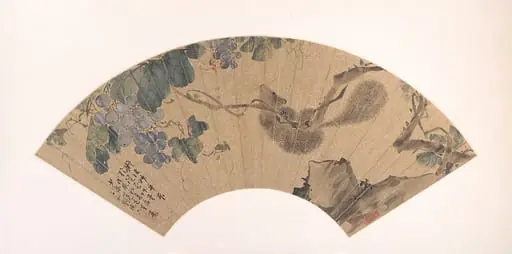
The artwork depicts a peony (Paeonia), rendered in ink and color on gold-flecked paper. Created in 1840 by the Qing dynasty artist Ren Xiong, the piece presents the flower as the central subject within a still-life composition. While the specific symbolic interpretation intended by the artist is not detailed in the provided records, the choice of the peony as the sole subject aligns with its traditional status in Chinese art as a symbol of wealth, honor, and prosperity.
The work's presentation as a folding fan mounted as an album leaf further contextualizes the depiction within the realm of portable, intimate artistic expression typical of the period.
Technique & Style
The work is executed on a folding fan that has been mounted as an album leaf, using ink and polychrome pigments applied to paper flecked with gold. Ren Xiong's brushwork renders the peony blossoms with vigorous, sweeping strokes, while the gold-flecked background provides a luminous surface that enhances the delicate gradations of color. The medium emphasizes a flat, decorative plane characteristic of Qing dynasty fan painting, and the composition balances dense floral clusters with negative space, creating a stylized yet naturalistic depiction of Paeonia.
History & Provenance
The work was created in 1840 in China by Ren Xiong as a folding fan mounted as an album leaf, executed in ink and color on gold-flecked paper. Its subject is the peony (Paeonia). The piece entered the collection of the Metropolitan Museum of Art, where it has been held since its acquisition.
The dating of 1840 is confirmed by both the artist's catalogue entry and the museum's metadata, which also record its dimensions and place of creation.
Context
The 1840 folding-fan painting by Ren Xiong, recorded as a still-life of peony (Paeonia), exemplifies the Qing artist's focus on still-life subjects and his use of decorative formats within fine art. Its presence in the Metropolitan Museum of Art's collection signals scholarly attention to Ren Xiong's contribution to 19th-century Chinese painting and to the cultural symbolism of the peony. The work's classification as a genre piece and its material details, ink, color on gold-flecked paper, have been referenced in studies of Qing visual culture, highlighting its role in the evolution of Chinese artistic exchange.
Overview
Ren Xiong's Peony, created in 1840, is an ink and color painting on gold-flecked paper. Originally a folding fan, it has since been mounted as an album leaf. The artwork presents a solitary peony blossom, rendered with delicate hues.
This piece exemplifies the artist's engagement with traditional subjects while subtly introducing his individual artistic perspective within the conventions of Chinese painting.
Artist & collection