Artwork
Seated Woman
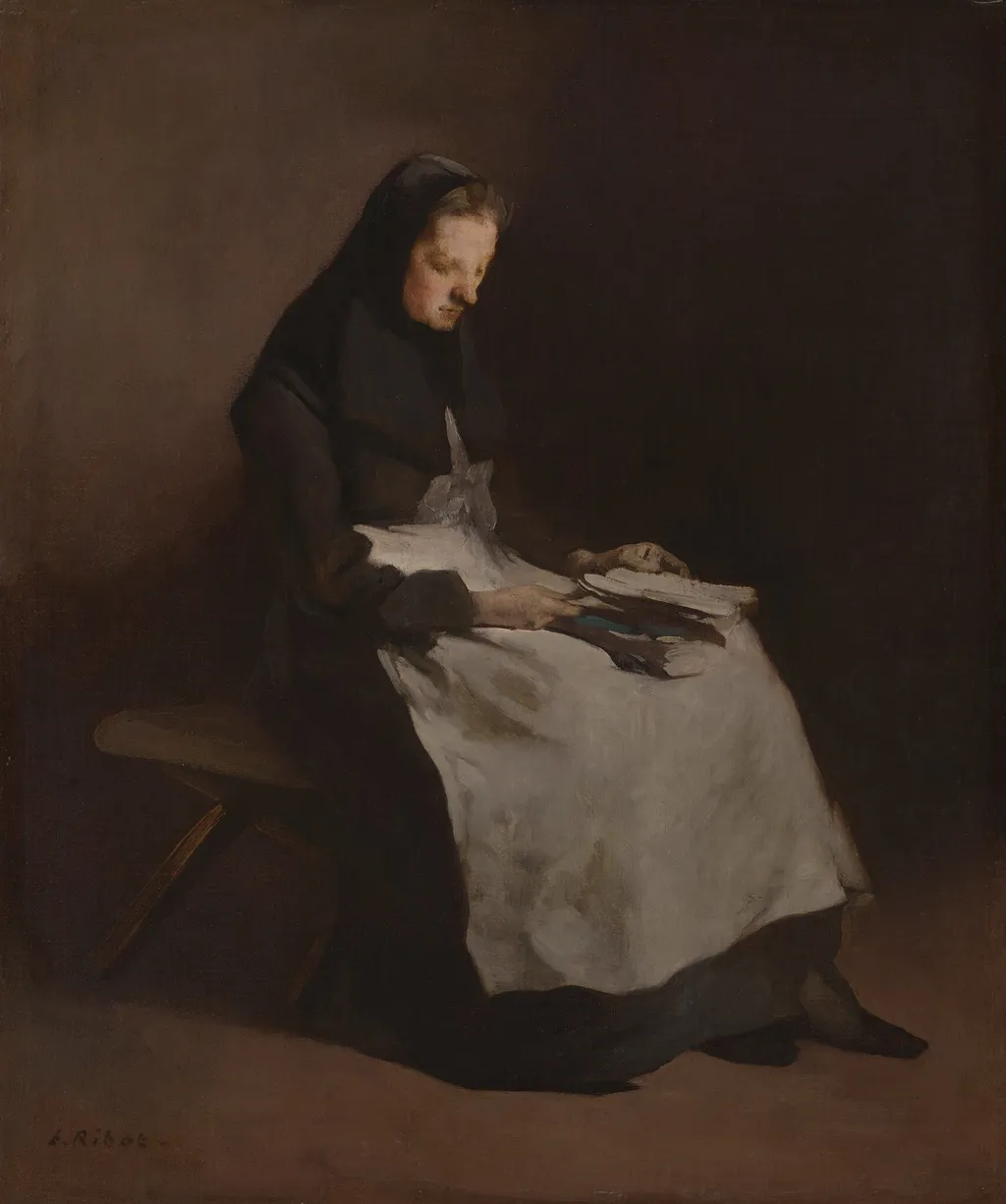
Seated Woman is an oil painting by the Impressionist artist Augustin Théodule Ribot. It dates from 1882 and is held in the collection of the National Gallery of Art.
- Inscription
- Inscribed:lower left: T. Ribot.
About this work
Subject & Meaning
The painting depicts a solitary figure of an elderly woman seated in quiet repose, rendered in a naturalistic style that emphasizes her dignified presence.
The painting depicts a solitary figure of an elderly woman seated in quiet repose, rendered in a naturalistic style that emphasizes her dignified presence. The work functions as a study of age and interiority, reflecting Ribot's interest in psychological depth rather than symbolic allegory. No additional iconographic elements accompany the figure, and the composition conveys a straightforward representation of a seated woman without narrative or allegorical significance.
The painting measures 45.72 cm in height and 36.83 cm in width.
Technique & Style
The work is executed in oil paint on a canvas support, measuring 45.72 cm in height and 36.83 cm in width. The handling aligns with Ribot’s characteristic approach to genre scenes, employing a subdued palette and carefully modulated lighting to render the figure’s form with volumetric solidity. The composition emphasizes the sitter’s seated posture through a restrained yet expressive brushwork that balances descriptive detail with an understated, naturalistic finish.
No signs of structural damage or significant restorations are recorded, indicating a stable condition consistent with its provenance within institutional collections since 1929.
History & Provenance
Augustin Théodule Ribot completed this oil on canvas in 1882. The work entered the collection of Frank Moss in Washington, D.C., and was subsequently inherited by his wife, Annie Moss. In 1929, Annie Moss gifted the painting to the Corcoran Gallery of Art in Washington. Following the dissolution of that institution's collection, the National Gallery of Art acquired the piece in 2015.
The painting Seated Woman by Augustin Théodule Ribot is currently held by the National Gallery of Art in Washington, D.C. It was acquired by the museum in 2015 following its transfer from the Corcoran Gallery of Art. The work entered the Corcoran collection in 1929 as a gift from Annie Moss, the widow of the original owner, Frank Moss of Washington.
Prior to these institutional holdings, the artwork remained within the Moss family after Frank Moss's death in 1924, passing by inheritance to his wife. The National Gallery of Art lists the work in its collection, having received it from the Corcoran Gallery of Art, which had previously held it for over eighty years.
The provided sources do not document specific exhibition histories for this work.
Context
The painting demonstrates Ribot's psychological depth within 19th-century French realism, aligning with his broader exploration of introspective portraiture. Its formal composition and somber tonality reflect influences from Spanish masters like Velázquez, situating it within his mature period following earlier academic training. The work entered prominent American collections through the Corcoran Gallery of Art, where it remained until its 2015 acquisition by the National Gallery of Art, ensuring continued scholarly attention to Ribot's transatlantic impact.
Critics have noted its restrained emotional intensity compared to Ribot's more overtly dramatic subjects, with recent scholarship emphasizing its role in bridging 19th-century portraiture and modernist abstraction through simplified forms and flattened spatial treatment.
Overview
Seated Woman is an oil on canvas painted in 1882 by the French artist Augustin Théodule Ribot. The work measures a modest size and presents a solitary figure engaged in domestic activity, rendered with Ribot’s characteristic restraint and muted palette.
Own this work as a print
Artist & collection


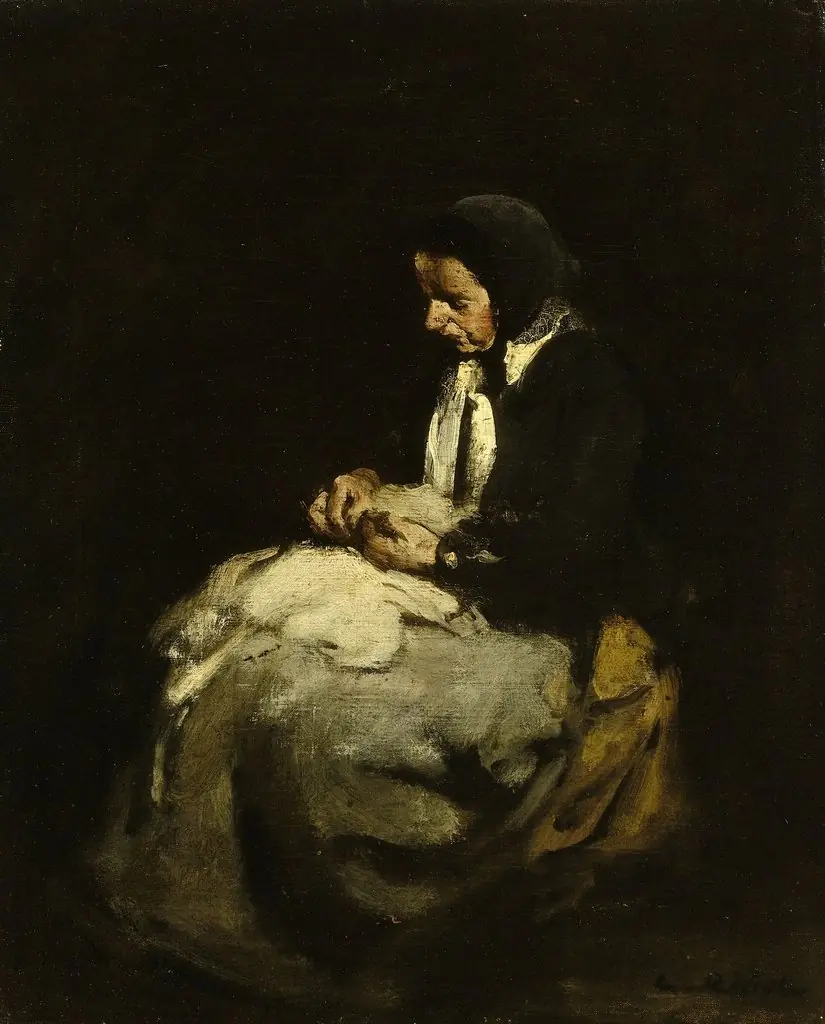
- Woman sewing
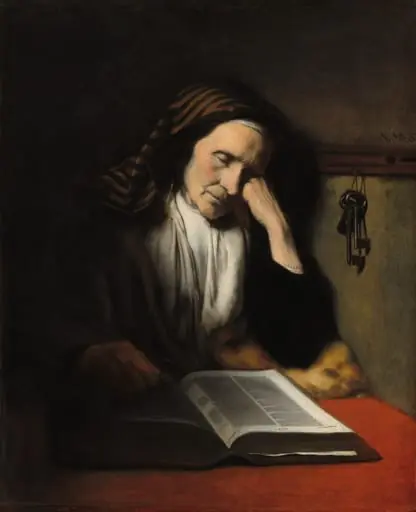 An Old Woman Dozing over a Book
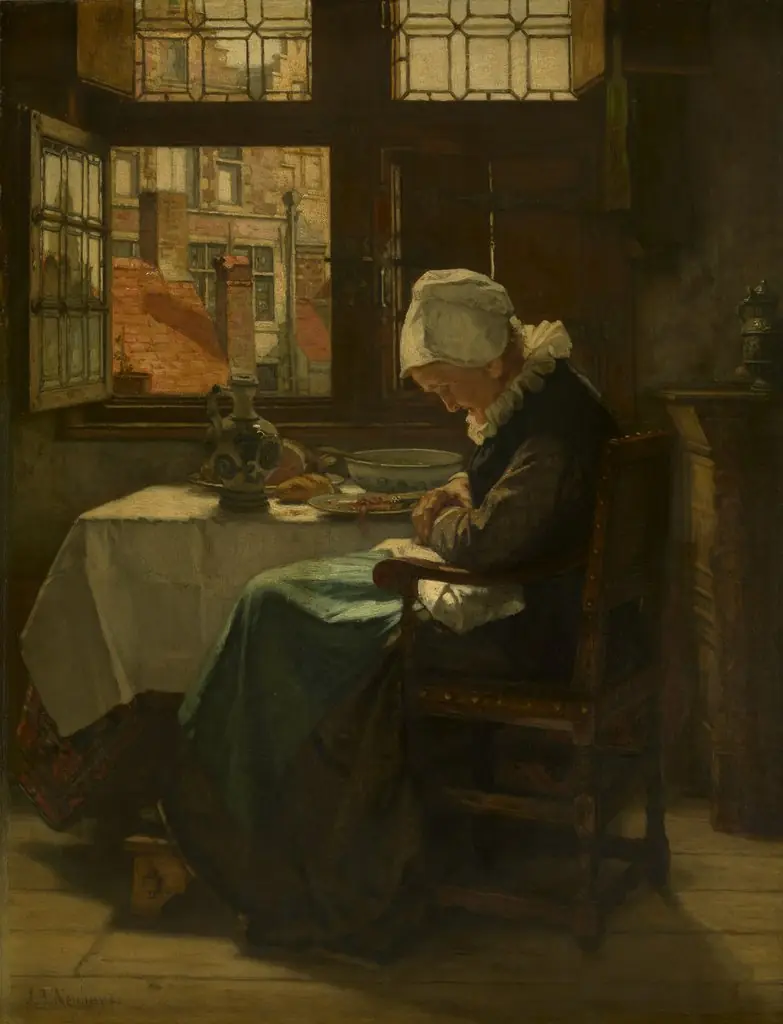 Afternoon Nap
 Study of a Seated Girl
 The Interrupted Prayer
 Girl Reading
 Isoäiti, tohtorinna Augusta Frosteruksen (os. Norling) muotokuva
 A young Woman
 The Artist's Mother
 Evening in the Drawing Room. The Artist's Mother and Wife
 Portrait of a Woman in Gray
 Portrait of Artist's Daughter Julia