Artwork
The Discovery of the Body of Holofernes
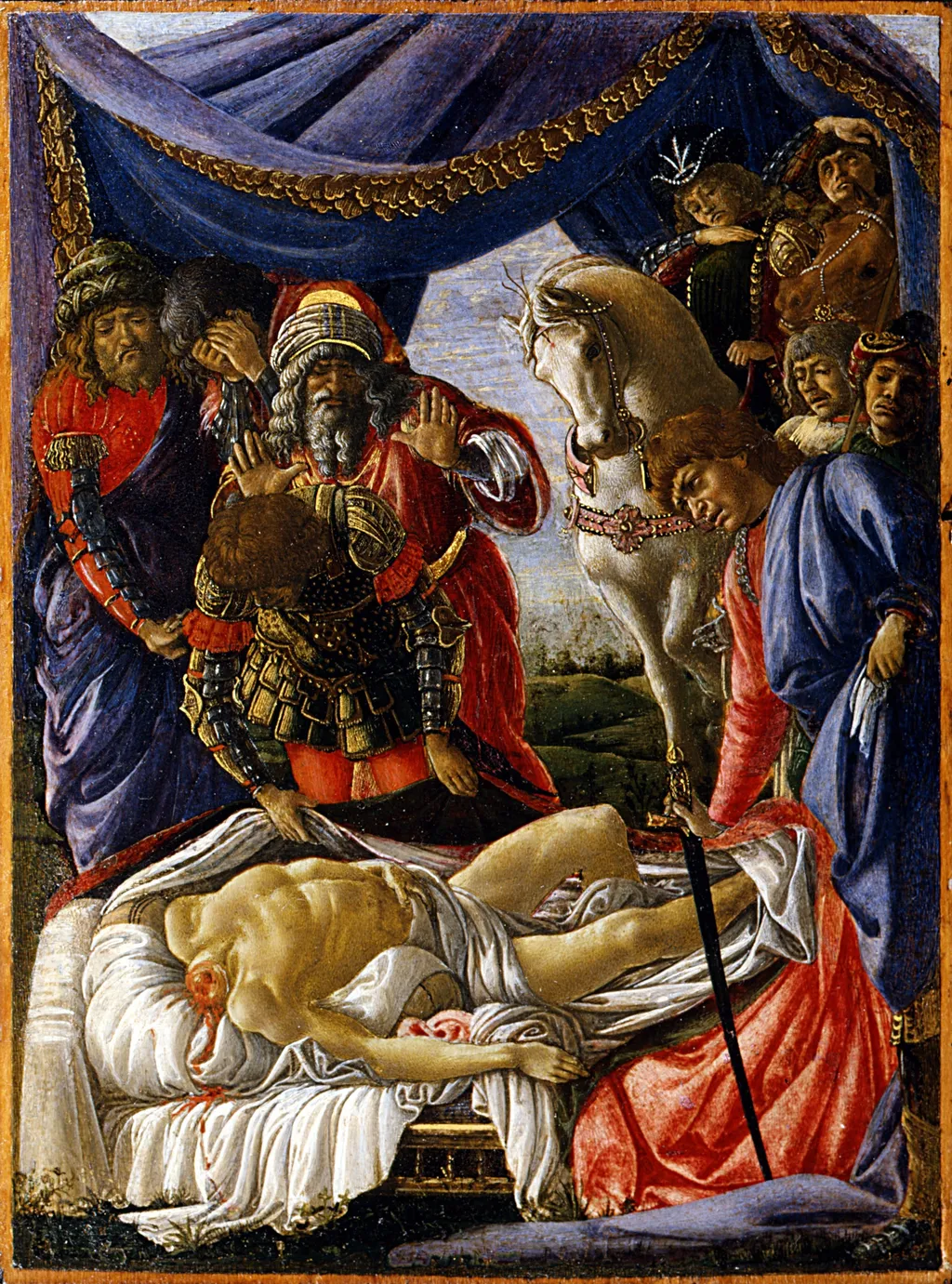
The Discovery of the Body of Holofernes is a tempera painting by the Early Renaissance artist Sandro Botticelli. It dates from 1470 and is held in the collection of the Uffizi Gallery.
About this work
Subject & Meaning
Symbolically, the work represents the triumph of the weak and pious over the arrogant and violent, illustrating divine intervention.
The painting depicts the biblical episode from the Book of Judith where Assyrian officers discover the headless, bloodied corpse of General Holofernes in his tent. This scene, set at dawn, follows the moment Judith decapitated the drunk general to save her besieged city of Bethulia. The composition focuses on the officers' horrified reactions, ranging from dread to bewilderment, as they lift the bedsheet to reveal the nude body, contrasting with the calm landscape visible through the tent opening.
Symbolically, the work represents the triumph of the weak and pious over the arrogant and violent, illustrating divine intervention. Botticelli avoids depicting the act of violence itself, instead emphasizing the dramatic aftermath and the shock of discovery. The youthful, relaxed anatomy of the corpse, rendered with classical precision, serves as a study in form while underscoring the sudden, shocking nature of the general's demise.
Technique & Style
Technique & Style
The Discovery of the Body of Holofernes is executed in tempera on a wooden panel measuring 31 × 24 cm, consistent with early Florentine panel painting practices of the late fifteenth century.
Stylistically, the composition is structured around a clearly defined outline that models the figures with taut, elastic contours, a trait associated with Botticelli’s study of Pollaiuolo’s graphic precision and anatomical clarity. The scene is staged within a confined, tented space organized as a shallow relief-like arrangement, directing the viewer’s gaze to the central corpse of Holofernes. The body is rendered with idealized, youthful proportions and relaxed repose, its nudity bathed in diffused morning light that heightens the contrast with the surrounding figures’ charged expressions of dread and horror.
Color is limited to a restricted palette, white in drapery and horse, red in blood and clothing, and a muted blue in the tent and a figure’s robe, creating a darker harmony than its pendant. The heavy, sculptural drapery and the distant, hushed dawn landscape further emphasize the dramatic tension of the discovery.
History & Provenance
The Discovery of the Body of Holofernes was painted by Sandro Botticelli as the left panel of a diptych paired with The Return of Judith to Bethulia. Scholars date the work to around 1470–1472, with Sergio Bettini proposing an earlier creation between 1467 and 1468. The painting's small format, 31 × 24 cm, suggests it was intended for private use, to be viewed at close range.
The earliest documented owner is the sculptor and painter Ridolfo Sirigatti, who gave the diptych to Bianca Cappello, second wife of Francesco I de' Medici, to decorate her study. The panels were once held together in a single frame, though it is unclear whether this arrangement was original. After Cappello's death, the works passed to her son Antonio de' Medici and were inventoried between 1587 and 1632 at the Casino Mediceo di San Marco.
In 1633 they entered the grand-ducal collections that became the Uffizi Gallery, where they remain today (Nos. 1156 and 1158).
The painting is held by the Uffizi Gallery in Florence. According to the English-language source, it is catalogued at the Uffizi alongside its pendant as Nos. 1156 and 1158. The Italian source records that the work entered the future Uffizi collections in 1633, having previously passed through Medici hands.
Earlier provenance, documented from the sixteenth century, traces the panel to the sculptor and painter Ridolfo Sirigatti, who donated it to Bianca Cappello, second wife of Francesco I de' Medici, to decorate a writing desk with paintings and antique statues. After her death it passed to her son Antonio de' Medici, who kept it in the Casino Mediceo di San Marco in Via Larga. The Italian source notes that Vincenzo Borghini recorded the diptych in 1584 as kept by Bianca Cappello in her scrittoio within a now-lost gilded and carved frame.
The French source adds that between 1587 and 1632 the panels were listed in the inventory of the Casino Mediceo di San Marco, where a walnut frame united them as a diptych, before their entry into the Uffizi collections.
No exhibition history beyond this Medici-to-Uffizi trajectory is documented in the provided sources.
Context
Scholars consistently place The Discovery of the Body of Holofernes among Botticelli’s earliest works, produced within his Florentine circle of the late 1460s–early 1470s. The panel’s compact figure grouping and linear definition reflect the Pollaiuolo brothers’ influence on the young artist, while its restrained palette and dramatic mood anticipate Botticelli’s later development. The pairing with The Return of Judith to Bethulia, treated as a diptych in Medici inventories, situates the pair within private devotional taste of mid‑sixteenth‑century Florence, where such small narrative scenes were valued for close viewing.
Critical discussion has centered on the painting’s iconographic novelty, Botticelli’s choice to depict the moment of discovery rather than the decapitation, and on the anomaly of a youthful corpse contrasting with the elder head in the pendant. Lightbown’s observation of this discrepancy underscores the panel’s place as an early experiment in reconciling classical form with biblical narrative, aligning it with contemporaneous Florentine interest in Antique models.
Overview
Sandro Botticelli's early work, The Discovery of the Body of Holofernes, painted around 1472, is a small-format tempera on panel. Measuring 31 × 24 cm, this painting is part of a pair, with its companion piece, The Return of Judith to Bethulia. Both artworks are housed in the Uffizi Gallery in Florence and illustrate episodes from the biblical Book of Judith, focusing on the dramatic aftermath of a significant event.
Own this work as a print
Artist & collection
Artist
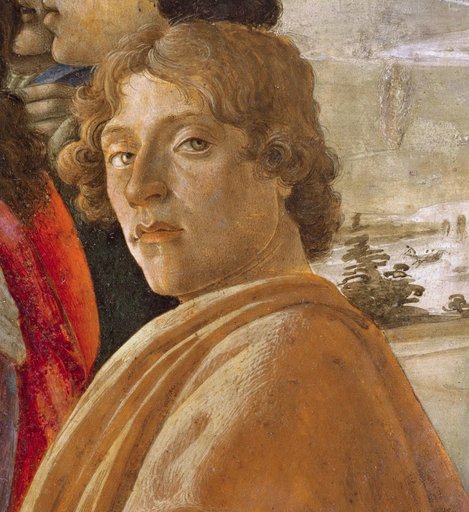
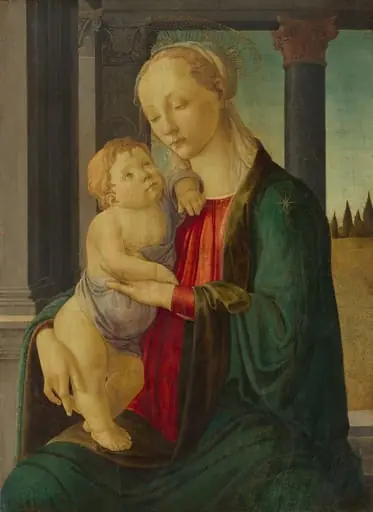
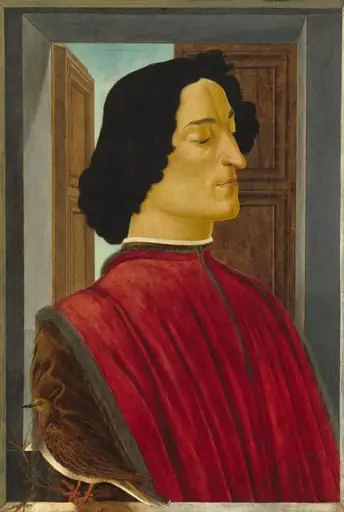
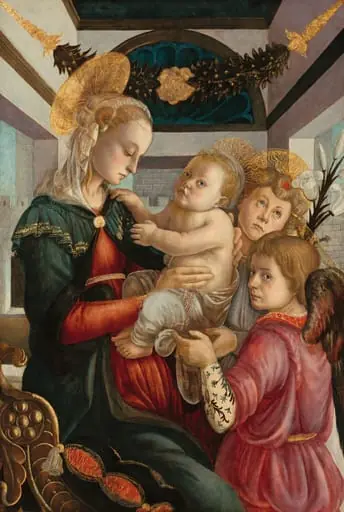
Alessandro di Mariano di Vanni Filipepi, better known as Sandro Botticelli or simply Botticelli, was an Italian painter of the Early Renaissance.

- The Beheading of St. Catherine of Alexandria
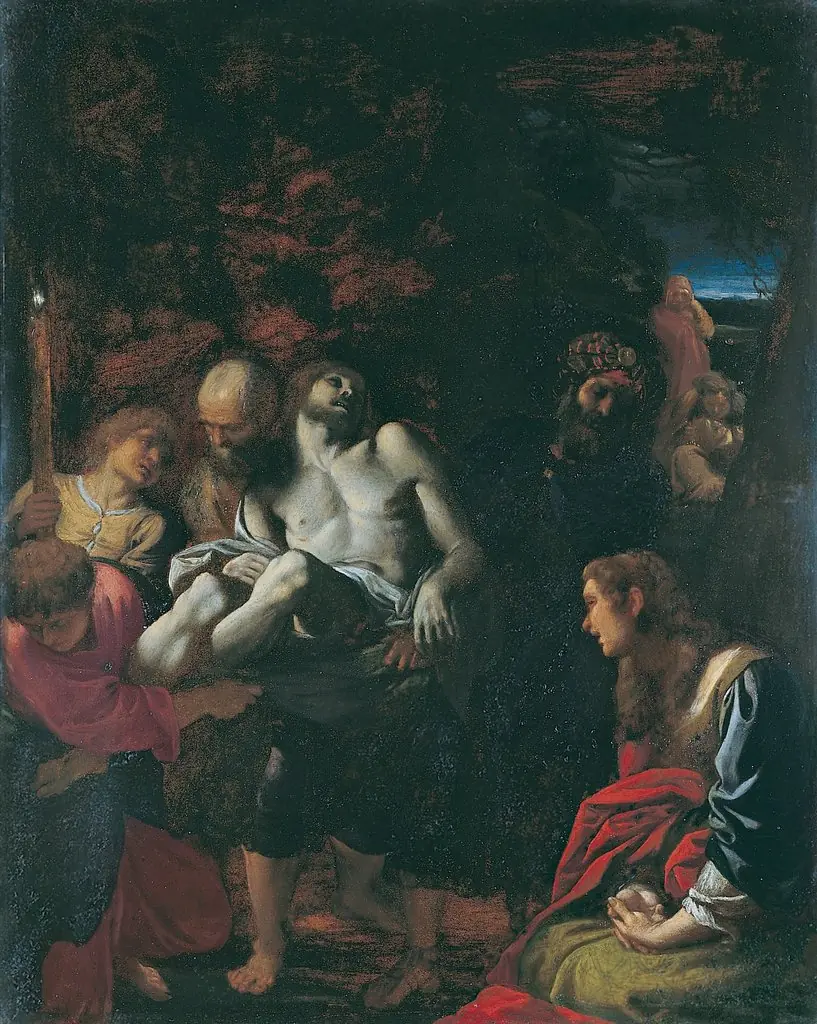 The Burial of Christ
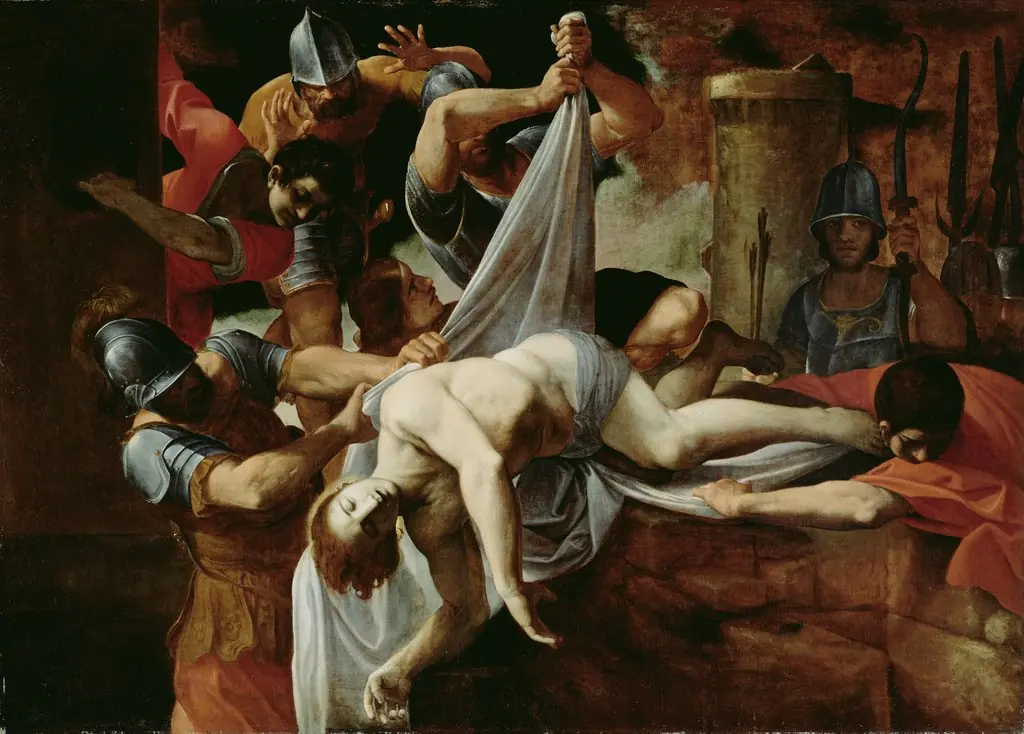 St. Sebastian Thrown into the Cloaca Maxima
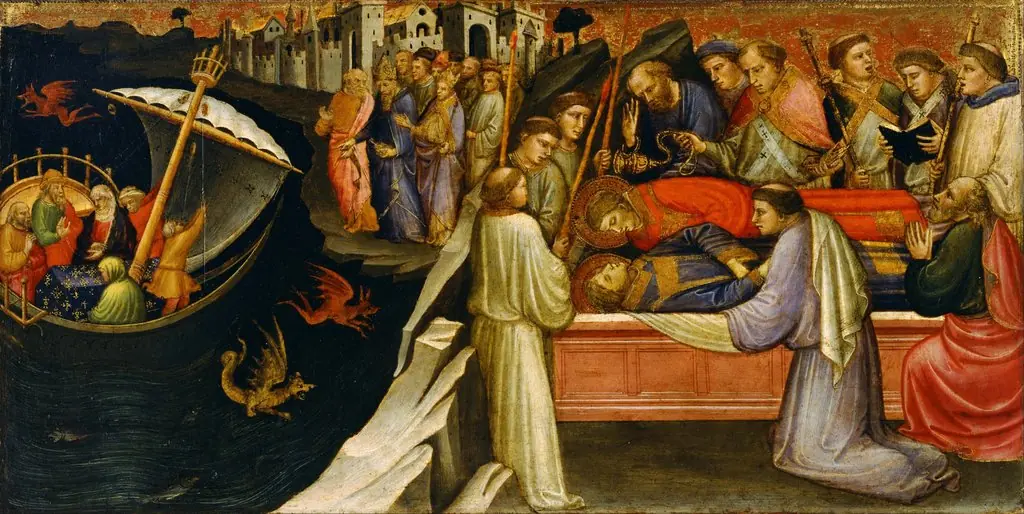 Predella Panel Representing the Legend of St. Stephen: Devils Agitating the Sea as Giuliana Transports the Body of St. Stephen from Jerusalem to Constantinople
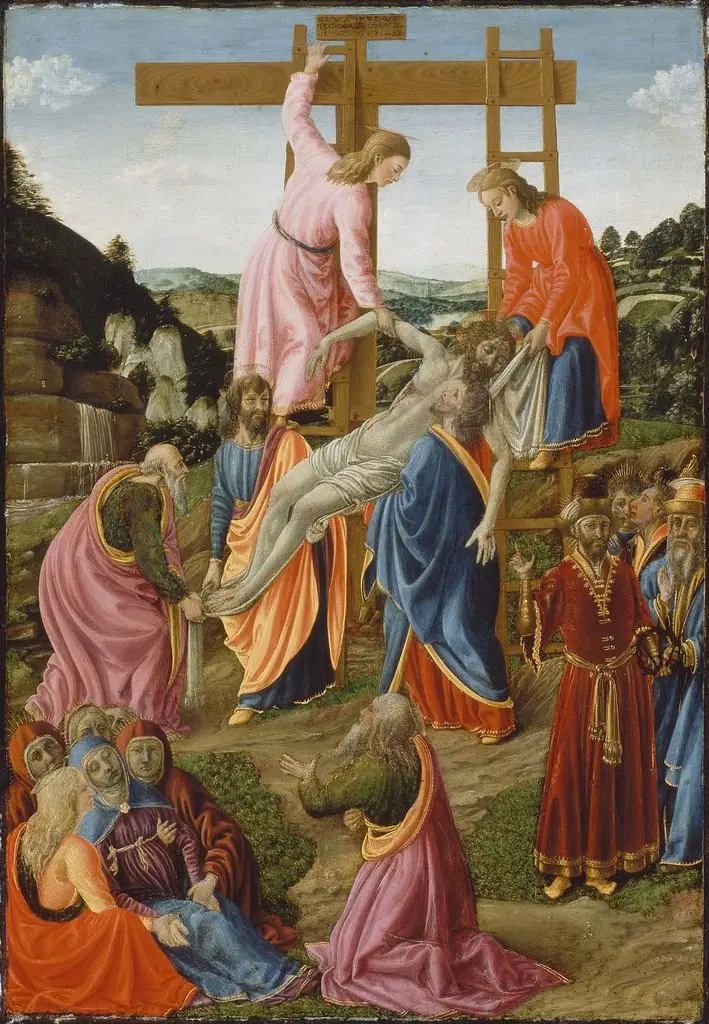 The Descent From the Cross
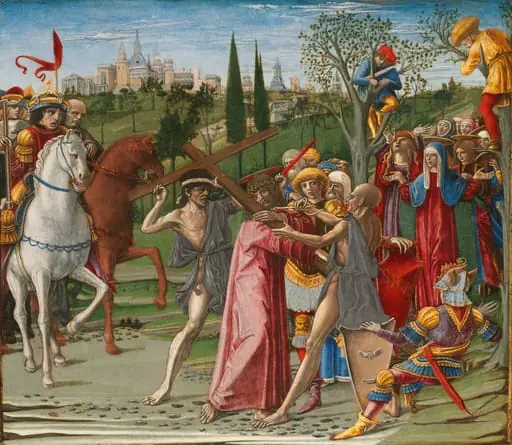 Christ Carrying the Cross
 Entombment of Christ
 The Crucifixion
 Die Grablegung Christi
 The entombment
 Death of the Virgin
 Preparation of Christ's Tomb