Artwork
The Annunciation
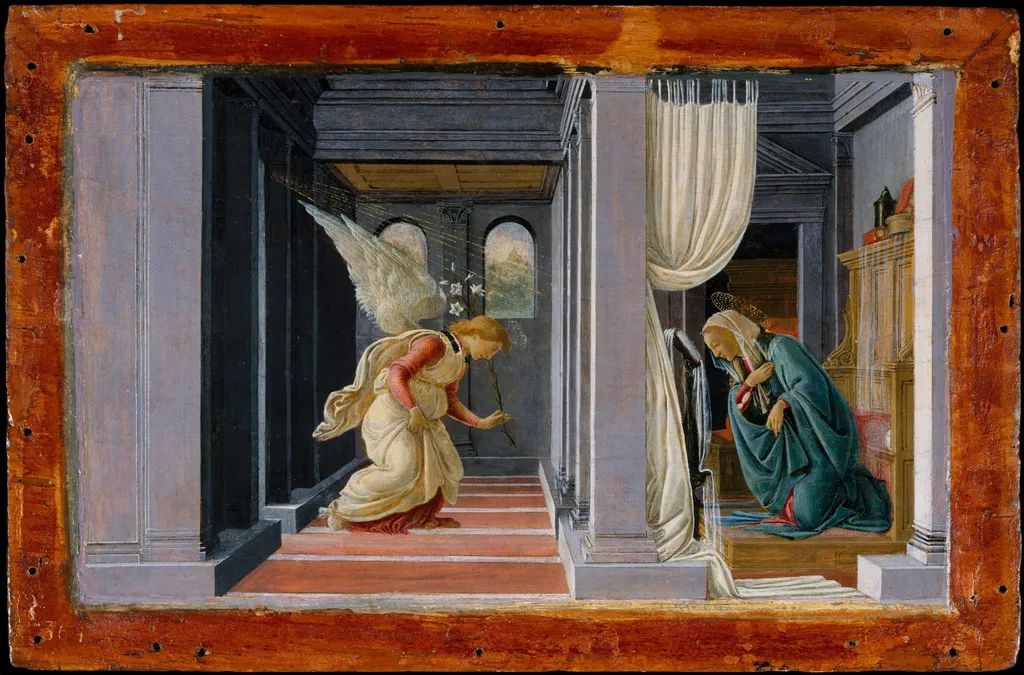
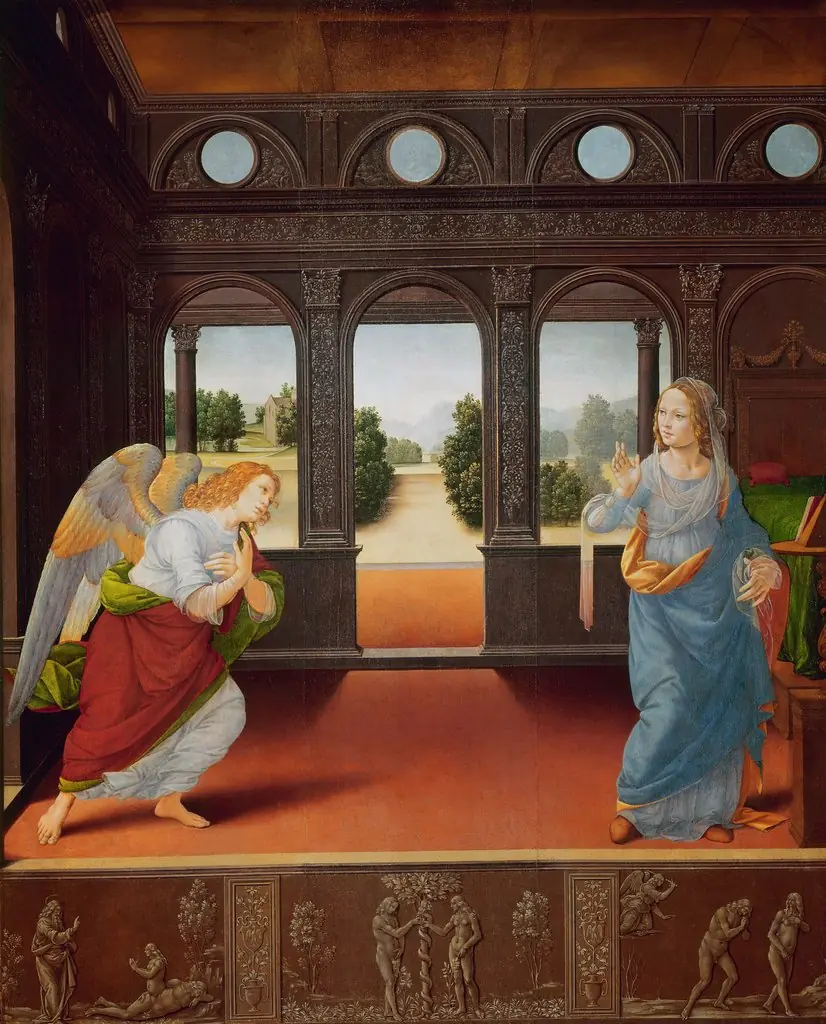
The Annunciation is a tempera painting by the Early Renaissance artist Sandro Botticelli. It dates from 1450 and is held in the collection of the Metropolitan Museum of Art.
About this work
Subject & Meaning
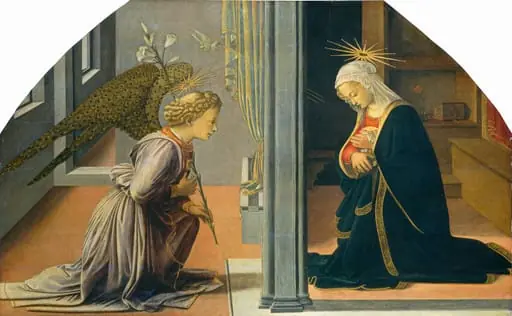
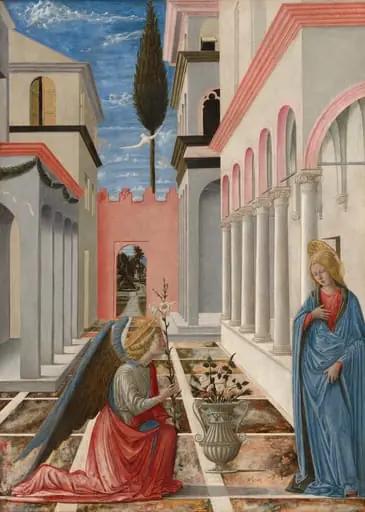
This small panel depicts the biblical Annunciation, where the Archangel Gabriel informs the Virgin Mary that she will conceive Jesus while remaining a virgin.
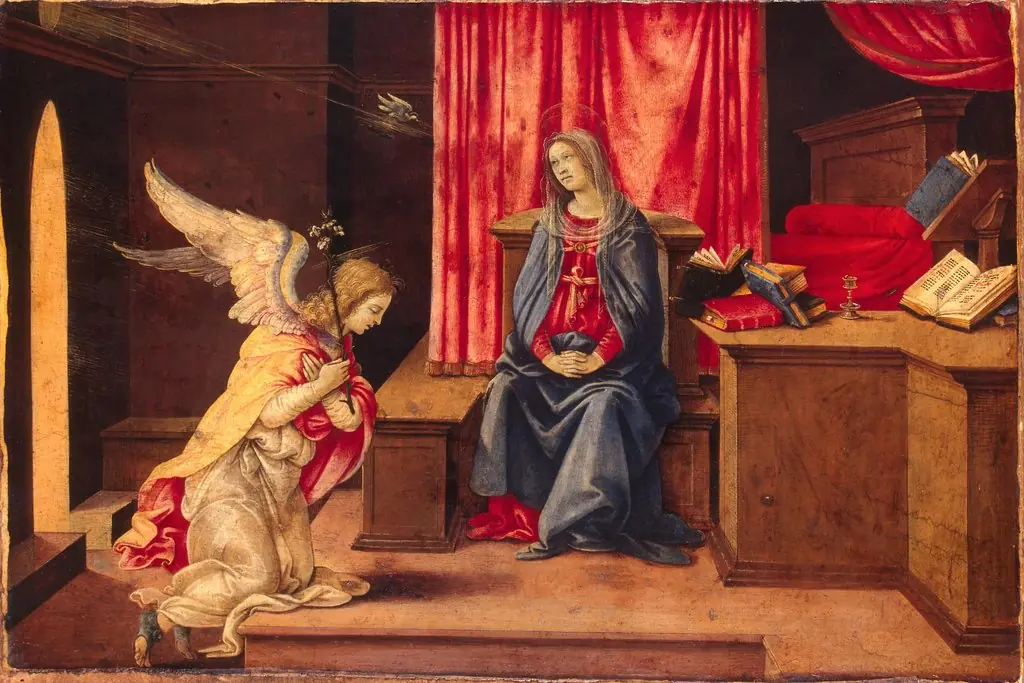
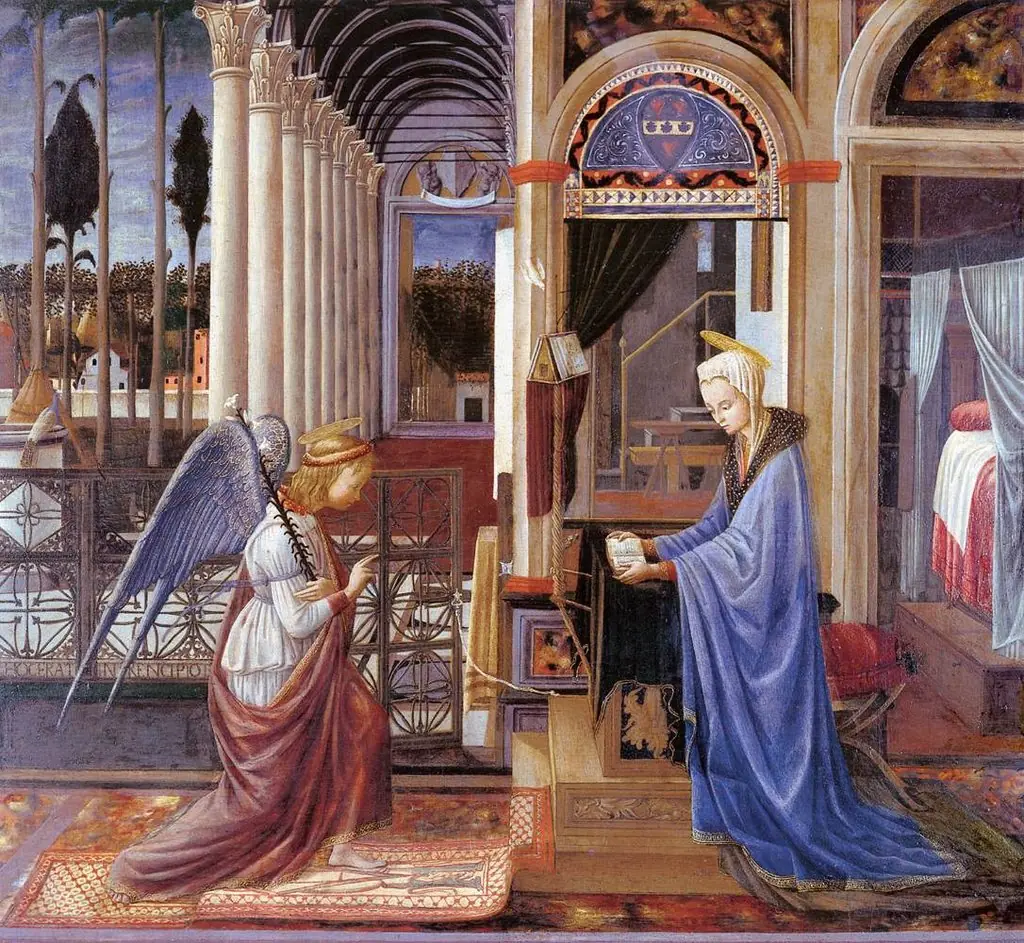
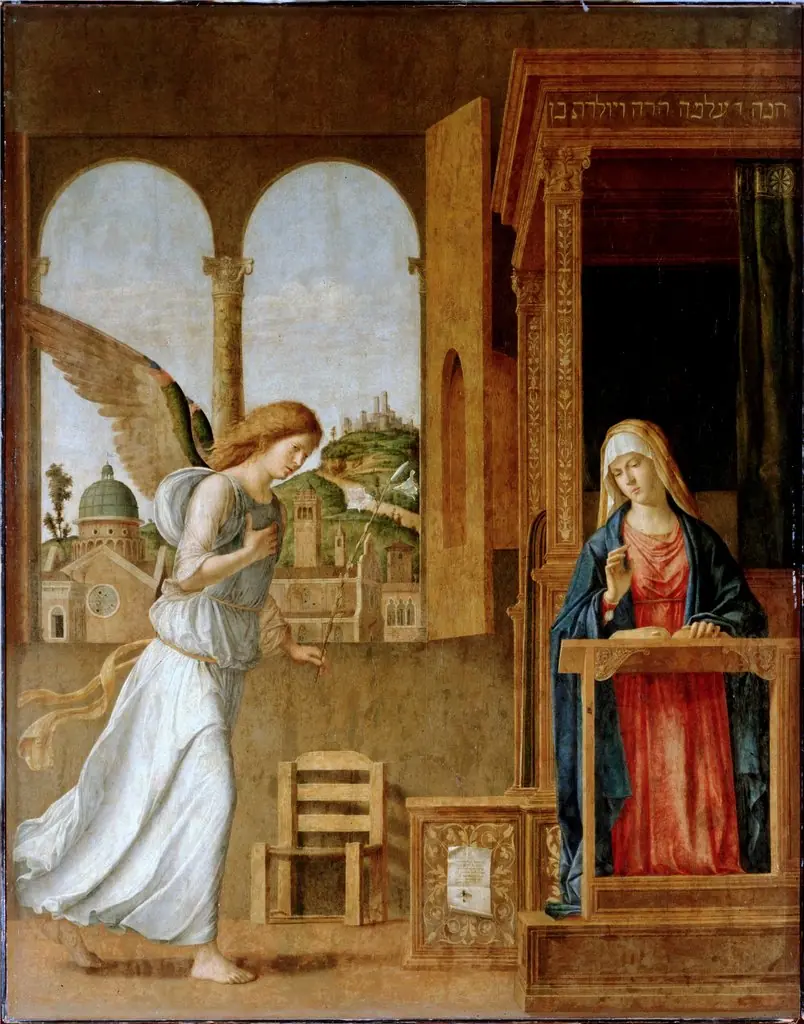
This small panel depicts the biblical Annunciation, where the Archangel Gabriel informs the Virgin Mary that she will conceive Jesus while remaining a virgin. Executed for private devotion, the composition includes standard iconographic elements: Mary is shown in surprise within her bedroom, accompanied by a book and an enclosed garden (hortus conclusus) visible through arched windows. Gabriel enters from the left holding a white lily, a traditional symbol of purity.
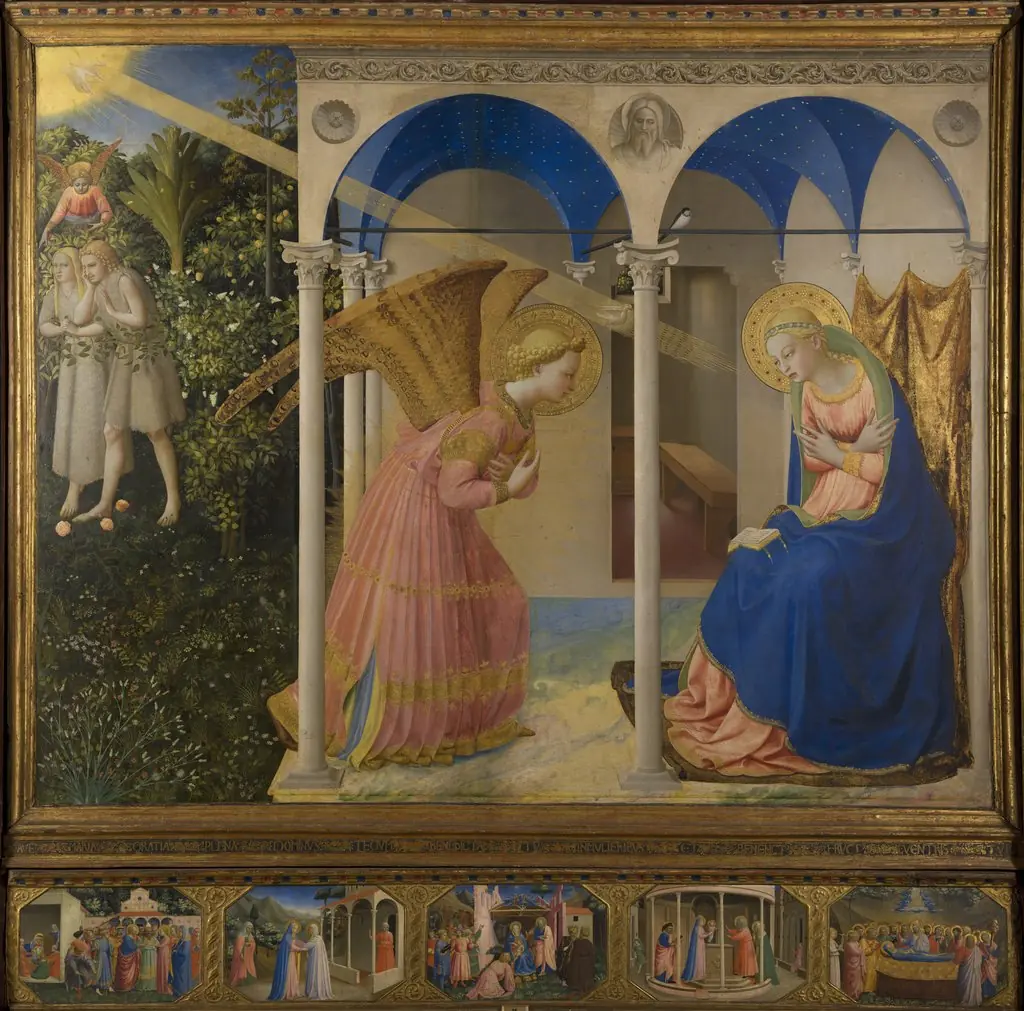
A central row of pilasters physically separates the two figures, an architectural choice interpreted as a symbol of Christ (Christus est columna). Despite this division, divine rays of light traverse the space to unify the scene, conveying God's message. The setting features linear perspective with a tiled floor and a view of a gentle landscape, reflecting the lyrical quality and mature style characteristic of Botticelli's religious works.
Technique & Style
The Annunciation is executed in tempera with gold leaf on a wood panel measuring approximately 24 × 36.5 cm. The support is a wood panel. Botticelli handles the medium with precise linear perspective, rendering the architectural setting, pilasters, columns, arched windows and a tiled floor, with meticulous clarity, while the figures are delicately modeled and separated by a central row of pilasters. The painting’s lyrical drawing, transparent color layers and subtle use of divine light reflect the artist’s mature style, as noted in contemporary analyses. The work’s small scale indicates it was intended for private devotion.
History & Provenance
The Annunciation is dated to circa 1485‑5). It was likely commissioned for private devotional use, as indicated by its small size and the Metropolitan Museum’s assessment that it was painted as a single image rather than part of a predella. The painting entered the Barberini family collection in Rome by the 17th century and remained there until the collection’s dispersal in 1905‑5).
After being handled by the antiquarian Elia Volpi, it was sold to Oscar Huldschinsky of Berlin, then joined the Robert Lehman Collection, which was donated to the Metropolitan Museum of Art in 1969‑5).
Context
The Annunciation is understood as a small-scale devotional image painted for private use rather than as part of an altarpiece predella (3). It remained in the Barberini collection from at least the eighteenth century, later passing through the hands of Elia Volpi and Oscar Huldschinsky before entering the Robert Lehman Collection and joining the Metropolitan Museum of Art in 1969 (3,4,5). Scholars situate the work within Botticelli’s extensive Annunciation output, noting his repeated exploration of the theme (4,5).
Analyses highlight its mature Early Renaissance style: precise linear perspective, a columnar motif between Gabriel and Mary that symbolizes Christ, lyrical drawing, and transparent colouring (4,5). A key reference is Daniel Arasse’s 1999 study, which offers a detailed examination of Botticelli’s Annunciations (4).
Legacy
The painting’s later reputation rests chiefly on its distinguished provenance and its entry into a major public collection. After remaining in the Barberini family’s Roman holdings from at least the seventeenth century, it passed through the antiquarian Elia Volpi in 1905 to Oscar Huldschinsky and then joined the Robert Lehman Collection, which was donated to the Metropolitan Museum of Art in 1969【3†L1-L4】【4†L1-L4】【5†L1-L4】. Its presence in the Met has made it a frequent subject of scholarship; it is cited, for example, in Daniel Arasse’s 1999 study L’Annonciation italienne, une histoire de perspective【4†L1-L3】.
Moreover, the work is one of several Annunciations painted by Botticelli, including the Cestello Annunciation and a San Barnaba panel now in Glasgow, situating it within a broader oeuvre that has shaped modern understanding of the artist’s treatment of the theme【3†L1-L3】. Contemporary notes also emphasize its original function as a small, private devotional image【3†L1-L2】.
Overview
Sandro Botticelli, a prominent Italian Renaissance painter, created The Annunciation, a small panel painting on wood. This work, depicting the biblical announcement to Mary, is now housed in the collection of the Metropolitan Museum of Art in New York. Its modest scale suggests it was intended for personal contemplation rather than public display.
Own this work as a print
Artist & collection
Artist
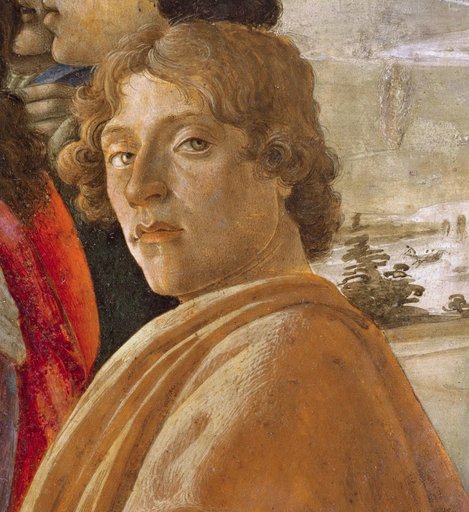
Alessandro di Mariano di Vanni Filipepi, better known as Sandro Botticelli or simply Botticelli, was an Italian painter of the Early Renaissance.