Artwork
Madonna and Child with Angels
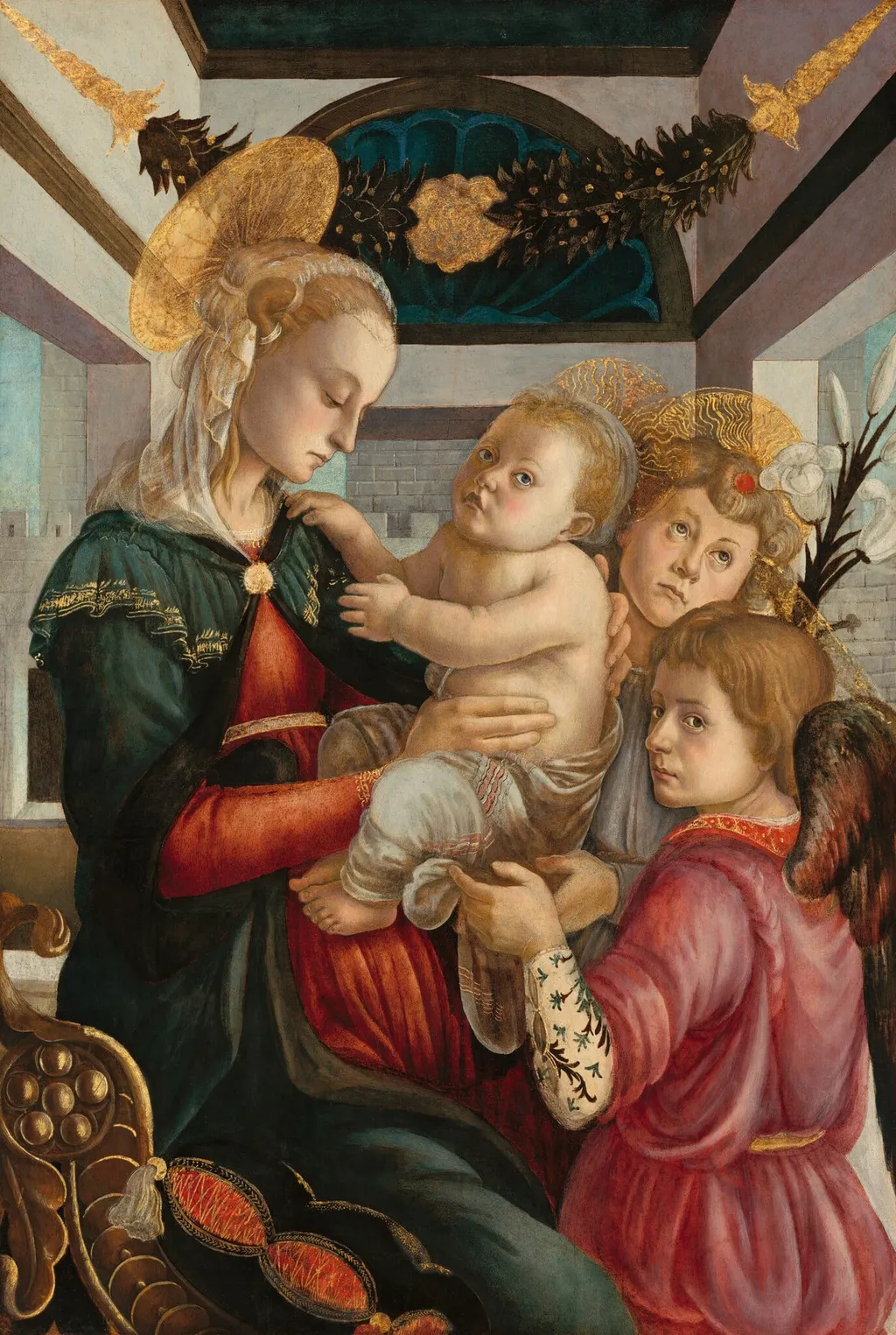
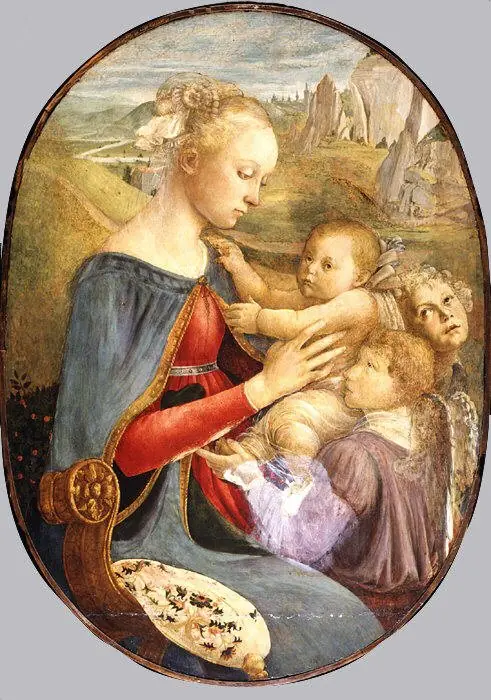
Madonna and Child with Angels is an oil painting by the Early Renaissance artist Sandro Botticelli. It dates from 1468 and is held in the collection of the National Gallery of Art.
About this work
Subject & Meaning
Two angels stand behind the figures, one partially visible at left, the other supporting a garland above Mary’s head, a motif derived from Lippi’s work.
The painting depicts the Virgin Mary seated on a cushioned throne, holding the Christ Child, who rests against her abdomen, a composition echoing Fra Filippo Lippi’s Madonna and Child with Angels (La Lippina). Two angels stand behind the figures, one partially visible at left, the other supporting a garland above Mary’s head, a motif derived from Lippi’s work. The Child holds a scroll, a conventional symbol of scripture, while Mary’s gaze and gesture toward the viewer emphasize maternal intercession.
The Medici coat of arms on the throne’s armrest, though missing the later fleur-de-lis augmentation, aligns the work with Medici patronage, situating it within the humanist and devotional culture of mid-15th-century Florence.
Technique & Style
The panel employs oil and tempera on poplar, a medium typical of Florentine practice in the mid-fifteenth century. Mary is seated on a cushioned throne, the Virgin’s drapery modeled with smooth transitions and fine linear accents, while the Christ Child is rendered with delicate modeling against her lap. Two angels stand behind, their heads inclined in reverence, their forms softened by atmospheric recession.
The handling combines precise linear definition with subtle tonal gradations, reflecting Botticelli’s early training in the workshop of Fra Filippo Lippi. The poplar support remains stable, with no structural deformations reported, and the original ground and paint layers appear intact under technical examination.
History & Provenance
Attributed to Sandro Botticelli, the work is dated variously to 1450 or the period between 1465 and 1470. The absence of a seventh fleur-de-lis on the Medici coat of arms depicted on the throne suggests a creation date prior to 1465, when Piero de' Medici received permission to add it. The painting was likely commissioned for a Medici family member.
By the late 19th century, it appeared in Paris and London collections, including the 1885 sale of Baron E. de Beurnonville. It was held by the Paris dealer Charles Sedelmeyer by 1914 and sold to Duveen Brothers in May 1925. Geneviève Garvan Brady owned the piece by 1932, later passing to William J. Babington Macauley.
After being consigned to Duveen in 1939, it was sold to the Samuel H. Kress Foundation in January 1942 and gifted to the National Gallery of Art in 1943.
The painting is currently held in the collection of the National Gallery of Art in Washington, D.C., specifically within the Samuel H. Kress Collection. It entered the museum's holdings in 1943 as a gift from the Samuel H. Kress Foundation, following its acquisition by the foundation in January 1942. Prior to this, the work was owned by William J. Babington Macauley and his wife, Geneviève Garvan Brady, who had possessed it since at least 1932.
The piece was placed on consignment with the Duveen Brothers in 1939 before the final sale to the Kress Foundation. While the work likely originated for a Medici patron and appeared in private Parisian and London collections during the late nineteenth and early twentieth centuries, its modern institutional history is defined by its 1943 entry into the National Gallery of Art.
Context
The composition of the Madonna and Child with Angels reflects the formative influence of Fra Filippo Lippi, whose Lippina served as a partial model for the arrangement of Mary seated with the Christ Child and standing angels behind them, according to the French-language reference on the work. The Medici coat of arms on Mary's armrest, bearing six torteaux but lacking the seventh torteau with fleurs de lis that the king of France authorized Piero de' Medici to add in 1465, has been cited as evidence establishing a terminus ante quem for the painting's execution, as discussed in Roy Brogan's dissertation on Medici heraldry. The work was probably made for a member of the Medici family, situating it within Botticelli's early devotional output produced for his patrons' private devotion.
It later passed through 19th-century Parisian and London collections before entering the American market through Sedelmeyer and Duveen Brothers, ultimately joining the Kress Collection and entering the National Gallery of Art in 1943.
Legacy
After entering American collections in 1943 through the Samuel H. Kress Foundation’s donation to the National Gallery of Art, Washington, the painting secured a place in the canon of early Italian Renaissance art through sustained exhibition and scholarly circulation. Its Medici associations and technical refinement underwrote its reputation as a key transitional work between Fra Filippo Lippi’s softer modeling and Botticelli’s later linear elegance. The composition’s influence is most evident in later Florentine Madonnas that adopt the arched throne and flanking angels, reinforcing the panel’s role as a touchstone for studies of Quattrocento patronage and iconography.
Overview
Sandro Botticelli completed Madonna and Child with Angels in 1468. This religious painting, executed in oil and tempera on a poplar panel, presents a traditional Christian theme. It features the Virgin Mary tenderly holding the Christ Child, a central motif in Renaissance art, accompanied by a retinue of angelic figures. The work exemplifies Botticelli's early approach to devotional imagery, combining sacred narrative with artistic skill.
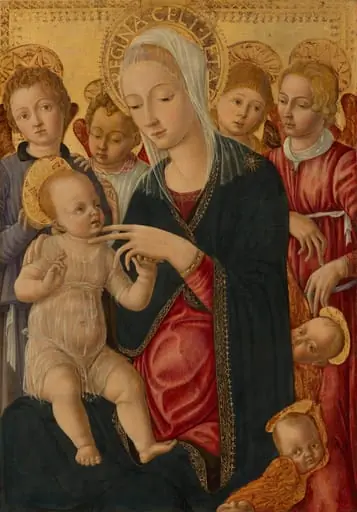
Own this work as a print
Artist & collection
Artist
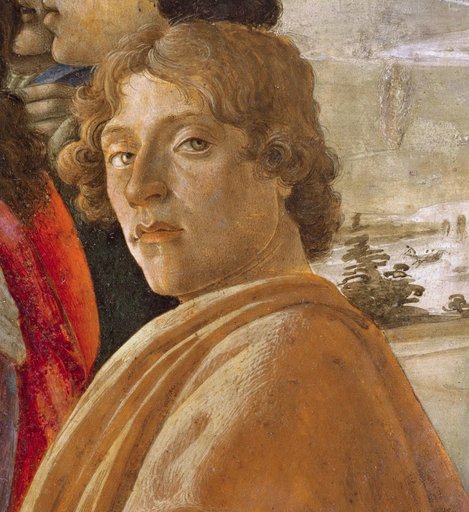
Alessandro di Mariano di Vanni Filipepi, better known as Sandro Botticelli or simply Botticelli, was an Italian painter of the Early Renaissance.

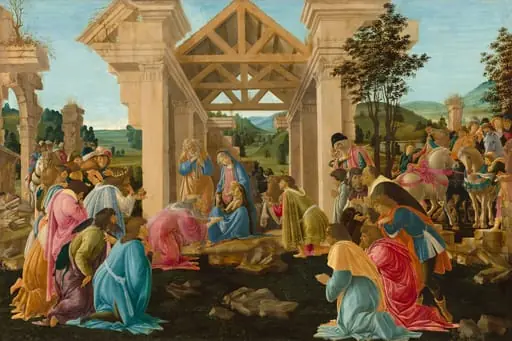
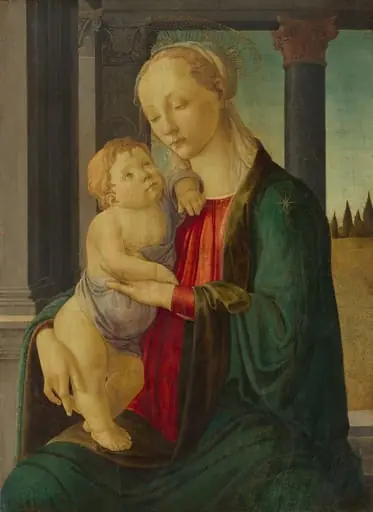
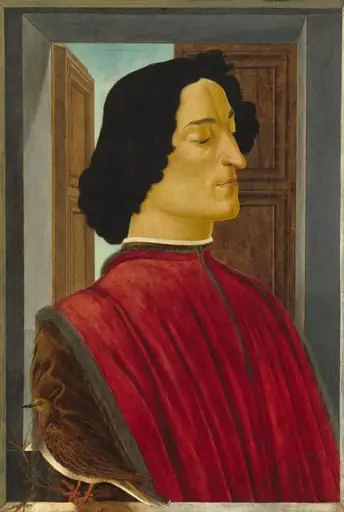
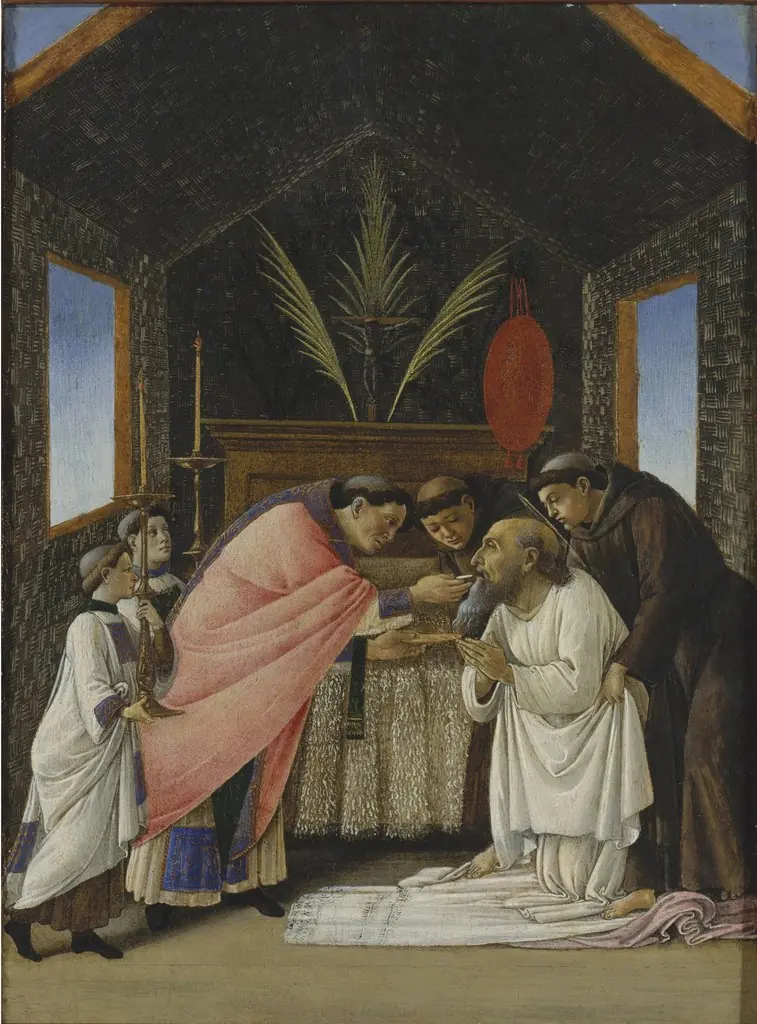
- Madonna and Child with Angels and Cherubim
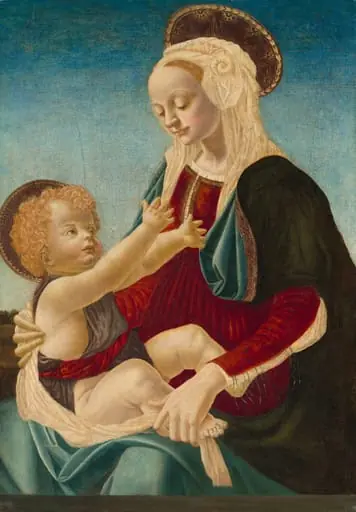 Madonna and Child
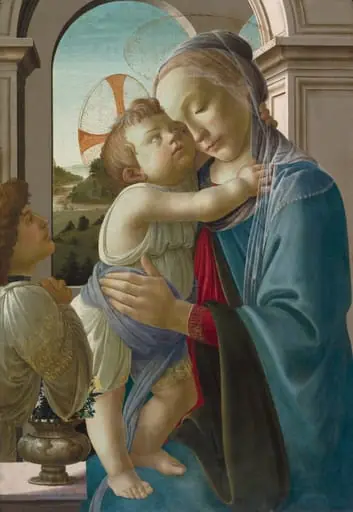 Virgin and Child with an Angel
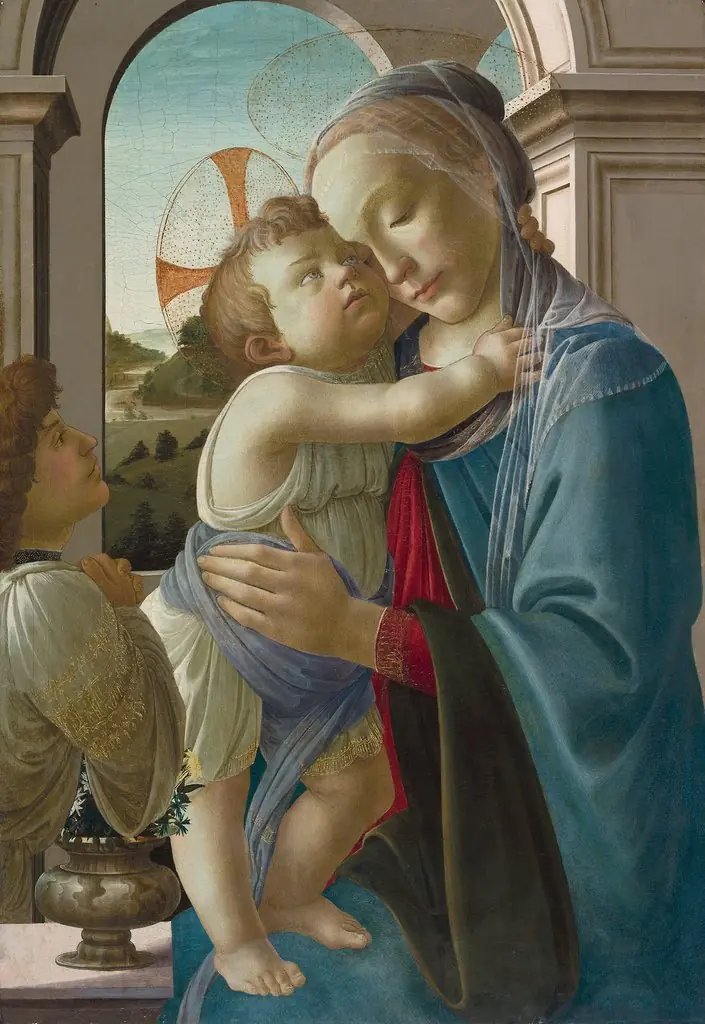 Virgin and Child with an Angel
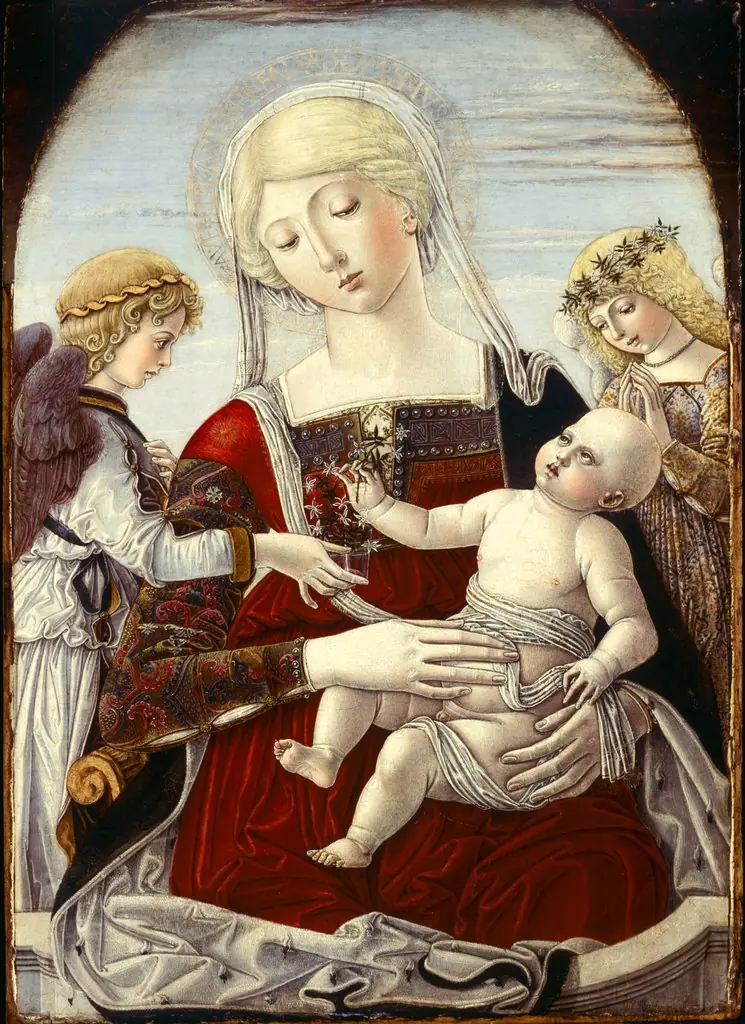 Virgin and Child with Angels
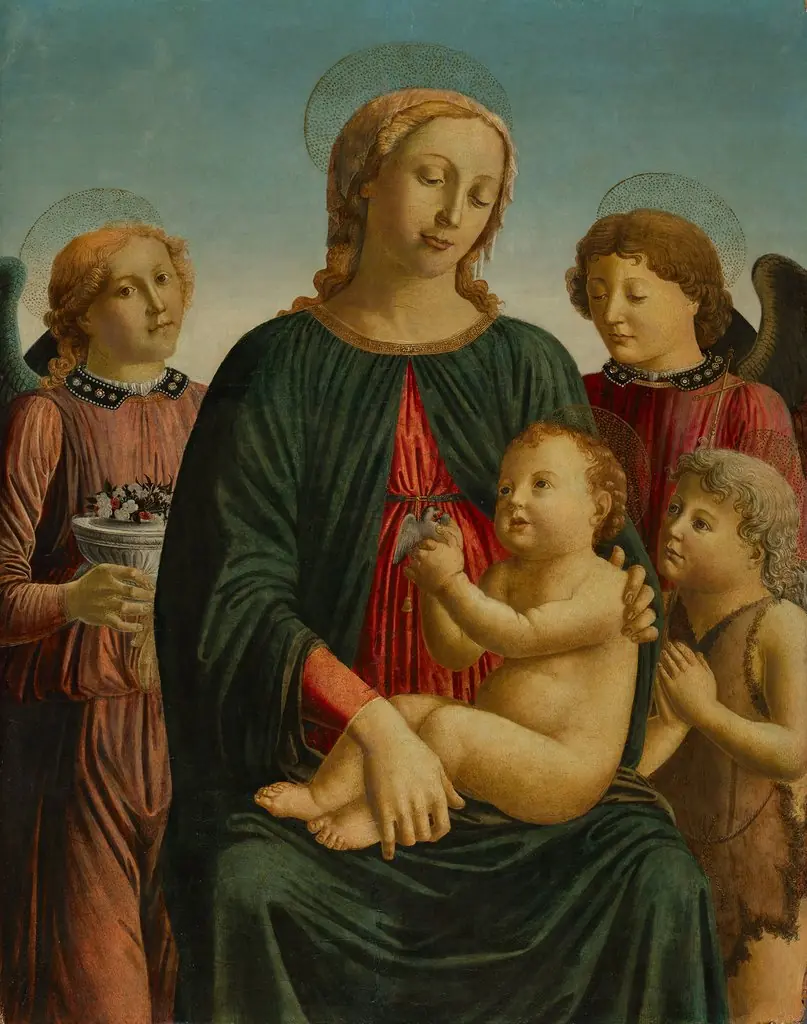 Mary with the Child, the Boy John Adoring the Child, and Two Saints
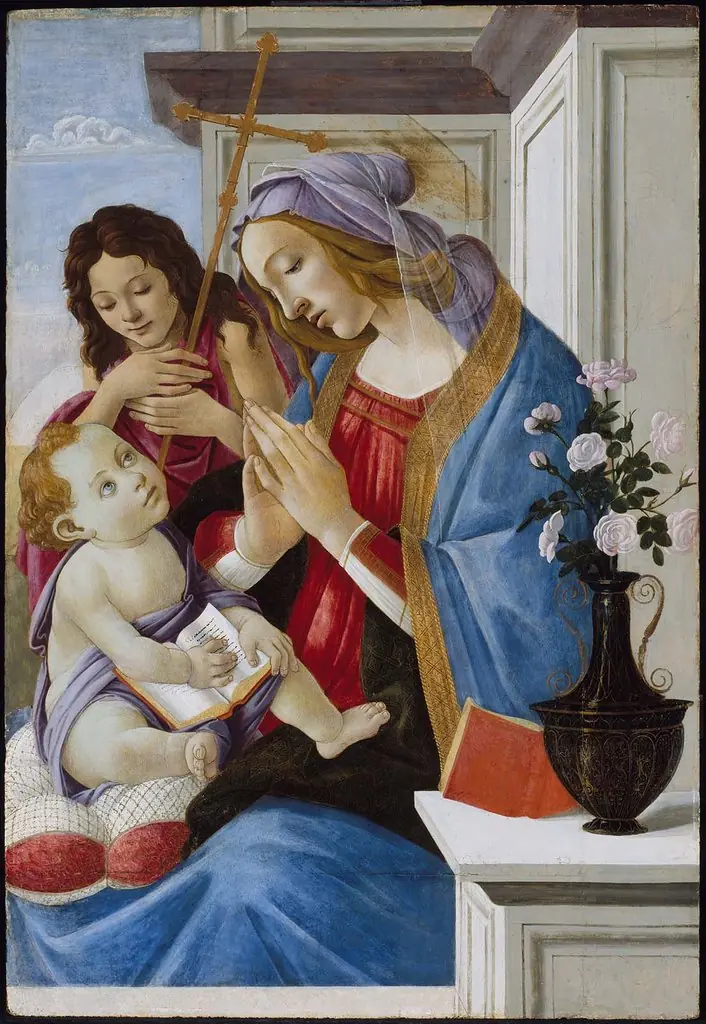 Virgin and Child with Saint John the Baptist
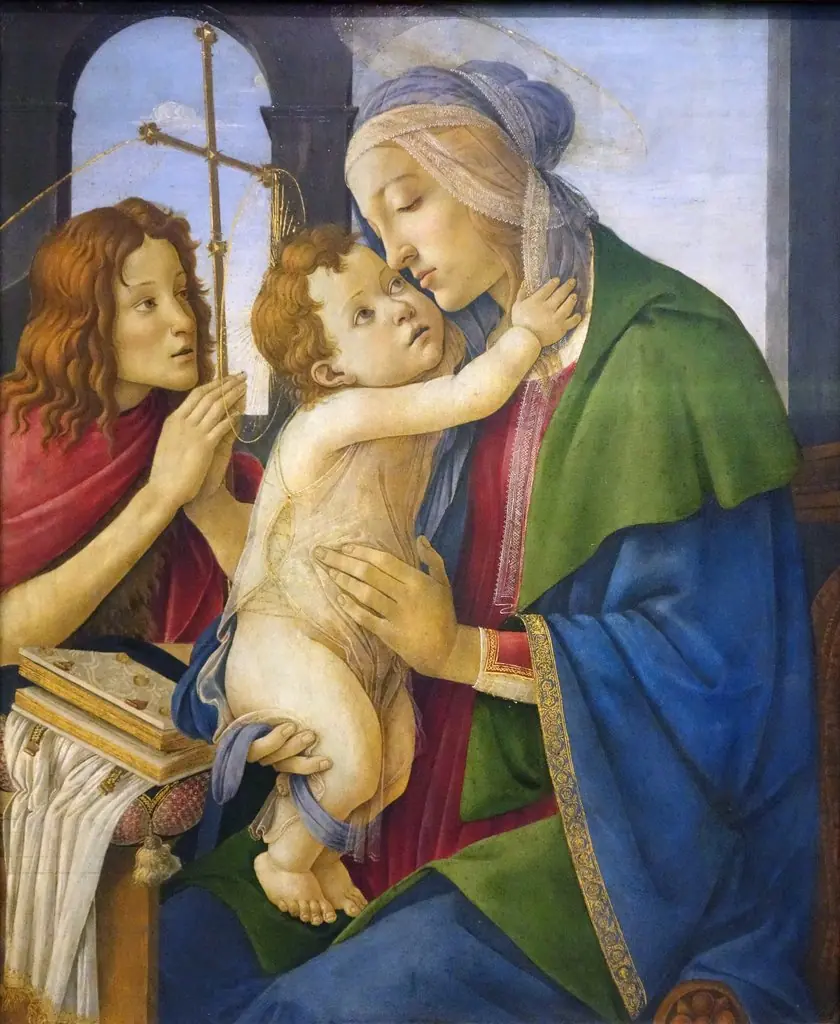 The Virgin and Child with the Young Saint John the Baptist
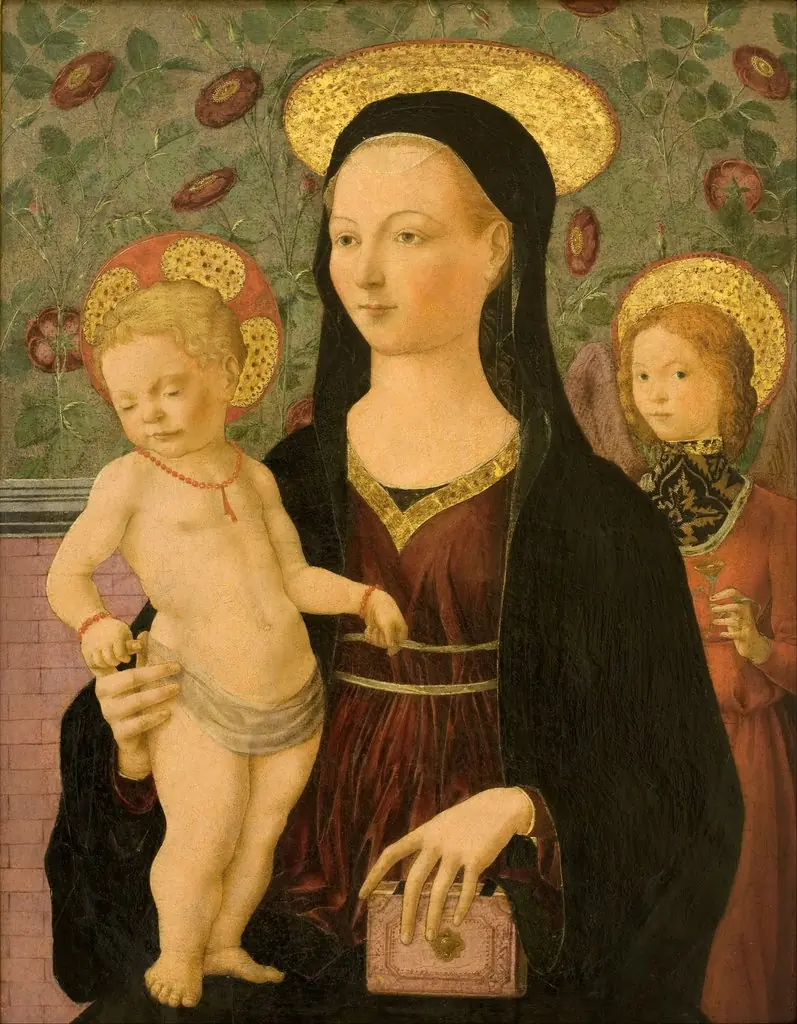 Virgin and Child with an Angel
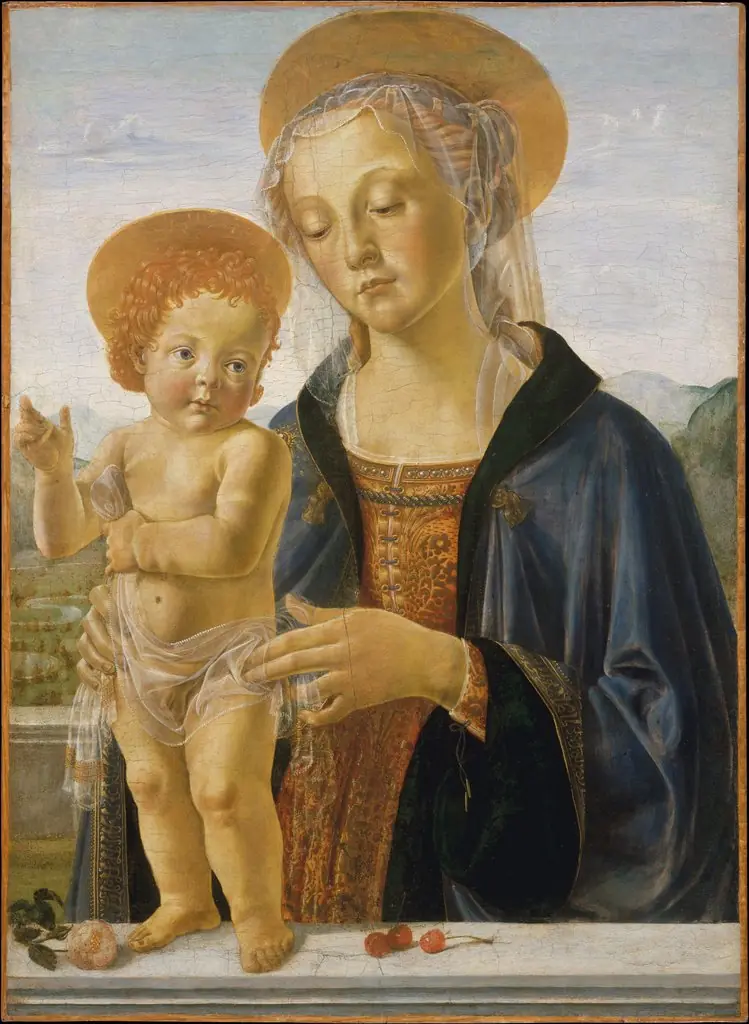 Madonna and Child