Artwork
The Stone Breaker
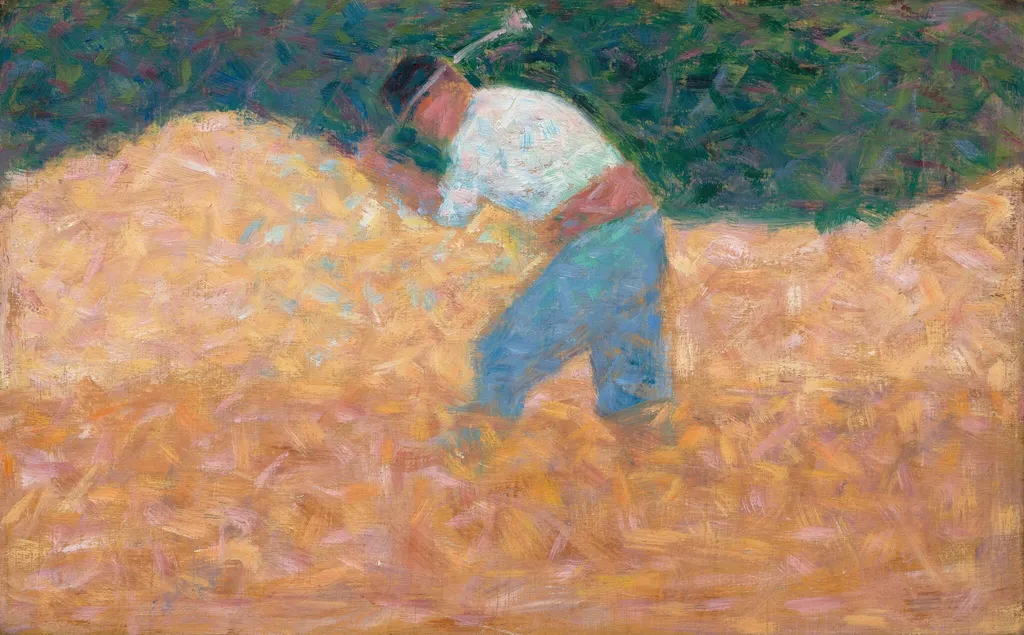
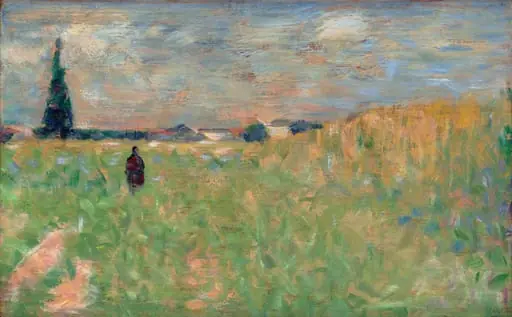
The Stone Breaker is an oil painting by the Impressionist artist Georges Seurat. It dates from 1882 and is held in the collection of the National Gallery of Art.
About this work
Technique & Style
Seurat applied oil paint to this compact wooden surface rather than to canvas, a choice consistent with the work's modest dimensions and intimate handling.
The Stone Breaker is an oil painting executed on a wood panel, a small-scale support measuring about 14.6 by 24.1 centimeters. Seurat applied oil paint to this compact wooden surface rather than to canvas, a choice consistent with the work's modest dimensions and intimate handling. Stylistically, the work belongs to Seurat's early phase, preceding the systematic pointillist divisionism he would later develop.
The brushwork and handling on the small panel reflect a more traditional, painterly approach characteristic of his studies of rural labor and everyday subjects from the early 1880s.
History & Provenance
Georges Seurat created The Stone Breaker in 1882 as an oil painting on wood panel. The work remained in the artist's possession until his death in 1891, appearing as item number 4 in the posthumous inventory of his studio. Following Seurat's death, the painting was inherited by his cousin Marie Puybonnieux and subsequently held by her sons, Jacques and Pierre Puybonnieux of Paris, who retained ownership until 1956.
The piece later entered the collection of Paul Mellon of Upperville, Virginia. In 1999, Mellon bequeathed the painting to the National Gallery of Art in Washington, D.C. (accession no. 1999.8.1), while his wife, Rachel Lambert Mellon, retained a life interest in the work.
Legacy
The work's legacy is anchored in its exhibition record and its presence in a leading museum collection. It was likely lent to the 1933 exhibition Seurat et Ses Amis by the Puybonnieux brothers, who had inherited the painting from Seurat's family, introducing the piece to contemporary audiences and highlighting its place within Seurat's oeuvre. The painting remained in the artist's family until 1956 and entered the National Gallery of Art in Washington, D.C., in 1999, where it remains part of the permanent collection, ensuring ongoing public access and scholarly attention as a key example of Seurat's early technique.
Overview
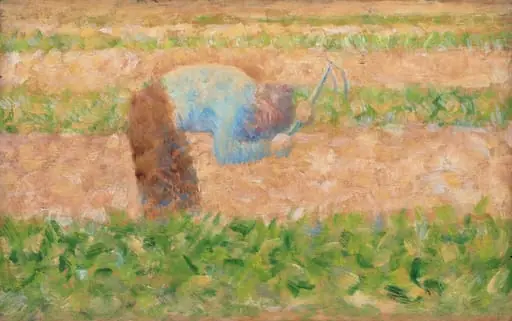
Georges Seurat’s oil painting titled The Stone Breaker was executed around 1882 on a wooden panel. The work presents a solitary figure engaged in manual labor, set against a muted landscape of greens and browns. Its modest dimensions and subdued palette place the piece within Seurat’s early explorations of everyday subjects.
Subject & Meaning
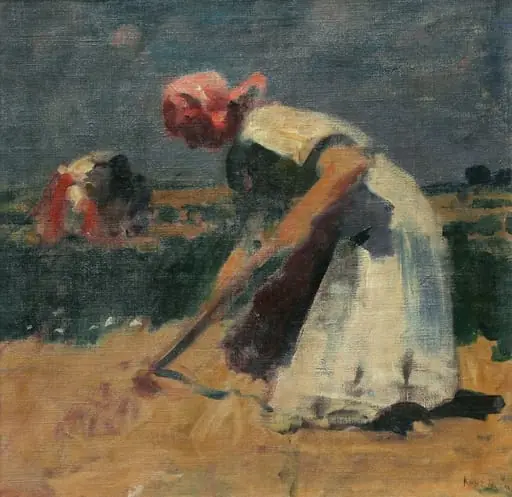
The composition centers on a bent laborer who is breaking rocks on a dusty road. He is dressed in a white cap, a blue apron, and a red cloth tied around his head, emphasizing his working attire. The portrayal of a humble, physically demanding task reflects an interest in the dignity of ordinary life.
Own this work as a print
Artist & collection

Artist
Georges Pierre Seurat (UK: SUR-ah, -ə, US: suu-RAH; French:; 2 December 1859 – 29 March 1891) was a French post-Impressionist artist.