Artwork
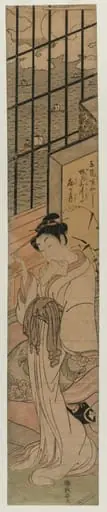
Courtesan Dreaming of her Childhood

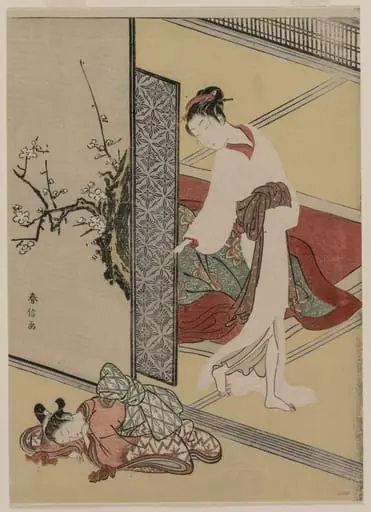
Courtesan Dreaming of her Childhood is a print by the Romanticist artist Suzuki Harunobu. It dates from 1770 and is held in the collection of the Cleveland Museum of Art. The work is a vertical, double‑panel print that measures the height of a traditional Japanese interior post.
- Accession no.
- 1920.516
- Credit line
- Gift of J. H. Wade
About this work
This print is shaped like a tall strip, two sheets glued together so it could hang on a wooden post in a Japanese home.
A woman in a long kimono leans against a pillow, eyes closed. Behind her, a younger version of herself walks hand-in-hand with a man down a moonlit path.
This print is shaped like a tall strip, two sheets glued together so it could hang on a wooden post in a Japanese home. The dream blurs the line between past and present, showing how memory can feel both close and far away.
Look up Japan, Edo period (1615–1868) to see more prints like this.
Overview
The work is a vertical, double‑panel print that measures the height of a traditional Japanese interior post. It portrays a woman in a long kimono reclining against a pillow, eyes closed, while a younger version of herself walks hand‑in‑hand with a man along a moonlit path. The composition juxtaposes present repose with a remembered departure, creating a layered narrative of memory.
Subject & Meaning
The scene suggests the woman's recollection of the moment she was taken from her family to enter the Yoshiwara district of Edo, the licensed quarter for courtesans. By placing the adult figure beside her younger self, the artist visualizes the lingering impact of that transition, emphasizing how past experiences continue to shape identity and emotional state.
Technique & Style
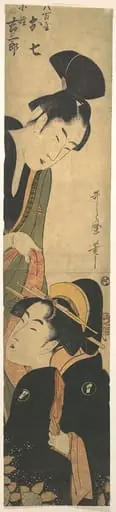
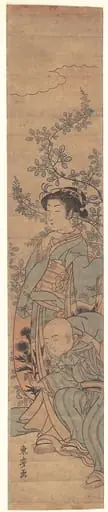
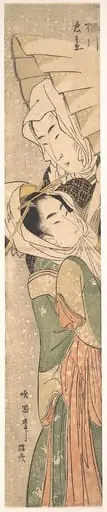
Executed as a hashira‑e, or pillar print, the image is formed by adhering two narrow sheets of paper vertically, producing a tall, slender format suited for hanging on wooden support posts. The woodblock technique allows for delicate line work and subtle gradations of tone, while the composition’s verticality reinforces the sense of ascent from memory to present.
History & Provenance
Created during Japan’s Edo period (1615–1868), the print reflects the era’s popular interest in ukiyo‑e subjects such as courtesans and urban life. While specific attribution is not recorded, the piece aligns with the broader tradition of prints designed for domestic decoration, indicating it likely circulated among households that valued both aesthetic and narrative art.
Artist & collection